

The spirit, courage, and glorious victory of the August Revolution of 1945 have etched into the history of the nation and the history of Thanh Hoa province a vibrant autumn of fiery colors...
 The Provisional Revolutionary People's Committee, chaired by Comrade Le Tat Dac, was inaugurated in Thanh Hoa town on August 23, 1945. (Photo reproduced from documents and artifacts preserved at the Thanh Hoa Provincial Museum)
The autumn air and colors often evoke poignant, romantic feelings. If only fate hadn't burdened the Vietnamese people with so much suffering, perhaps autumn would have simply flowed beautifully through the pages of history. But life has no "if onlys." The history of Vietnam, of many generations of Vietnamese people, is written in blood and tears, struggle and sacrifice. That blood and tears permeated over a thousand years of Chinese rule with its "dark nights"; the feudal regime oppressed us for centuries. The brutal and savage boots of colonialists plundered our resources and wealth, murdered our compatriots, and forced us to live in slavery...
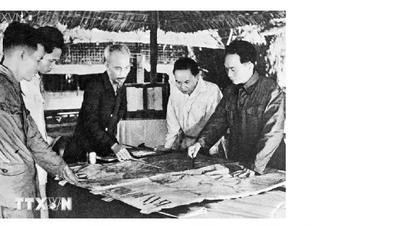
The plight of the nation, the suffering of the people, deeply troubled the beloved father of the nation, Uncle Ho. That night, in the Na Lua hut, at the foot of the Hong mountain range ( Tuyen Quang ), despite being afflicted by a persistent fever, drifting in and out of consciousness, Uncle Ho remained steadfast in his goal, upholding a firm resolve: "The opportune moment has arrived; no matter the sacrifice, even if we have to burn down the entire Truong Son mountain range, we must resolutely fight for independence..." In mid-August 1945, also in Tan Trao (Tuyen Quang), Uncle Ho called out: "The decisive moment for our nation's destiny has arrived. All compatriots, rise up and use your strength to liberate yourselves!" His words then ignited the flame of revolution, warming the hearts of communist soldiers and burning the enemy with a fervent, surging spirit of anger and resentment.
Thanh Hoa province, in the autumn days, was seething with fighting spirit, determination, and revolutionary fervor. Since joining the rest of the country in its "trial by fire," and having gone through three revolutionary upsurges – three revolutionary peaks: the 1930-1931 revolutionary upsurge, culminating in the Nghe Tinh Soviet movement; the revolutionary upsurge demanding people's livelihoods and democracy (1936-1939); and the national liberation revolutionary upsurge (1939-1945) – the heroic and resilient land of Thanh Hoa has ignited its own flame, shining brightly on the golden pages of the nation's history.
Amidst the flickering torches in Treo Cave (Ngoc Trao commune, Thach Thanh district), 21 members – exemplary soldiers of the Thanh Hoa guerrilla self-defense force – took an oath to establish the "Ngoc Trao Guerrilla Team," with Comrade Dang Chau Tue as its leader. Under the glorious banner of the Party, "hearts as bright as jewels" together wrote an epic poem called the Ngoc Trao Guerrilla War Zone. Fierce battles raged between the newly formed revolutionary forces and the colonial invaders. The Ngoc Trao guerrillas, with their tenacious and courageous spirit, repelled many enemy counterattacks, but also suffered casualties and losses. Faced with overwhelming forces, the war zone leadership decided to move the entire force to Cam Bao village (Vinh Loc district), reorganizing it into a small unit and redirecting its operations to maintain strength for future struggles. The people of Cam Bao village, undeterred by sacrifice and hardship, wholeheartedly protected and cared for the Ngoc Trao guerrillas. On the evening of October 25, 1941, the entire guerrilla unit set off for revolutionary bases in the province, preparing for a new battle.
As the revolutionary movement spread and its momentum grew, the French colonialists, like a monstrous beast with a body riddled with wounds, retaliated in kind. An atmosphere of brutal terror prevailed. Following the Ngoc Trao incident, a wave of white terror swept across the province, targeting areas suspected of harboring Party and revolutionary masses. Hundreds of cadres, Party members, and revolutionary people were tortured and imprisoned. Thanh Hoa prisons were overflowing with revolutionary fighters; many villages and hamlets were destroyed, and property confiscated. All our soldiers and people united as one, urgently preparing for the General Uprising amidst the colonialists' fury and brutality.
On March 9, 1945, the Japanese fascists staged a coup against the French, seizing control of Indochina. In response, on March 12, 1945, the Central Committee of the Party issued a directive: "The Japanese-French conflict and our actions." In Thanh Hoa, from the early days of April 1945, a conference was held to prepare for a swift uprising, resolutely raising the slogan: "Drive out the Japanese fascists," developing "Vanguard Propaganda Teams" to expand the revolutionary base; developing self-defense units for national salvation, combat self-defense units, establishing bases to fight against the Japanese, and ultimately launching an uprising to seize power. These timely decisions brought the revolutionary movement in Thanh Hoa to a decisive moment.
During those heroic historical moments, the resounding drumbeats of the July 24, 1945, uprising to seize power in Hoang Hoa echoed, urging people on, inspiring their spirit and will to "use our own strength to liberate ourselves." Accurately assessing the situation, the army and people of Hoang Hoa made thorough preparations, united as one, and launched a preemptive strike against the enemy as soon as they set foot in the area, quickly achieving victory. At noon on July 24, 1945, the Party cell and the Viet Minh committee of the district urgently organized a rally at Con Ba Cay, amidst the joy and jubilation of the army and people of Hoang Hoa. A powerful indictment denouncing the crimes of District Chief Pham Trung Bao and the puppet government resounded before thousands of people. The uprising became a memorable historical event, a source of pride for the Party committee, government, and people of Hoang Hoa district in particular, and Thanh Hoa province in general. This victory marked the beginning of the uprisings to seize power and brought the revolutionary movement throughout the province to its peak, contributing to the nationwide success of the August 1945 Revolution.
Following that victory, a series of events and good news followed one another, igniting a fierce revolutionary spirit. On August 13, 1945, the Provincial Party Committee held an expanded conference in Mao Xa village (Thieu Toan commune, Thieu Hoa district) to decide on policies and measures to prepare for the people's uprising to seize power. On August 15, 1945, the Japanese fascists surrendered unconditionally to the Allies. Creatively applying the Central Committee's directives to the province's actual situation, a provincial-level uprising committee was immediately established, chaired by Comrade Le Tat Dac, and key comrades were sent to lead the seizure of power in various localities. On the night of August 18 and the early morning of August 19, 1945, the uprising forces seized power in the districts of Yen Dinh, Vinh Loc, Thach Thanh, Quang Xuong, Hau Loc, Ha Trung, Nga Son, Tho Xuan, and Thieu Hoa. On August 20, 1945, the districts of Tinh Gia (now Nghi Son town) and Cam Thuy successfully seized power. In Thanh Hoa town (now Thanh Hoa City), revolutionary forces implemented many clever, flexible, but decisive measures to force the Japanese fascists and their collaborators to surrender. On August 23, 1945, thousands of people enthusiastically flocked to the town center to welcome the revolutionary government – the first People's Democratic government.
The August Revolution of 1945 was "an unprecedented leap forward in the history of mankind." Under the brilliant and wise leadership of the Party, headed by President Ho Chi Minh , our nation rose up to break the chains of slavery, overthrow the feudal regime, and open a great turning point in the revolution, establishing the Democratic Republic of Vietnam - the first People's Democratic State in Southeast Asia: "The chest, flat for four thousand years, today a strong wind/ Blows it up. The heart suddenly becomes the sun" (Hue in August - To Huu). The flame of the revolutionary autumn of 1945 opened a new era, the most glorious era in the history of the nation - the Ho Chi Minh era: "Vietnam, from blood and fire/ Shakes off the mud and rises up brilliantly" (The Country - Nguyen Dinh Thi).
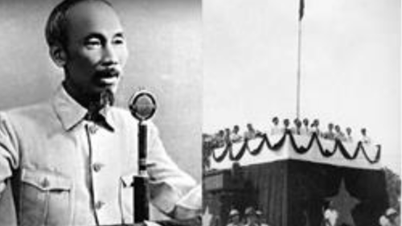
Seventy-nine years have passed since the successful August Revolution of 1945, but the spirit, momentum, and glorious victory have been etched into the history of the nation and the history of Thanh Hoa province, a vibrant autumn of fiery colors... Thanh Hoa remembers Uncle Ho. Our hearts remember Uncle Ho. We remember that sacred moment on a sunny autumn day in Ba Dinh Square, when Uncle Ho solemnly read the Declaration of Independence, proclaiming to the world the birth of the Democratic Republic of Vietnam: "...A nation that has bravely resisted the yoke of French slavery for more than 80 years, a nation that has bravely stood with the Allies against fascism for several years, that nation must be free. That nation must be independent." His words echoed in the vast autumn sky, in millions of hearts beating with joy: "Vietnam has the right to enjoy freedom and independence, and in fact has become a free and independent nation. The entire Vietnamese nation is determined to dedicate all its spirit and strength, its life and property, to uphold that right to freedom and independence." And it is from this peace that we deeply understand Uncle Ho's words: "Making a revolution to transform the old society into a new society is a very glorious undertaking, but it is also a very heavy task, a very complex, long, and arduous struggle," where "the victories we have achieved are only the first steps on a long journey." Therefore, "we must move forward, the revolution must move forward further. If we do not move forward, it is a regression. And if we regress, the victories we have achieved cannot be consolidated and developed"...
This article uses material from the book "Geography of Thanh Hoa", Volume I - Geography and History, published by the Culture and Information Publishing House.
Thuy Duong - Huong Thao
Source: https://baothanhhoa.vn/trong-bung-bung-anh-lua-222506.htm
![[Photo] National Assembly Chairman Tran Thanh Man working with the Standing Committee of the National Assembly's Delegation Affairs Committee.](https://vphoto.vietnam.vn/thumb/1200x675/vietnam/resource/IMAGE/2026/05/20/1779294340023_ndo_br_1-1691-jpg.webp)
![[Photo] General Secretary and President To Lam works with the Party Committee of the Ministry of Health on the work of Vietnamese traditional medicine.](https://vphoto.vietnam.vn/thumb/1200x675/vietnam/resource/IMAGE/2026/05/20/1779294323718_a1-bnd-2978-3319-jpg.webp)
![[Image] "Journey of Hope" promotes the organ and tissue donation movement in Vietnam.](https://vphoto.vietnam.vn/thumb/1200x675/vietnam/resource/IMAGE/2026/05/20/1779294400833_1-8910-jpg.webp)



















































Comment (0)