

Squares are not an inherent feature of Vietnamese architecture and urban development, but rather a colonial heritage that was imported. However, over more than a century, they have been adopted, transformed, and blended: bearing both the imprint of Western planning and integrating with contemporary urban life.
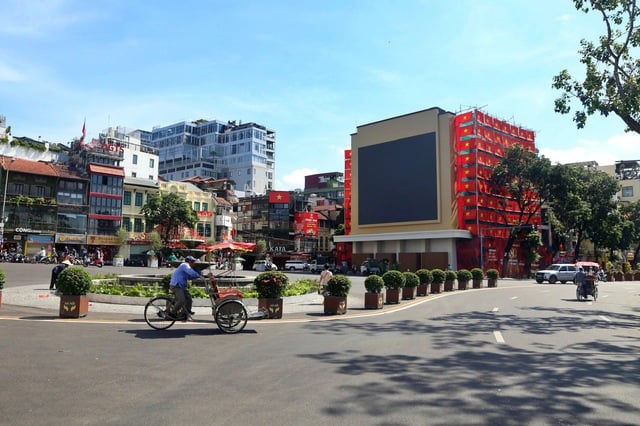
Dong Kinh Nghia Thuc Square after renovation and upgrading, phase 1.
Photo: Nguyen Truong
Hanoi has just completed phase 1 of the expansion and renovation of Dong Kinh Nghia Thuc Square after the "Shark's Jaw" building was demolished, in time to serve the activities commemorating the 80th anniversary of National Day on September 2nd. Accordingly, a large LED screen has been installed at the gable end of the building at 7-9 Dinh Tien Hoang Street; the facades of buildings on the streets adjacent to the "Shark's Jaw" building have also been renovated (removing awnings, canopies, etc.); additional seating and movable flowerbeds have been added; parking lots and transformer stations have been relocated, etc.
Although the space has been significantly expanded and renovated, the new appearance of Dong Kinh Nghia Thuc Square after the completion of phase 1 still sparks much debate regarding its aesthetics and functionality. Acknowledging this as "a very difficult problem," Mr. Nguyen Manh Cuong, Deputy Director of the Institute of Urban Planning and Architecture (Hanoi University of Civil Engineering), representing the design unit for the renovation of Dong Kinh Nghia Thuc Square, stated that they will continue to listen to and incorporate community feedback when moving on to phase 2, which includes: constructing an underground space beneath the square, reconstructing the facades of the related streets, paving the entire area with stone, and adding urban amenities. The design unit's viewpoint is "not to introduce European or foreign architecture. The architecture here must be Vietnamese, Hanoi-style architecture…"
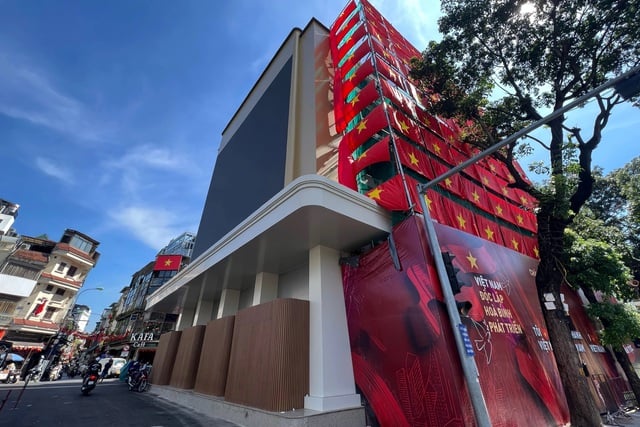
LED screens have been installed in the new space of Dong Kinh Nghia Thuc Square.
Photo: Nguyen Truong
However, to date, the so-called distinctive architectural features of Hanoi and Vietnam have not been clearly displayed in the new appearance of Dong Kinh Nghia Thuc Square. Creating a square space that reflects the unique characteristics of Vietnamese culture, architecture, and the inherent attributes of a square, while also having an appearance suitable for the contemporary context, is indeed a difficult task.
An import model
Essentially, the concept of a square is an imported one. In the history of pre-modern Vietnamese urban development, the European meaning of "square" did not exist. Only from the late 19th century, along with the French colonial planning in Hanoi and Saigon, were the concepts of "place" and "boulevard" introduced. In this context, a square is defined as a traffic and visual hub, often associated with structures of power such as mansions, theaters, and monuments.
Accordingly, in Hanoi, squares such as Place Négrier (Dong Kinh Nghia Thuc), Place de l'Opéra (in front of the Grand Theatre), Place Puginier (Ba Dinh)... gradually took shape. In Saigon, there were squares like: Place de la Cathédrale (Notre Dame Cathedral Square), Place du Théâtre (City Theatre Square), the square in front of the Hôtel de Ville (now the Ho Chi Minh City People's Committee building)...
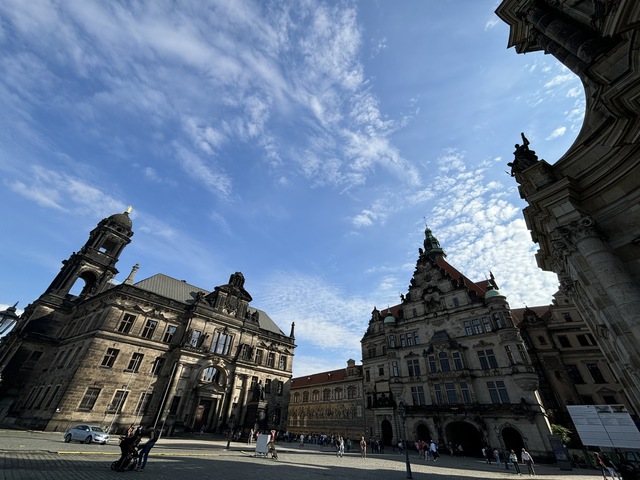
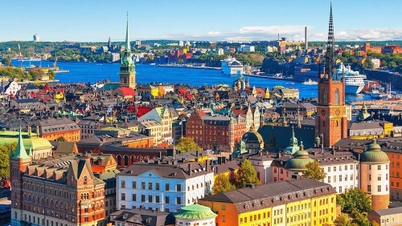
Schlossplatz square is located in the old town of Dresden (Germany).
Photo: Le Quan
These spaces become morphological exceptions within the indigenous organic structure: in Hanoi, they open connections between the Old Quarter and Hoan Kiem Lake or the French Quarter; in Saigon, they position iconic colonial buildings within the network of boulevards.
Thus, squares in Vietnam are a hybrid urban heritage: neither purely Vietnamese nor purely European, but they have become an important element, reflecting the interplay between imported planning and indigenous usage culture.
Contemporary transformation
In the history of European architecture, squares are often associated with distinctive public buildings, such as churches, town halls, and palaces, creating a sustainable spatial-architectural pairing. They are not only venues for festivals but also steeped in daily life: markets, sidewalk cafes, and continuous community activities. European squares exist as "outdoor rooms" with clearly defined enclosed proportions, allowing users to feel surrounded and oriented by architectural axes.
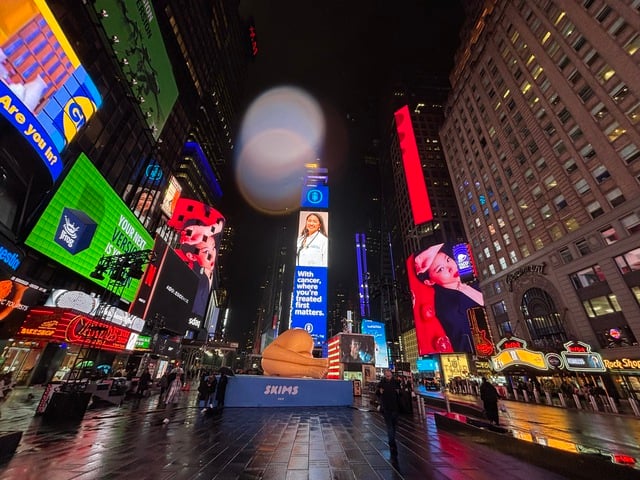
A corner of Times Square in New York City, featuring a series of giant LED screens.
Photo: Le Quan
Conversely, in Vietnam, post-colonial squares are often used for rallies, political commemorations, and collective events. They are rarely associated with public architecture used for daily life (except for theaters, but their role has diminished). This makes Vietnamese squares tend to be more "ceremonial" and "event-driven" rather than spontaneous community spaces.
It's no surprise that the Vietnamese government and people are starting to pay more attention to public spaces like squares and parks, especially during the recent A50 and A80 highway projects – which required the utilization of spaces with large capacities.
In the context of increasing urban density and a lack of public space, people have recently begun to reclaim squares, spaces traditionally heavily influenced by politics, for walking, outdoor activities, weekend commerce, and cultural and artistic performances. This is closer to the civic urban function prevalent in Europe. Squares, more than anything, represent the concept of democracy in urban studies.
In urban studies, a square is an "outdoor room" defined by its perimeter of buildings, but not under private control. It creates an open space within a densely populated area, bound to be shared by various social groups. In principle, it is a place where no one has a monopoly. Only when the necessary elements of proportion, morphology, and the ability of the people to occupy it are met does the square become a complete component of urban infrastructure. (to be continued)
Source: https://thanhnien.vn/tu-di-san-du-nhap-den-bien-the-van-hoa-185250923232112542.htm
















![[Photo] Prime Minister Pham Minh Chinh receives the Chinese Ambassador to Vietnam](https://vphoto.vietnam.vn/thumb/1200x675/vietnam/resource/IMAGE/2026/04/05/1775397481797_ndo_br_dsc-5512-jpg.webp)





























![[Infographic] Key indicators for the period 2026-2030 to achieve "double-digit" growth targets](https://vphoto.vietnam.vn/thumb/402x226/vietnam/resource/IMAGE/2026/04/06/1775450004801_fb4e219c8aa77c339a75ff13c44b2e595f8db215db15da7b4648b200deade68240d89ec5e4bd2e86c42f5ed9eeb-_ndo_br_chi-tieu-2-con-so-thumb-1.jpeg)








Comment (0)