Legitimate desire
The lens through which women are viewed in her poetry is an ontological lens, followed by gender experiences shaped by her daily life. Ha Hong Hanh doesn't need to "learn to be a woman." The aspects of her life, the voice of her consciousness, and the rhythm of her language in her poetry give voice to her gender identity. It's a voice of longing, sharing, empathy, and profound compassion for her own gender.
“Last night you went to the village festival/ Do your feet remember the old path?/ I laid a mat to wait for you,” these are three lines from the last stanza of the poem “I Lay a Mat to Wait for You,” which Ha Hong Hanh cherished and chose as the title for her poetry collection.
In married life, the bedroom is one of the most important rooms in the house, because it is the most private and cozy space. Bedroom carpets are the most comforting element. "I'll lay the carpet waiting for you," isn't that just a matter of a wife's cleanliness? More than that, it carries the spiritual meaning of virtue, fidelity, cherishing, and waiting for happiness.
"She" loves "him," belongs to "him" through the love of a couple, through the love of their identity, "the sound of the flute opens the way/ luring her/ astray." And so, through the years, "the sound of the flute calls her spirit through the door/ calling her to climb the mountain with him to plant rice seeds/ painting colors on the fields." They are truly happy.
In this poem, within the "gendered emotions" there is jealousy and anxiety when "he goes to the village festival / do his feet remember the old path?" Reading this poem, the reader can imagine "her" pacing back and forth in the room, looking at the sky, then glancing at the stars, restless... Ha Hong Hanh's poetry thus resonates with gender identity.
Like other female poets, Ha Hong Hanh writes about love. Love and happiness are always legitimate desires and heartfelt longings. This can be seen in poems such as "Do You Know?", "Searching for You", "Searching for You in the Unconscious", "The Woman & the Golden Autumn", "I Lay a Carpet Waiting for You", "A Day Without You", "The Wind Draws Your Face", "A Day I Long to Be Foolish"...
“I fear the day I don’t see you / I’ll burst into tears / during endless nights / frantically searching unconsciously / and sadness will leave me too,” (A Day Without You). That must be a void, a terrifying one.
Unique indigenous cultural space



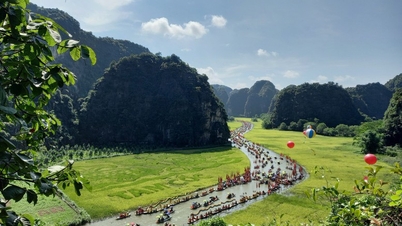
Artistic space is the form in which imagery exists. "I Lay a Carpet to Wait for You" possesses a distinct, indigenous cultural space. These are the sounds of the mountains and forests, echoing from the heart of the mountains, which the author creates within the artistic space of her poetry.
“The twelve-stringed zither plays a magical melody / in the moonlight of ripe pomelos / I take you across nine streams and ten passes / winding terraced fields,” (The Night Breaks). In this poem, the reader not only learns about the “zither” – a plucked string instrument commonly used by some mountainous ethnic groups in Vietnam such as the Thai, Tay, and Nung people – but also encounters poetic images of “then,” “vía,” “men lá,” and “váy chàm,” often only seen in the festivals of ethnic minority communities.
In the lives of ethnic minority communities, the khene (a type of bamboo flute) is not just a musical instrument; it is a cultural symbol. For the Hmong community, the khene and khene dance are two typical intangible cultural heritages, deeply rooted in their unique cultural identity. Those who have visited ethnic minority groups can easily imagine the cultural rituals and recognize the poignant, melodious sounds of the khene flutes used by young men to call out to their lovers.
Reading Ha Hong Hanh's poetry, one recognizes those sounds. The sound of the bamboo flute, as an artistic image in her creative work, is used in many of her poems. Bamboo flutes, leaf flutes, mouth flutes... are also present in "The sound of the bamboo flute luring you astray" and "The forgotten moon."
It could be said that Ha Hong Hanh's memories encompass the full spectrum of colors, smells, and sounds. "You don't know / in my unconscious / I follow your scent / even in utter despair" (Searching for You in My Unconscious).
The poetic soul of Ha Hong Hanh encompasses all colors, from the shadows of mountains, the sound of the flute, the alluring costumes, the vibrant atmosphere of cultural festivals, and the profound depth of mountain and forest rituals.
Poetry originates from the human heart. There are three main points to writing poetry: firstly, emotion; secondly, scenery; and thirdly, events. Emotion is the person, scenery is the sky, and events are the harmonious combination of heaven and earth” (Van Dai Loai Ngu, Le Quy Don). It seems that the ancients placed great importance on the author's inner feelings in poetry.
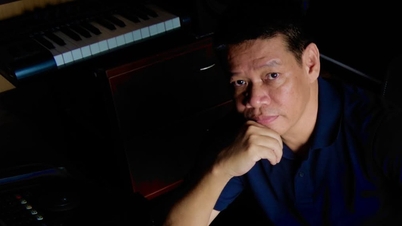
Ha Hong Hanh comes from a family of poets; her talent for poetry began in childhood, and she was a dynamic and hardworking journalist. It was this environment that helped her cultivate the essence of life within her soul. In other words, reality settled, refracted, and shone into haunting poems.
“Tea rises with a silvery aroma / soft silken smoke / gentle drops or warm, silent sweat / softly / the tea pot awaits dawn” (Tam Dao Tea Plantation). Thai Nguyen is the homeland of “the finest tea,” and in this poem, Ha Hong Hanh imagines a dream, resolving the dream about Thai Nguyen tea and her own fate.



Ha Hong Hanh finds solace in the universe in general and nature in particular. This solace is the harmonious blend of a kind of inner music in the light of enlightenment. Her poetry has sounds like the voice of the meditative realm: “There’s an echo from the mountains / The mist rises fiercely this season / I see the form of a past life / The branches of trees woven into a hammock / rocking me” (Form of a Past Life).
The verses of reflection, explanation, and self-discovery from the unconscious are not lacking in "I Lay a Carpet for You": "I sell faith wrapped in darkness / concealing daily deception / the moth doesn't understand why the light is so dazzling / burning / blindness paid for with death / tonight a lonely star lights itself up / vaguely in the Milky Way" (The Lonely Star).
Ha Hong Hanh has been presenting a thoughtful, colorful, and multifaceted "map of the soul"—the size and shape of a poet with many dreams and rich inner strength.
Source: https://giaoducthoidai.vn/tu-trang-sach-mong-lung-trong-dai-ngan-ha-post780562.html












![[Video] Typhoon No. 1 is about to form, forecast to make landfall in the Gulf of Tonkin on July 4th.](https://vphoto.vietnam.vn/thumb/402x226/vietnam/resource/IMAGE/2026/07/02/1782979459453_dung00-08-51-13still004-png.webp)