However, if established in accordance with international practices, this would be a turning point in expanding equal opportunities, eliminating prejudice, and bringing practical benefits to learners in their studies, employment, and integration.
First, it's necessary to clearly distinguish the structure of secondary education worldwide . According to UNESCO's ISCED classification, secondary education comprises two stages: lower secondary (grades 6-9, ages 11-15), which is the basic level of universal education; and upper secondary (grades 10-12, ages 15-18), which prepares students for higher education or entry into the labor market. Most developed countries consider upper secondary education as the minimum standard, while many developing countries have only achieved universal education up to lower secondary level. Therefore, Vietnam's goal of achieving universal upper secondary education or equivalent demonstrates its determination to approach international standards.
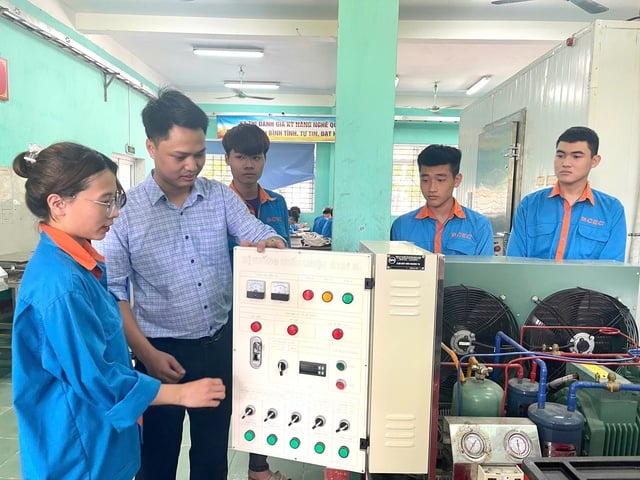
Invest heavily in vocational schools, from facilities to staff, to provide students with a quality learning experience.
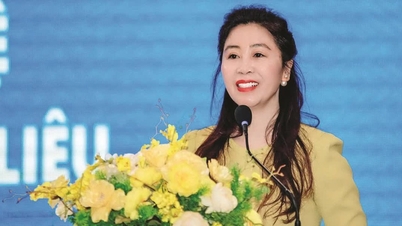
Photo by My Quyen



"Equivalence" should be understood as different pathways being recognized for their legal validity and development opportunities, not as duplication of degrees.
For example, in France, high school students can choose a general baccalaureate, a technology-based baccalaureate, or a vocational baccalaureate; all are considered equally valuable. In Germany , whether studying at a Gymnasium, Realschule, or Berufsschule, students who meet the standards are recognized at Level 3 of the National Qualifications Framework and can continue their studies or enter the workforce. In the US, in addition to a high school diploma, there is also the GED (General Educational Development) – both are accepted by universities and businesses. The common point is that there are multiple pathways, but their legal value is "equivalent."
The 2022 Chinese Vocational Education Law, effective from 2023, stipulates in Article 53 that students in vocational schools of the same level and students in general schools of the same level have equal opportunities for further education. This regulation clearly affirms two different but equally valuable pathways. Vocational students are still considered to have completed their high school education.
In Vietnam, high school has long been considered the mainstream path, while vocational high school has been neglected. If "equivalent" is not properly defined, universal high school education could easily become merely a formality, focusing solely on vocational training and ignoring it. This contradicts the spirit of Resolution 71 as well as international trends.
So how should we understand "equivalent to high school"? First, it must be recognized at Level 3 of the National Qualifications Framework. Whether following a high school, vocational high school, or other flexible pathway, as long as the learning outcomes are met, students have equal rights: to continue their studies at college or university; to enter the labor market; and to have their qualifications recognized abroad. Furthermore, the learning outcomes must be standardized. Diplomas need to be benchmarked against the ASEAN Qualifications Reference Framework (AQRF) and ISCED.



To implement this, several solutions are needed. Firstly, establish unified learning outcomes applicable to both high schools and vocational schools. Secondly, amend the Education Law and the Vocational Education Law to clearly state the equal recognition between the two paths within the National Qualifications Framework (level 4). Thirdly, strengthen communication to change perceptions, helping parents and students understand that vocational training is not inferior, but rather another option to achieve the same level of qualification. Fourthly, invest heavily in vocational schools, from facilities to staff, to provide students with a quality learning experience. Fifthly, integrate internationally by publishing bilingual learning outcomes and issuing transparent diploma appendices, enabling students to study and work abroad.
Source: https://thanhnien.vn/tuong-duong-thpt-hieu-sao-cho-dung-185250915194601222.htm


![[Image] A look back at the capital's preparations for the century-long master plan.](https://vphoto.vietnam.vn/thumb/1200x675/vietnam/resource/IMAGE/2026/06/29/1782750453122_quy-hoach-100-nam-minh-duy-1-2118-jpg.webp)
![[Photo] National Assembly Chairman Tran Thanh Man attends the Conference to announce the Master Plan for Hanoi Capital City with a 100-year vision.](https://vphoto.vietnam.vn/thumb/1200x675/vietnam/resource/IMAGE/2026/06/29/1782709639728_ndo_br_1-jpg.webp)

![[Photo] General Secretary and President To Lam works with the Party Committee of the Government on the work of preventing and combating storms, floods, extreme natural disasters and climate change.](https://vphoto.vietnam.vn/thumb/1200x675/vietnam/resource/IMAGE/2026/06/29/1782729441945_a1-bnd-0385-9454-jpg.webp)



















































![[Image] Building an elevated road through the Ma Da forest.](https://vphoto.vietnam.vn/thumb/402x226/vietnam/resource/IMAGE/2026/06/29/1782724737750_anh-man-hinh-2026-06-29-luc-16-18-43.png)