

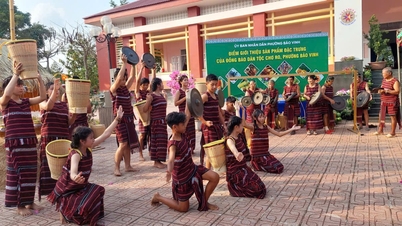
Every spring, the villages and hamlets of the four Muong ethnic groups (Bi, Vang, Thang, Dong) in Hoa Binh province resound with the lively sound of gongs. The sound of Muong gongs, along with the traditional folk songs, is a distinctive feature of the New Year celebrations in these Muong villages.
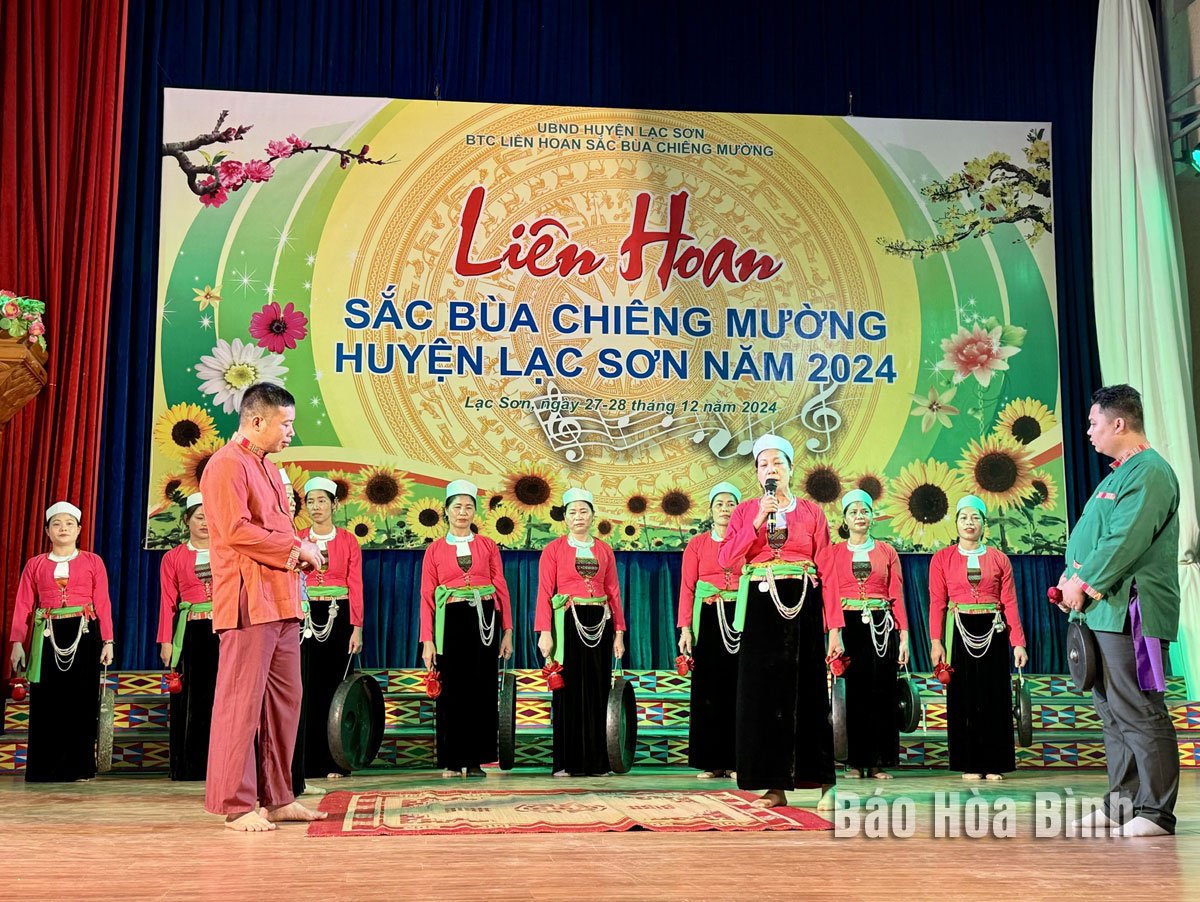
The shamanic group of Thuong Coc commune performed the art of shamanic singing at the 2024 Shamanic Singing and Muong Gong Festival of Lac Son district.
"Today, the first day of the new spring, we have come to wish your family a happy new year" - this is the opening line of the folk song, accompanied by the sound of gongs, as the folk song troupe enters the gate of the homeowner's house. When the homeowner opens the gate and welcomes the troupe into the yard, at the foot of the stairs, the entire troupe stops to play gongs and sing New Year's greetings: "May your family have many buffaloes and cows / May you prosper in your work," "In the new year, we wish your family much luck and success, may you gain wealth and peace"... When the troupe sings the closing song: "May you have a happy new year / We promise to come again on this day next year..." the homeowner usually gives gifts to the troupe as a New Year's greeting or as a thank you.
In the Muong community of Thao Ca hamlet, Vinh Tien commune, Kim Boi district, the "sac bua" singing tradition is quite common during the New Year celebrations. On Tet (Lunar New Year), the members of the "sac bua" singing troupe all wear traditional costumes; women wear skirts, men wear brown clothes, and they carry gongs to visit and wish families a Happy New Year. The "sac bua" troupe in Thao Ca hamlet currently attracts dozens of participants of all ages and backgrounds. Meritorious Artist Bui Tien Xo from Vinh Tien commune said: "Sac bua singing is a long-standing folk cultural form, often performed at important events such as birthday celebrations, weddings, and especially during Tet. The lyrics of these 'sac bua' songs contain wishes for everyone and every family to have good health, luck, peace, and prosperity in the new year."
In particular, this custom is being preserved by the Muong community in many communes in the Quyet Thang and Cong Hoa areas of Lac Son district. According to Mr. Bui Bao Du, Chairman of the Four Muong Club in Thuong Coc commune, the "sac bua" singing tradition is a unique way of wishing Happy New Year. Each lyric, along with the sound of the Muong gongs, blends to express the feelings, aspirations, and dreams of the community, connecting people with each other and with nature. We, the younger generation, hope to continue contributing our small efforts to preserve this tradition so that the "sac bua" singing tradition can continue to promote its heritage value.
Ms. Bui Thi Tham, Director of the Culture, Sports and Communication Center of Lac Son District, shared: As an area where 92% of the population are Muong ethnic people, the district is preserving unique Muong cultural values: Mo rituals, gongs, Thuong Rang singing, Bo Meng rituals, Dum Giao Duyen singing, Danh Mang game... and Sac Bua singing. In December 2024, within the framework of Project 6, the National Target Program for socio -economic development in ethnic minority and mountainous areas, the District People's Committee organized a special program "Muong Sac Bua and Gong Performance Festival" with the theme of ancient gong pieces from Hoa Binh province. Besides creating a lively atmosphere for people to celebrate the Spring Festival and Tet, Sac Bua singing also meets the needs of families on the first day of the new year with the purpose of wishing for spring, blessings, and peace.
According to the distinguished artisan and folk culture researcher Bui Huy Vong from Huong Nhuong commune, Lac Son district, the "sac bua" singing tradition is a memorable aspect of the traditional Tet (Lunar New Year) celebration of the ancient Muong people. The beauty of "sac bua" singing lies in the combination of lyrics and gong music. While visiting relatives and friends to offer New Year greetings, the "sac bua" singers would play gongs and sing simultaneously. The songs could be improvised and adapted to suit the family circumstances or the audience. Currently, the tradition of "sac bua" singing is in danger of disappearing. However, some local authorities are showing interest and encouragement, creating an environment for its practice; artisans, researchers, and individuals dedicated to preserving the cultural heritage of the Muong ethnic group are playing their roles and responsibilities in preserving, collecting, and researching... so that "sac bua" singing can become increasingly prevalent in the cultural life of the Muong community in Hoa Binh.
Bui Minh/Hoa Binh Newspaper
Source: https://baophutho.vn/vang-dieu-sac-bua-chuc-xuan-226824.htm




![[Image] National Assembly discusses the implementation of the socio-economic development plan.](https://vphoto.vietnam.vn/thumb/1200x675/vietnam/resource/IMAGE/2026/04/20/1776696707422_ndo_br_img-20260420-185419-jpg.webp)
![[Photo] General Secretary and President To Lam meets with National Assembly delegates from ethnic minorities.](https://vphoto.vietnam.vn/thumb/1200x675/vietnam/resource/IMAGE/2026/04/20/1776696701056_a1-bnd-8331-3342-jpg.webp)
















![[Infographic Series] Historical Sites in Dong Nai: Long Khanh Provincial Administrative Building, Long Khanh Town Party Committee Base, Xuan Loc Temple - Xuan Hoa Pagoda Complex](https://vphoto.vietnam.vn/thumb/402x226/vietnam/resource/IMAGE/2025/9/26/1331532306fb4ad18e4a849e5c64202a)















































Comment (0)