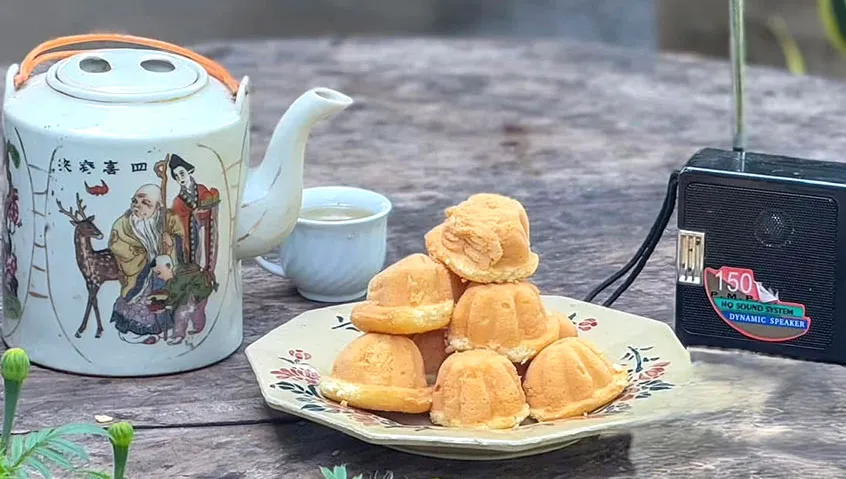
“Oh, Auntie Hai, the sponge cake has a yellow pistil and white petals, but this sponge cake has a yellow pistil and yellow petals too. Yet, whenever you're far away, I feel so sad. Maybe I'll come back and stay here… down here…” Mentioning the cakes and pastries of their homeland, people in the South almost know by heart the folk song from the work "Sponge Cake" (by Quế Chi). The heartfelt lyrics touch the wellspring of memories for countless people from the South.
Amidst the ever-changing pace of life, the sponge cake remains a simple, enduring taste of home. It's like a bridge connecting memories and affections, making those who have gone far want to return and "stay here forever," living with the honest, warm family traditions.
Southern Vietnamese sponge cake is famous for its simple yet refined taste. The ingredients are easy to find: flour, eggs, and sugar; sometimes a little vanilla is added, and in some places, coconut milk is added to enhance the richness and aroma. But the skill lies in knowing how to "do it," knowing how to whisk the eggs until fluffy, mix the flour just right, and control the charcoal fire evenly.


In the old days, before electric ovens existed in the countryside, aluminum molds were placed over glowing charcoal stoves, covered with burning rice husks. Adults would tend the fire and listen to the crackling of the coals, while the children sat waiting, their eyes eager, inhaling the sweet aroma that permeated the entire village. When the cakes were cooked, their golden-brown surface and soft, fluffy interior released a sweet, comforting fragrance—an aroma powerful enough to soothe the hardships of a toil-filled life.
More than just a treat, sponge cake embodies the warm and friendly spirit of the Southern region. After returning from the market, my mother would often buy a few cakes to share with the children at home, or offer a plate to neighbors as a token of goodwill. Sometimes, on rainy days, when neighbors dropped by, my mother would pour a cup of hot tea, offer them a plate of sponge cake, and they would chat while eating, strengthening the bonds of community.
On the full moon day and during Tet (Vietnamese Lunar New Year), a plate of cakes is placed respectfully on the ancestral altar. It's not just food, but a token of gratitude and a continuation of family traditions. The sweet, soft cake symbolizes wishes for warmth, prosperity, and the virtues of love and sharing. Thus, this small cake embodies the gentle and benevolent philosophy of life of the people of Southern Vietnam.
Nowadays, whether in rural markets or city streets, sponge cake comes in many variations: round sponge cake, rolled sponge cake, cheese sponge cake, salted egg sponge cake… Each type has its own unique characteristics, pleasing diners of all ages. But no matter how it transforms, the essence remains unchanged: a gentle sweetness, a fragrant egg aroma, a soft and fluffy texture, the "golden core" of rural charm.
Inside the cake, one can still see the image of the hardworking, resilient woman of Southern Vietnam. Her mother's hands, her sister's hands, skillfully stir the batter, light the fire, and watch over each batch of cakes. The profits may not be much, but they contribute to a simple family meal and a new pair of sandals for her children to wear to school. The love and effort in each cake are therefore warm and profound, not just flour and eggs.


And when the traditional folk song rings out: "The sponge cake has a golden center and golden petals too…", one sees not only the golden color of the cake, but also the golden color of the warm, affectionate people of the South. The sponge cake, therefore, is not simply a food item; it is also a memory, a way of life, a gentle and enduring source of pride. So that anyone who travels far, upon catching a whiff of the aroma of baked cake, will feel a surge of emotion, wanting to return and "stay… down… here," to their homeland, to the sweet affection and kindness like a piece of sponge cake.
Source: https://www.sggp.org.vn/ve-o-luon-voi-banh-bong-lan-post812924.html