E-visa is restructuring the tourism industry.
The government has just issued Resolution No. 389, adding 41 border gates to the list of international border gates allowing foreigners to enter and exit with electronic visas (e-visas).
Specifically, in addition to the 13 existing air border crossings, four more will be added: Long Thanh International Airport (applicable upon commissioning); Gia Binh International Airport (applicable upon commissioning); Vinh Port; and Chu Lai Port. This step ensures consistency with the planning and aviation infrastructure in the new phase, contributing to the effective implementation of key national projects. Furthermore, 11 land border crossings have been added to the list, expected to boost trade, tourism, and expand economic corridors between Vietnam and neighboring countries. Notably, the new list includes 26 seaports eligible for e-visa, stretching from North to South. These ports play a crucial role in international trade, cargo transportation, logistics, and maritime tourism.
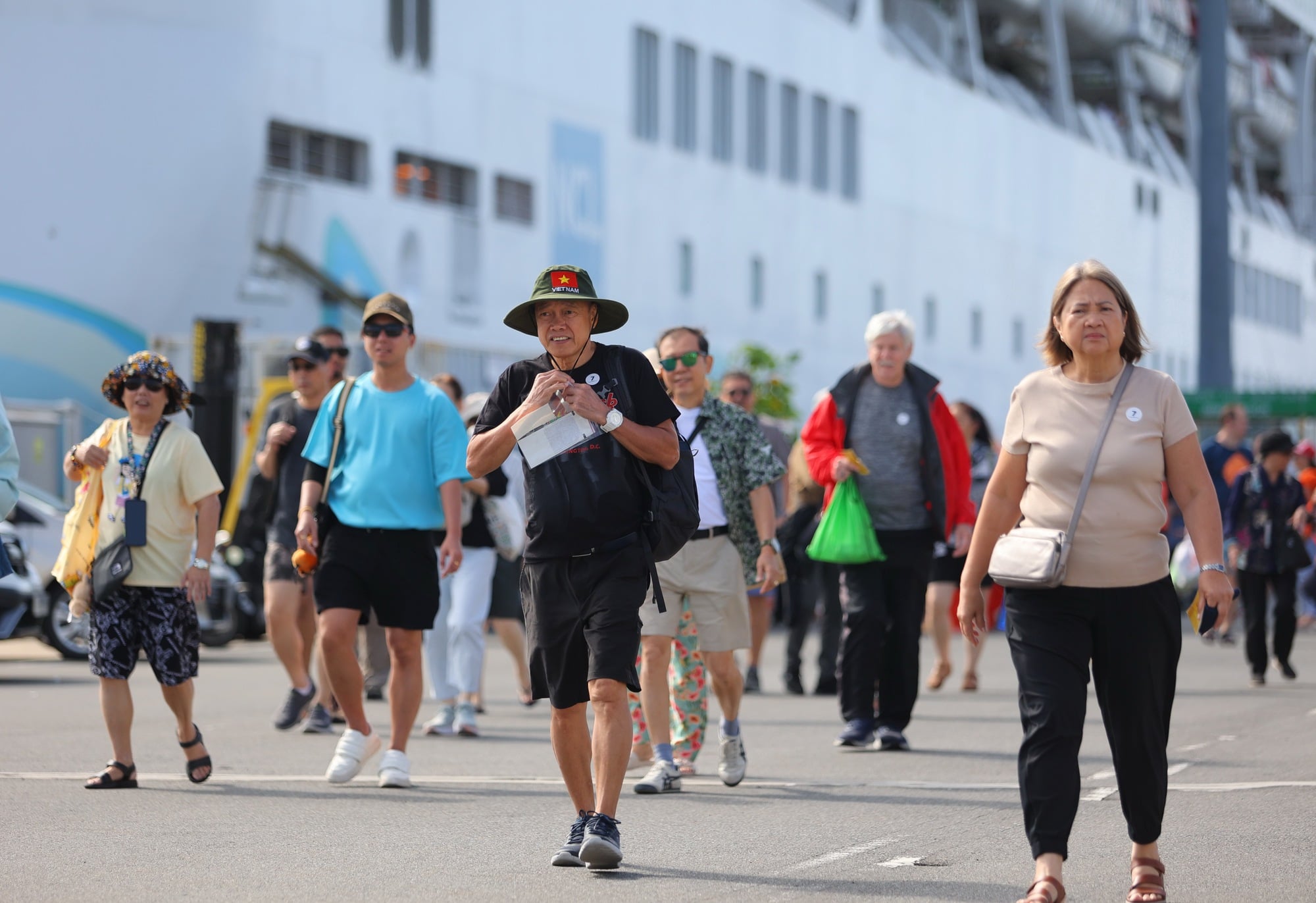
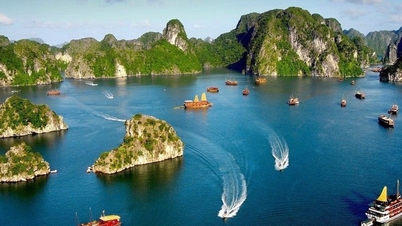
The decision to expand the list of border gates allowing the use of electronic visas (e-visas) is considered to create a breakthrough in the development of inter-regional coastal, mountain, and river tourism products.
PHOTO: BA DUY
Previously, since 2023, Vietnam had implemented e-visas at 42 international border gates, including 13 air border gates, 16 land border gates, and 13 sea border gates. The addition of 41 new border gates has increased the total number of e-visa acceptance points to 83, doubling the scope of application in just over two years. According to the National Tourism Administration, the e-visa policy has been highly appreciated by the business community and international tourists for its convenience, transparency, and accessibility; and has created a positive effect on the tourism, trade, and investment sectors. Since the Covid-19 pandemic, Vietnam's visa policies have been continuously updated and flexibly adjusted, expanding access and becoming a strong factor helping the tourism industry continuously set records in welcoming international visitors.
In particular, the e-visa policy has been expanded to all countries and territories, with a maximum stay of up to 90 days, valid for single or multiple entries, making it more convenient for tourists to apply for entry online. The government's continued expansion of border gates accepting e-visas demonstrates a strong determination to implement a flexible and modern visa policy, in line with international practices, making tourism a truly leading economic sector in the new era.
Welcoming the new e-visa policy, Mr. Vo Anh Tai, Deputy General Director of Saigontourist Group, observed: "Vietnam opening 41 more border gates allowing foreigners to enter with e-visas is a significant move that goes far beyond administrative procedures. Behind this policy lies the opportunity to restructure tourist flows, tourism spaces, and even the mindset of Vietnam's tourism industry in the coming years. Most notably, the border gate system is shifting from a 'three-center' model – Hanoi, Da Nang, and Ho Chi Minh City – to a 'multi-center' model. When tourists can enter through land border gates, seaports, and local airports, Vietnam's map of international tourist reception expands horizontally, no longer dependent on a few major hubs."
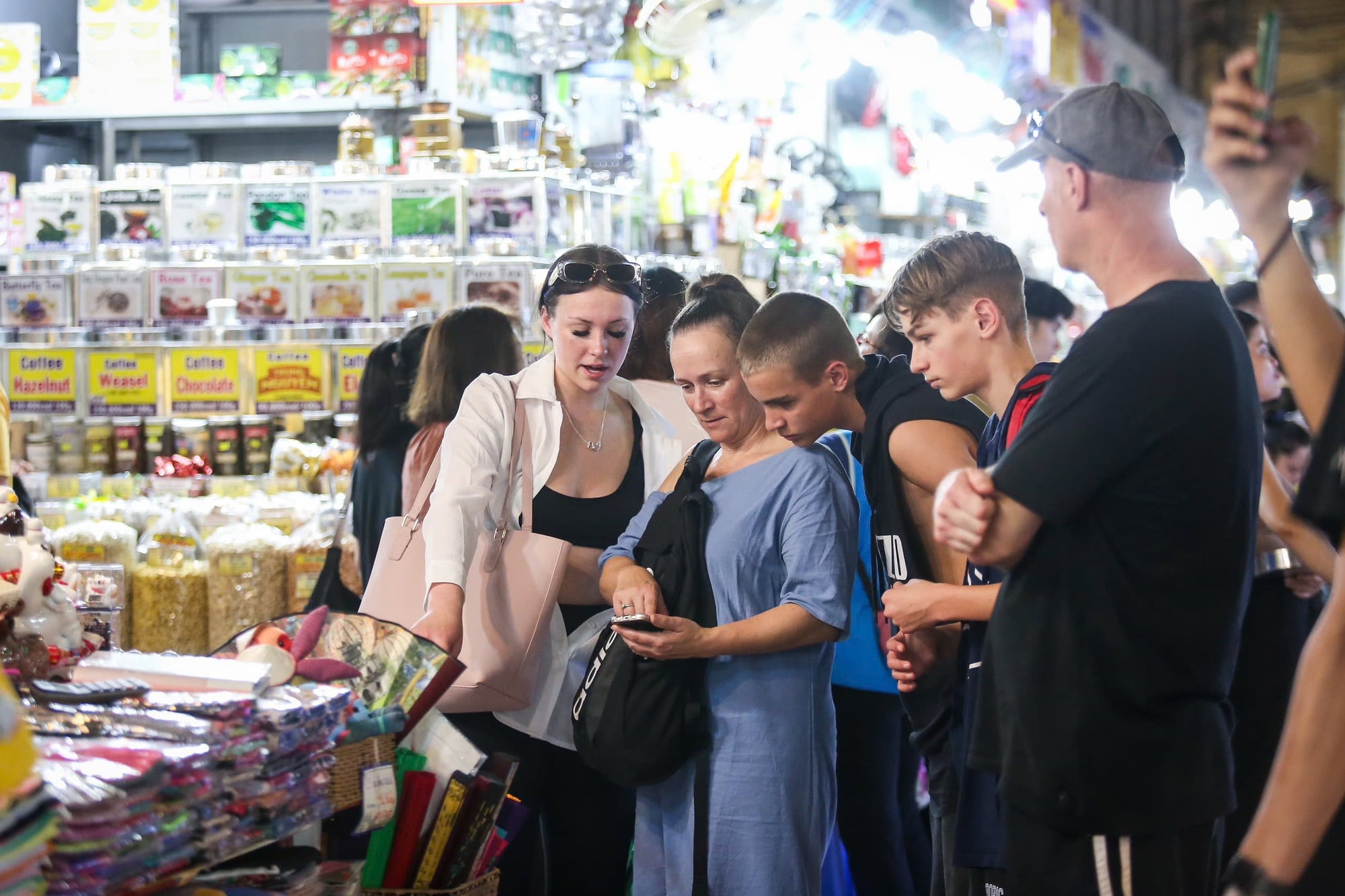
Vietnam's open visa policy has helped its tourism industry become one of the fastest-growing in the world after the Covid-19 pandemic.
PHOTO: NHAT THINH
"This relieves pressure on urban infrastructure while opening up opportunities for many localities to enter the international tourism market for the first time. From a market perspective, expanding e-visas helps Vietnam better align with global tourism trends: flexible, decentralized, and personalized. Tourists are no longer forced to follow traditional itineraries but can combine various types of travel: cross-border land travel, caravan tourism, experiencing the sea and islands by boat, or exploring mountainous and plateau regions – segments where Vietnam has enormous potential but is still underdeveloped," Mr. Vo Anh Tai analyzed.
According to the leaders of Saigontourist Group, this is a rare opportunity for tourism businesses to expand routes, products, and partnerships. Cross-border journeys, long-distance caravan tours, and inter-regional beach-mountain-river tours will become trends. Businesses that proactively seize the opportunity and invest early in new routes, services, and experiences will have a significant advantage as the market is strongly diversified along the newly opened border gate network.
Opening up opportunities for breakthroughs in various forms.
As soon as the government's policy of opening border gates to accept e-visas was issued, many localities quickly grasped the spirit to explore untapped tourism potential. For example, Quang Tri province immediately implemented the new regulations, updating and adding three border gates – Gianh Port, Hon La, and Cua Viet – to comply with the new rules. According to the provincial Department of Culture, Sports and Tourism, Quang Tri currently has seven border gates, including land, air, and sea routes, that will be eligible for e-visas. This is considered a crucial step in expanding trade for the province, creating a strong foundation for the development of sea tourism and attracting high-spending international tourists. The new visa policy is a key leverage point for the province to attract cruise lines, international tour routes, and high-end tourist groups.
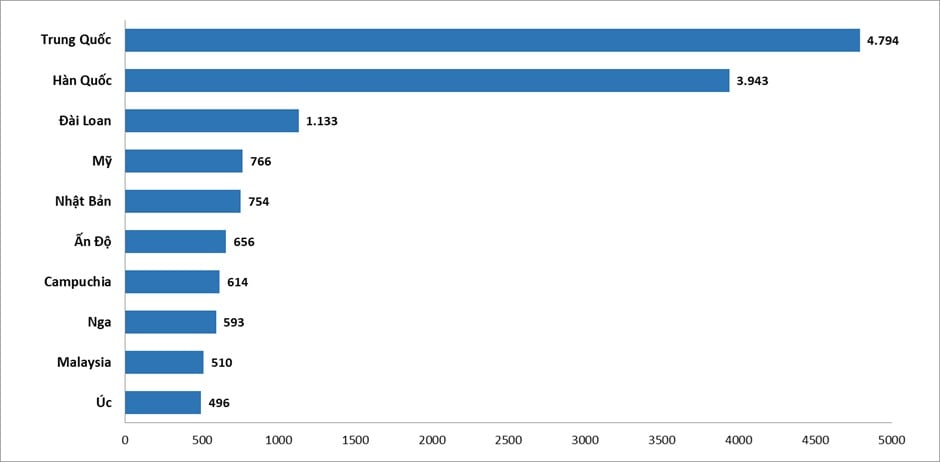
Top 10 source markets for customers in the first 11 months of 2025 (thousand visits)
SOURCE: TOURISM ADMINISTRATION
Quang Tri boasts nearly 200 km of coastline, along with a diverse ecosystem and abundant tourism resources, ranging from eco-tourism and nature tourism to cultural and historical tourism, as well as various forms of water sports, agriculture, and high-end resorts. In the context of the province prioritizing attracting international cruise ships, being allowed to apply e-visas at major ports is a key condition for Quang Tri to increase its competitiveness compared to other destinations in the region.
In reality, cruise tourism is a strength of Vietnam, but in recent times, the number of cruise ship passengers to our country has been quite modest compared to its potential. One of the biggest bottlenecks is visas. Due to the large number of passengers on each ship, visa approval is very difficult. Travel companies report that for a ship with 5,000-6,000 people, visa applications require a lot of paperwork and various conditions. Cruise passengers are often encouraged to apply for visas as a group for convenience during entry and exit, easier border control, and to minimize errors. Group visas in Vietnam have always had many requirements, and the application process is very time-consuming. Not to mention, if passengers apply for visas independently, it would be very difficult for them to return if the ship makes a stop at a certain point or leaves Vietnam.
Many foreign tourists currently staying in Central Vietnam have expressed excitement about the new information from Quang Tri province. Mr. Michael D., a tourist from Australia, shared: "I've always wanted to travel by sea along Central Vietnam, but the procedures made me hesitant. Now that Quang Tri has implemented e-visas at its ports, travel has become much easier. I really hope to be able to visit one of Quang Tri's seaports on my next trip."
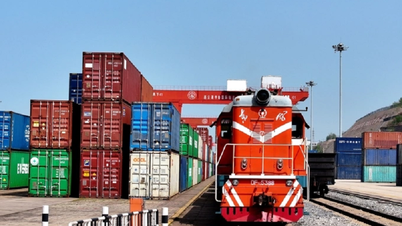
Not only sea routes, Mr. Cao Tri Dung, Chairman of the Da Nang Tourism Association, believes that the electronic visa policy will be a boost for Vietnam to "revive" land border tourism, which once had a golden age. Vietnam is located on the Trans-Asian Highway and the East-West Highway, both vital routes, so the potential for land-based tourism is enormous. However, after about 3-4 years of rapid development, from 2011 onwards, the number of tourists began to decline. One of the reasons is the many shortcomings in the entry policy, and the time taken for procedures is lengthy. That is why the southern border crossing between Thailand and Malaysia is very busy; the land border crossing between Thailand and Laos is also very busy, while Vietnam's border crossings with China are almost the only bustling ones, while most of the border crossings with Laos and Cambodia are not very active. Although in terms of transportation for tourism, land-based travel is second only to air travel in importance and attractiveness to tourists. Land-based tourism is in no way inferior to sea-based tourism in terms of passenger numbers, potential, and product ecosystems.
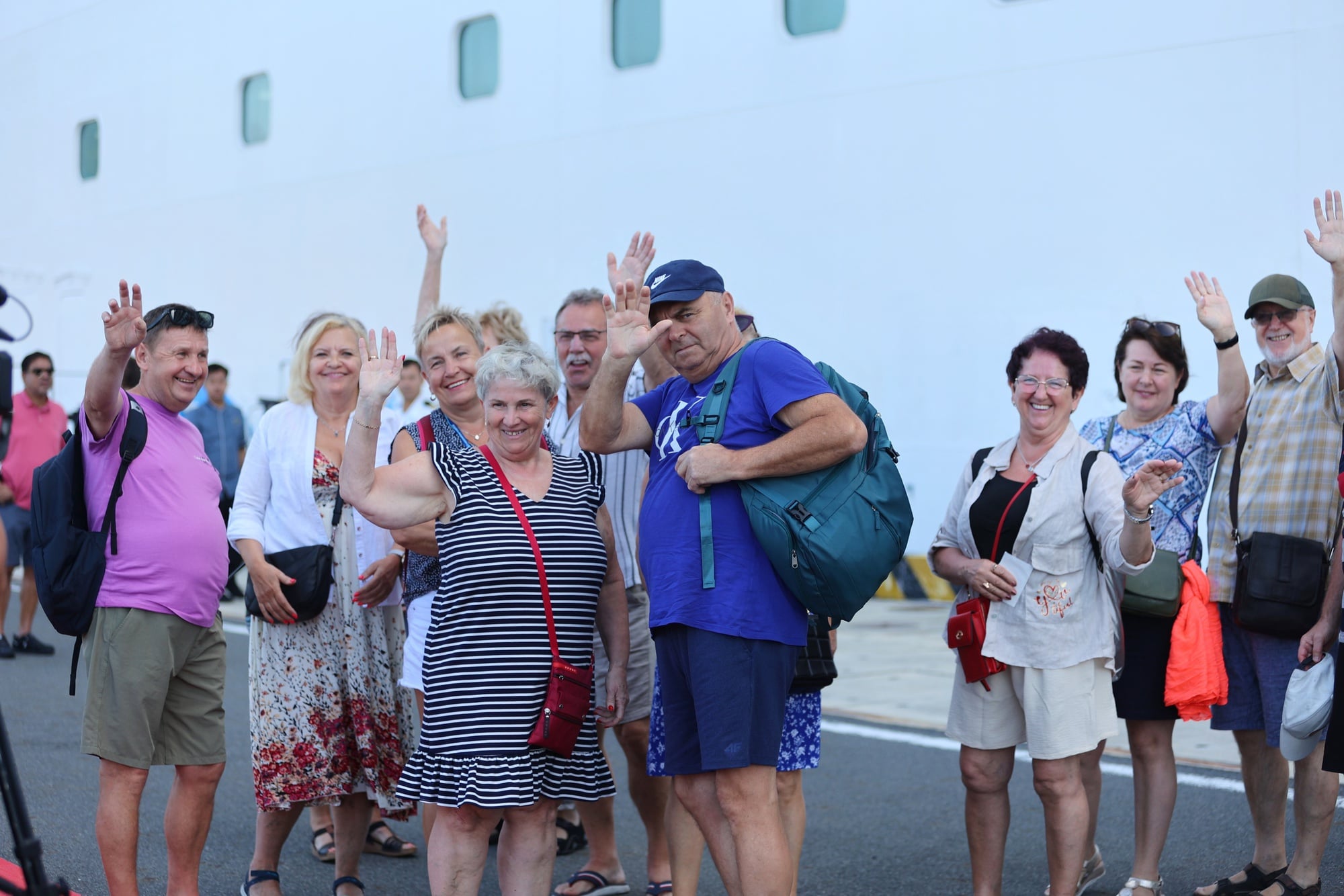
Electronic visas will unlock the bottleneck for Vietnam to break through in the cruise tourism market.
PHOTO: BA DUY
"This e-visa policy is another very correct and timely move by the Government, following many more open visa policies in the past. E-visa not only keeps up with the trend of independent travel among tourists but also adds more attractiveness to the diverse types of tourism in Vietnam. In the near future, land border crossings and seaports will be 'wide open' to welcome visitors as freely as air border crossings. Whether traveling in groups or independently, tourists can easily plan their trips, have more options for traveling by land or sea, connect to many destinations, and return to Vietnam for extended periods of up to 90 days. Vietnamese tourism will open up many more opportunities to break through in the coming period," Mr. Cao Tri Dung said enthusiastically.
After reopening, the focus must be on "opening up the quality of the destination."
On the other hand, the Chairman of the Da Nang Tourism Association noted that to anticipate visa policies, tourism businesses need to prepare suitable product lines early, not only meeting but also catering to the diverse needs of tourists. At the same time, government agencies must promptly issue consistent and appropriate management policies. From e-visa approval to entry/exit procedures, everything needs to be synchronized and streamlined to create a smooth and convenient journey for tourists.
Vietnam's tourism industry sets a record for welcoming international visitors.
According to data recently released by the General Statistics Office (Ministry of Finance), in the first 11 months of the year, the total number of international visitors to Vietnam reached over 19.1 million, an increase of 20.9% compared to the same period last year. This is a record high, surpassing the 18 million visitors for the whole of 2019 - the peak period before the Covid-19 pandemic. In November alone, Vietnam welcomed nearly 2 million international visitors, an increase of 14.2% compared to the previous month and a 15.6% increase compared to the same period in 2024. This is the third highest number of international visitors since the beginning of the year (January and March each reached over 2 million). The latest report from the United Nations Tourism Organization (UN Tourism) notes that the recovery of Vietnamese tourism is particularly impressive, especially considering that the Asia-Pacific region has only recovered 90% of its pre-Covid-19 levels. UN Tourism assesses Vietnam's tourism growth rate as among the highest in the world, along with Japan.
Mr. Vo Anh Tai also stated his view: The core of regional tourism development is not "attracting tourists," but "having unique products to retain them." A flexible and open visa policy is only a necessary condition to increase the number of tourists; the decisive factor in tourists staying longer, spending more, and returning multiple times must be the quality of the product. If every place has similar night markets, pedestrian streets, and commercial models, then opening more border gates will not create any unique value. Each locality needs to rediscover its original identity, from natural landscapes to local culture, to build distinctive products, instead of copying currently popular models. Furthermore, expanding border gates requires a more modern management system. The larger number of entry points means that procedures, monitoring tourist flows, data sharing, security management, and tourist support must be elevated to a national level, avoiding a lack of focus and fragmentation. Tourism today is no longer just about receiving visitors, but about managing safe, sustainable, and intelligent travel flows.
"Opening 41 more e-visa border gates is a significant step forward, but its meaning depends entirely on the transformative capacity of localities and businesses. This is not just a story of 'opening up,' but a problem of internal capacity including infrastructure, services, management, products, and differentiation. Opportunities continue to open up, but success will only come if Vietnam opens its mind, its approach, and the quality of its destinations," Mr. Vo Anh Tai emphasized.
According to Mr. Pham Van Thuy, Deputy Director of the National Tourism Administration, easing and diversifying visa policies is a necessary step to increase the attractiveness of Vietnam as a destination. However, compared to other countries in the region, there is still significant room for reform. Specifically, Malaysia currently grants visa-free entry to citizens of 166 countries, Indonesia to 169, and Singapore to 158, while Vietnam is only at 27. Some countries even apply flexible policies such as permanent visa exemption, granting group visas at border crossings, or visa-free transit for up to 240 hours. These are valuable experiences to consider in our reform roadmap.
"Following the Government's directive, relevant agencies are coordinating research and proposing to expand the list of visa-exempt countries and preferential visa policies for strategic target groups. Simultaneously, the tourism industry is implementing strong promotional activities focusing on markets with favorable visa policies such as Northeast Asia, Southeast Asia, Europe, Australia, the US, and India, while also targeting high-spending tourist segments such as MICE tourism, golf, and healthcare… With the synchronized combination of a liberal visa policy and a professional promotion strategy, Vietnam has grounds to expect a significant increase in international tourists, contributing to the growth of the tourism industry and making a positive contribution to the socio-economic development of the country," Mr. Pham Van Thuy informed.

Source: https://thanhnien.vn/visa-mo-duong-bang-cho-du-lich-cat-canh-185251207215627054.htm
















































































Comment (0)