

VNPT currently maintains a redundancy level of over 40% of its international Internet transmission channel capacity and has announced the deployment of the first 10Gbps high-speed Internet infrastructure project in Vietnam.
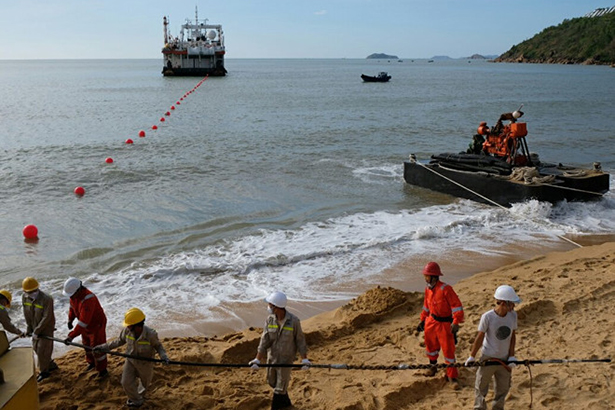
According to the plan, Viettel and VNPT will deploy additional submarine cables to land in Quy Nhon. If these lines become operational, they will fundamentally address the backup capacity needs of the network operators.
Ensuring quality international internet connectivity.
In March 2023, five of Vietnam's international undersea fiber optic cables experienced malfunctions, significantly impacting Vietnam's international internet connectivity. This was the first time five of Vietnam's cables simultaneously failed. This unusual situation had a considerable impact on the quality of Vietnam's international internet services and directly affected the business operations of technology companies.
According to the Ministry of Information and Communications , in response to the situation where multiple undersea cables are experiencing problems, the Ministry has established a Steering Committee to address the issue and develop a national plan for undersea fiber optic cables. It has also organized and coordinated efforts among telecommunications companies to handle the broken undersea fiber optic cables, ensuring the continued connectivity of Vietnam's telecommunications and Internet services internationally.
Following the directives of the Ministry of Information and Communications, telecommunications enterprises have quickly expanded the capacity of terrestrial fiber optic cables; shared and provided mutual support for telecommunications and international Internet traffic to ensure the quality of fixed and mobile broadband telecommunications services serving production, business, and socio-economic activities.
The Ministry of Information and Communications also requires telecommunications businesses to ensure a minimum reserve of 10% capacity to maintain the stability of telecommunications and international internet services provided to customers, and to quickly coordinate with international partners to restore undersea fiber optic cables. The Telecommunications Department has worked with telecommunications businesses to continue implementing current and future risk management plans to ensure service quality for customers; developing a plan for Vietnam's undersea fiber optic cable routes, and accelerating the development of several international undersea fiber optic cable routes to ensure Vietnam's leading and dominant role.
To date, 4 out of 5 of Vietnam's undersea fiber optic cables have been restored, and the quality of Vietnam's internet has been ensured.
According to a representative from VNPT, during peak periods, the utilization rate of international internet bandwidth only reaches about 60% of the available channel capacity. With the current capacity, VNPT ensures fast connection speeds to international servers even during peak hours. In addition, VNPT reserves up to 40% of its capacity, ready to serve customers in all situations and meeting the quality standards of the Ministry of Information and Communications.
VNPT is working closely with submarine cable management units to expedite the repair of the APG submarine cable. It is expected that the APG cable will be fully repaired in June, contributing to strengthening VNPT's capacity and increasing its international internet capacity reserve ratio to 60%. Along with reserve capacity for bandwidth growth, VNPT's internet quality is ensured to be higher than the national average.
Preparing to provide ultra-broadband internet service to 10,000 customers.
According to the Vietnam Internet Center (Ministry of Information and Communications), VNPT's quality monitoring results showed that download speeds in May ranged from 92Mbps to 111Mbps, higher than the national average of 90.59 Mbps for other network providers. Similarly, VNPT's upload speed reached 92.09Mbps, also higher than the national average of 89.56 Mbps.
Recently, VNPT also collaborated with Nokia to bring ultra-broadband technology to Vietnam. This is the first time ultra-broadband technology has been deployed in Vietnam. With this technology, Internet users can choose service packages with speeds up to 10 Gbps. The initial deployment phase will connect 10,000 households and businesses in the 8 largest provinces and cities nationwide, building the best telecommunications platform to deploy digital transformation solution ecosystems for the government and businesses. VNPT has also participated in researching standards and testing towards 7th generation Wi-Fi with multi-connectivity and speeds up to 30Gb/s.
Currently, VNPT has invested in four new submarine cable routes, of which the SJC-2 route is expected to be completed and put into operation by the end of this year, adding 18T of international traffic for users in Vietnam.
Mr. Vu The Binh, Secretary General of the Vietnam Internet Association, believes that in the next five years, Vietnam will likely need at least 2-3 more submarine fiber optic cables to meet growing demand. According to plans announced by Viettel and VNPT, these network operators will launch an additional cable connecting to Quy Nhon in 2023. If these lines become fully operational, they will fundamentally address the network operators' backup capacity needs.
Recently, the Vietnam Telecommunications Authority worked with telecommunications businesses to develop a plan for Vietnam's submarine fiber optic cable network, accelerating the construction of additional international submarine fiber optic cables to ensure Vietnam's leading and dominant role. In any plan, Vietnamese businesses must hold the leading position, representing the investment group or joint venture in constructing new routes. It is projected that by 2025, Vietnam will have at least 10 international submarine fiber optic cable routes.
According to VNN
Source








![[Infographics] Ha Tinh Tourism and Targets for 2026](https://vphoto.vietnam.vn/thumb/402x226/vietnam/resource/IMAGE/2026/04/02/1775081809011_fb_ban-sao-cua-chi-tieu-du-lich-ha-tinh-2026-png.webp)
















































































Comment (0)