

By the end of 2023, the whole country had more than 182 million individual payment accounts, corresponding to 87.08% of adults having bank accounts. Many banks have processed over 95% of their transactions through digital channels; the percentage of customers making cashless payments through electronic channels reached approximately 50%.
The number of mobile and QR code payment transactions is also growing rapidly. Currently, there are 85 payment service providers offering internet payment services and 52 offering mobile payment services.
Statistics show that in the first four months of 2024, cashless payments reached approximately 4.9 billion transactions with a total value of over 87 million billion VND (an increase of 57% in volume and 33% in value). Transactions via the internet and mobile phones both increased sharply, especially payments via QR code, which reached nearly 101.2 million transactions with a value of over 126,800 billion VND (an increase of 167% in volume and over 424% in value).
However, with the development of payment technology, cybercrime tends to increase with increasingly sophisticated, complex, and unpredictable methods. Many customers have been deceived and proactively transferred money to accounts as instructed by criminals. These funds are then immediately transferred to other accounts (within the scam network). Therefore, it is very difficult for victims to recover their lost money.
In this context, the State Bank of Vietnam has actively coordinated with the Ministry of Public Security and relevant agencies to implement numerous measures to help prevent and minimize the risks of fraud, deception, and payment insecurity. Among these, Decision No. 2345/QD-NHNN on the implementation of security solutions in online payments and bank card payments (effective from July 1, 2024) is noteworthy. Accordingly, this decision requires that electronic transactions by individuals with a value exceeding VND 10 million or a total daily payment value exceeding VND 20 million must apply one of the biometric authentication methods.
The essence of Decision No. 2345 is to verify that the account holder's information matches the information on the Citizen Identification Card issued by the Ministry of Public Security, eliminating fake, unauthorized, and illegal accounts. Thus, credit institutions will be able to accurately identify and verify customers during payment transactions, contributing to preventing and minimizing crimes involving the renting, borrowing, buying, and selling of payment accounts, cards, and e-wallets for illegal purposes.
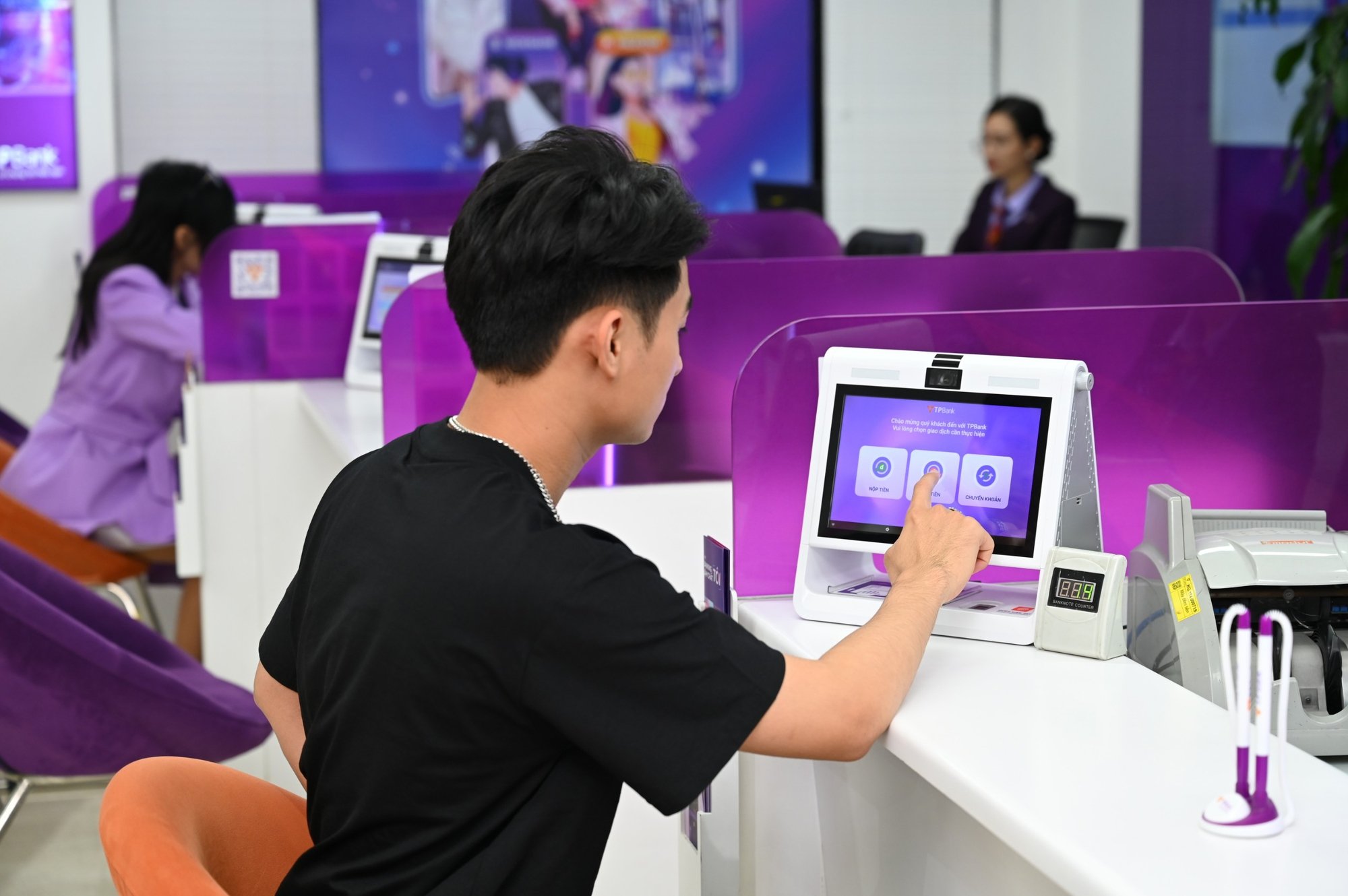
Account holders register for biometric authentication at the bank. Photo: BINH AN
Currently, if a user's payment account information is stolen, criminals can gain control of their phone. However, with the new regulations in Decision No. 2345, facial recognition is required for money transfers; if the facial recognition doesn't match the original records, criminals cannot steal the money. Furthermore, when stealing customer account information, criminals often install the app on another device to carry out the theft. But from July 1st, banks require biometric authentication, making it impossible for criminals to install the app on another device to steal money.
According to data from the State Bank of Vietnam, transactions exceeding 10 million VND account for only about 11% of the total number of transactions. The number of people with transactions exceeding 20 million VND per day is also less than 1%. Therefore, biometric authentication does not significantly impact users' payment transactions, but it still contributes to minimizing fraud.
Statistics up to the end of 2023 show that the Ministry of Public Security has issued over 84.7 million chip-embedded citizen identification cards and 70.2 million VNeID accounts, ensuring that the data is "accurate, complete, clean, and active," and has been connected and integrated with several other reliable data sources (social insurance, public services, etc.). This is an important input data source, not only helping to accurately identify and verify customers but also providing payment intermediary organizations with additional information and data for analyzing and evaluating customers; designing and providing products and services that meet customer needs.
Mr. TRAN CONG QUYNH LAN , Deputy General Director of VietinBank :
Continuously updating security technology.
The goal of Decision No. 2345 is to eliminate accounts that are not registered in the account holder's name. This helps to ensure transparency in money flow and contributes to preventing fraud. In reality, in many situations, victims are scammed and proactively transfer money to fraudsters. However, the fraudsters' accounts are not registered in their names (possibly due to previously forged documents), making it very difficult to trace the fraudsters. Now, according to the new regulations, all account holders must verify and re-identify their accounts, and accounts registered in their names will not be able to transfer money exceeding 10 million VND... In that case, the stolen money will be held, facilitating recovery by the authorities.
There are also opinions that biometrics can be deepfaked (a sophisticated scam involving the falsification of customer images and videos ), but when initial verification includes both NFC (reading information from the chip card on the citizen identification card) linked to data from the Ministry of Public Security and biometrics, this solution remains the safest and most feasible. In reality, there is no foolproof solution because criminals constantly change their scam methods and credit institutions must also continuously upgrade. The technological challenge is always evolving, and currently, the solutions in Decision No. 2345 will contribute to limiting online fraud.
Assoc . Prof. Dr. Tran Hung Son , Director of the Institute for Research and Development of Banking Technology (Vietnam National University Ho Chi Minh City):
AI applications detect fraud.
The rate of losses caused by digital fraud in Vietnam reached 3.6% of GDP, higher than the global average (1.1%) and significantly higher than countries like Brazil or Thailand (both 3.2%). Common forms of digital payment fraud in Vietnam include cyberattacks (malware, phishing, man-in-the-middle attacks), impersonation, non-technical fraud, abuse of refund policies, first-party fraud, etc. The rate of confirmed fraud cases in Southeast Asia increased by 5 percentage points last year to 54%.
To combat the increasing rate of fraud, banks and businesses need to implement a comprehensive set of solutions, among which the application of artificial intelligence (AI) and machine learning technology to detect fraud is an effective risk prevention method. Through intelligent algorithms, AI systems can continuously analyze transaction behavior, identify anomalies, and provide timely warnings to operators and customers. By continuously "learning" from data, AI is becoming increasingly smarter in detecting new forms of fraud.
Furthermore, payment service providers need to proactively cooperate and share databases on fraud, while also agreeing on common processing procedures. Improving the digital identification system will also significantly contribute to fraud prevention in payments.
Ms. DANG TUYET DUNG , Director of Visa Vietnam and Laos:
Investing billions of dollars in security.
Visa has invested billions of dollars in AI-based solutions to combat fraud and enhance security awareness. We've also implemented a strategy to replace account information with a unique identifier. This strategy strengthens security and allows users to manage data sharing options across banking apps. The application of transaction encryption technology removes cardholder privacy from the payment stream, further enhancing security.
Visa is also working with banks and partners to adopt data-based authentication instead of OTP codes for e-commerce transactions. This is a trend in developed markets like Singapore and Malaysia, significantly enhancing payment security. The State Bank's regulation requiring facial recognition for money transfers is a significant step forward in efforts to prevent fraud and protect customer assets.
Linh Anh wrote
(*) See Nguoi Lao Dong Newspaper, issue dated June 25th.
Source: https://nld.com.vn/chia-khoa-phong-chong-lua-dao-qua-mang-xac-thuc-de-thanh-toan-an-toan-196240626195938811.htm



































































































Comment (0)