

Over time, generation after generation, people of various ethnic groups have created dishes using ingredients readily available in nature. Living in harmony with and relying on nature, using its products to prepare food, people in each region, each area, and each ethnic group have also come up with new innovations…
These days, many people choose to travel to Northwest and Northeast Vietnam to admire the majestic mountains. There, the climate is fresh and countless flowers bloom. And during these trips, don't forget to enjoy the tempting local dishes. Among them, sticky rice leaves a lasting and unforgettable taste…
Dien Bien sticky rice
Whenever you have the chance to visit Dien Bien, after visiting the historical sites, don't forget to enjoy sticky rice made with mountain-grown glutinous rice by the Thai ethnic people to experience its unique flavor, which is quite different from other types of sticky rice...
Sticky rice is widely grown in the Northwest provinces, but when talking about the best sticky rice, people often immediately think of Dien Bien sticky rice. The grains of Dien Bien sticky rice are plump and round, glossy when cooked, sweet, fragrant, and soft and chewy.
The Thai people in Dien Bien place great importance on rice selection. This is the decisive factor in making delicious sticky rice.
In Dien Bien, there are two types of glutinous rice: upland glutinous rice and paddy glutinous rice. And the rice we use in this dish is upland glutinous rice.
According to the experience of the Thai ethnic people, the characteristic of upland sticky rice is that the grains are usually large, coarse, and come in two colors: opaque white (from grains that have been sun-dried for a long time) and translucent white (from grains that have not been sun-dried for a long time). Although they are mixed together, those who know how to appreciate good food will usually prefer the rice with more translucent white grains because it has a much more fragrant and chewy taste.
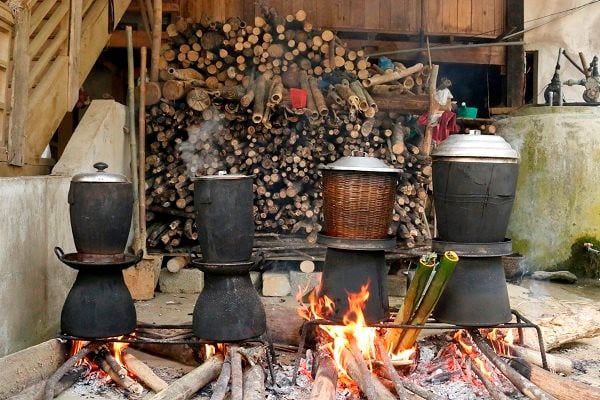
Steaming upland sticky rice involves many more steps than steaming rice grown in lowland rice paddies. To make a delicious and chewy pot of upland sticky rice, Thai ethnic women usually soak the rice for at least 8 hours (soaking prevents the rice from becoming hard when steamed). After soaking, the plump, white grains of rice are steamed in special wooden steamers used by the Thai people. These steamers are usually very airtight, so the steam concentrates completely on cooking the rice grains.
While regular sticky rice only needs one steaming session, according to the experience of Thai women, mountain sticky rice must be steamed twice to be soft and fragrant. The first steaming session, when the rice is fragrant and just cooked, is done by pouring it out, spreading it evenly with chopsticks, letting it sit for a while, then pouring it back into the wooden steamer and steaming it again until evenly cooked. Dien Bien mountain sticky rice is cooked by steam, resulting in a soft, chewy texture that doesn't stick to your hands.
Most people who have had the chance to enjoy this sticky rice dish share the same unforgettable feeling and impression, not only because of the fragrant, chewy sticky rice grains but also because they are captivated by the harmonious blend of colors and the rich, unique flavors of the grilled meat from Northwest Vietnam. This is also what sets it apart from sticky rice dishes in other regions.
Tourists visiting Dien Bien often buy steaming hot sticky rice from the ethnic people to take with them and eat to warm their stomachs. In the cool, crisp air of the Northwest mountains, visitors will find it hard to forget the fragrant, delicious taste of sticky rice. It's incredibly delightful to roll each ball of rice in your hand, savoring it slowly, and when you open your palm, your hand still feels clean and not sticky at all.

Five-colored sticky rice
In the highlands, you can find five-colored sticky rice in many places. The Muong, Tay, and Thai ethnic groups all have their own unique versions of this dish. If you have the opportunity to visit Sa Pa ( Lao Cai ), you can learn about the process of making five-colored sticky rice by the Tay people living there. The sophistication and meticulousness in the cooking methods of Tay women have created this unique five-colored sticky rice, a distinctive feature of the highland people.
Locals here often make five-colored sticky rice for ancestral worship ceremonies, weddings, housewarming parties, and on the 5th day of the 5th lunar month, the 15th day of the 7th lunar month, when the village holds festivals, or when there are honored guests...
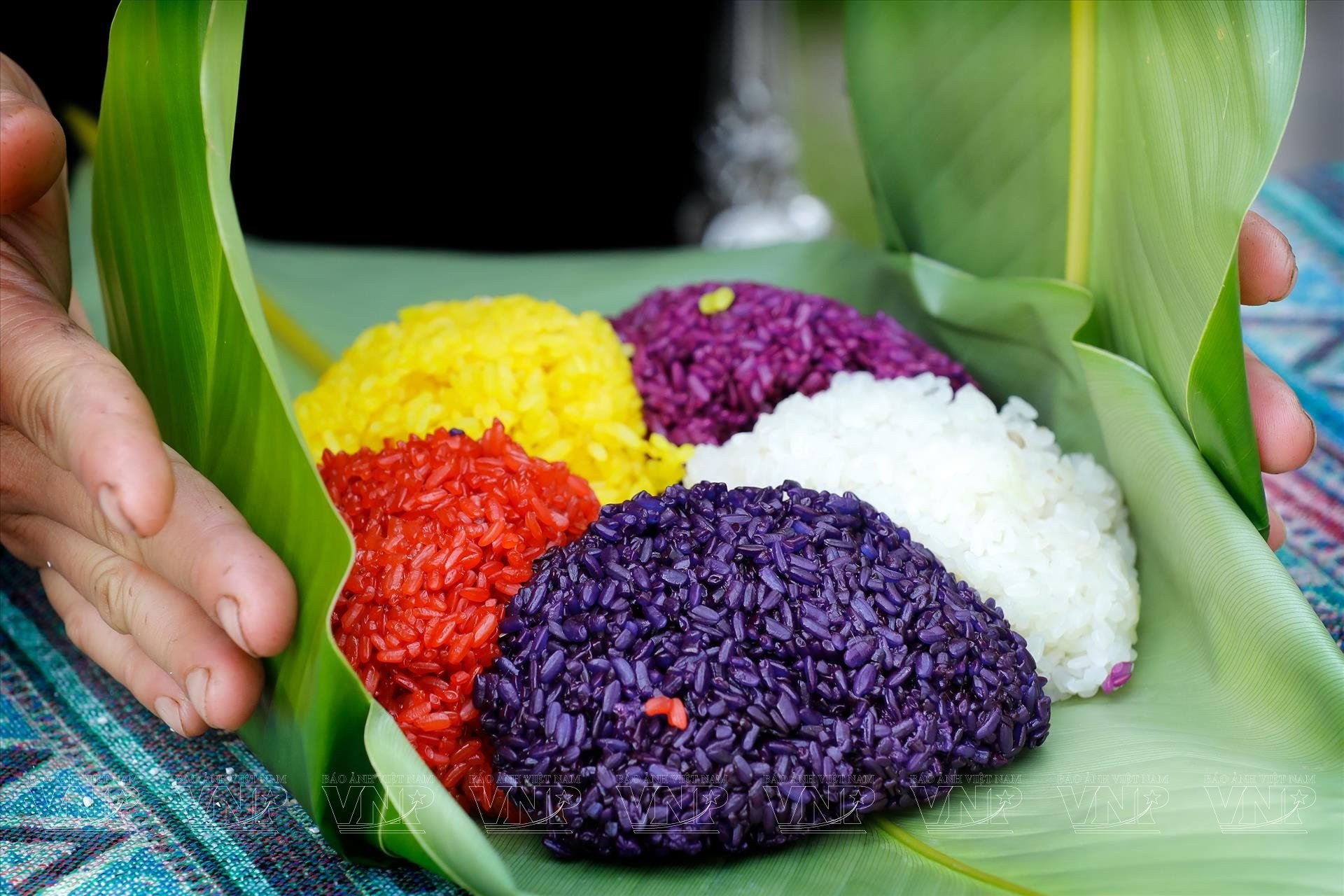
Five-colored sticky rice is made from five types of sticky rice with five different colors: red, yellow, green, purple, and white. However, depending on the region, they may mix or use other colors besides these basic ones to create five-colored sticky rice. The five colors of sticky rice symbolize the "five elements": yellow is the color of earth, green is the color of wood, red is the color of fire, white is the color of metal, and black is the color of water.
The ingredients for five-colored sticky rice include: fragrant, sticky rice with even grains, mixed with various forest leaves for coloring. Red is made from gac fruit and red rice leaves. Green is made from ginger leaves, green sticky rice leaves, or grapefruit peel, bitter bamboo peel, burned to ash and soaked in water mixed with a little lime. Yellow is made from crushed old turmeric root. Purple is made from black sticky rice leaves, or the leaves of the Sau Sau tree…
Before coloring the sticky rice, the washed glutinous rice is soaked in plain water for 6-8 hours to allow the grains to swell to the right consistency.
Divide the rice into 5 portions, each corresponding to a color: if you want red sticky rice, boil the leaves of the *co khau* plant thoroughly, strain the liquid, let it cool, then add the rice and mix well, letting it sit for about an hour. When the rice grains have turned red, then steam the sticky rice; when cooked, it will have a very attractive bright red color.
Similarly, light red and yellow sticky rice are also made from the leaves of the *co khau* plant, but the preparation method and fermentation time differ slightly. The purple and brown sticky rice, however, are made from the *khau den* plant. Before grinding the leaves, they are wilted over a fire, mixed with the ash of the *Nuc nac* fruit, and the resulting liquid is filtered and mixed with glutinous rice. When steamed, the sticky rice turns purple; if cooked longer, it turns brown...
The Tay people believe that if someone's sticky rice is prepared with the right, beautiful colors, they are considered skillful and prosperous in business.
Based on traditional recipes, five-colored sticky rice, in addition to its delicious, rich, and attractive flavor derived from forest leaves, also has medicinal properties for treating intestinal ailments and boosting overall health.
Ant egg sticky rice from Mu Cang Chai
When visiting Yen Bai, tourists are often "advised" to enjoy many delicious dishes from the highlands, reflecting the unique flavors of the Dao, Tay, and Thai ethnic groups... In particular, the ant egg sticky rice from Mu Cang Chai is intriguing and unforgettable once tasted...
Traditionally, the ant egg season begins around the second and third months of the lunar calendar each year. During this time, people from the ethnic groups in the highlands of Yen Bai province go into the forest. This work is usually undertaken by the men. However, to obtain high-quality ant eggs, they must be collected on sunny days. Otherwise, the ant eggs will absorb rainwater and taste unpleasant.
Not all types of ants can have their eggs harvested for cooking. According to local experience, the best ants for egg harvesting are the black suffocating ants. When in the forest, people look for large ant nests in trees and cut them down to collect the eggs. However, the highlanders never take all the eggs from a nest, leaving them for future reproduction.
The preparation of sticky rice with ant eggs in Mu Cang Chai is quite meticulous and careful. Glutinous rice is soaked and washed thoroughly for 3-4 hours before being drained and steamed. The rice grains become plump, turn translucent white, and emit a fragrant aroma. The ant eggs, after being collected, are sifted to remove impurities and dirt, then soaked in clean warm water, gently stirred, rinsed, and drained. Afterward, the ant eggs are seasoned and stir-fried with shallots that have been sautéed in chicken fat until fragrant and just cooked through, creating an enticing aroma.
Ant eggs are placed in banana leaves and added to steamed sticky rice. The aroma of the ant eggs combined with the fragrant sticky rice, the rich and creamy taste of the ant eggs, and the fragrant fried shallots will be very appealing to tourists.
People in the highlands of Yen Bai often eat sticky rice with ant eggs, served with dried stream fish grilled over charcoal, dipped in a mixture of salt, chili, and lime juice…
Source


![[Photo] Presenting the Binh Ngo Spring Edition of Nhan Dan Newspaper to officers and soldiers on the border and islands.](/_next/image?url=https%3A%2F%2Fvphoto.vietnam.vn%2Fthumb%2F1200x675%2Fvietnam%2Fresource%2FIMAGE%2F2026%2F01%2F27%2F1769491058494_trao-tang-bao-xuan-cho-cb-cs-bien-gioi-hai-dao-0994-5950-jpg.webp&w=3840&q=75)
![[Photo] Working under the scorching sun on the construction of a multi-level boarding school in the border region of Dak Lak.](/_next/image?url=https%3A%2F%2Fvphoto.vietnam.vn%2Fthumb%2F1200x675%2Fvietnam%2Fresource%2FIMAGE%2F2026%2F01%2F27%2F1769489254973_ndo_bl_img-1285-4083-jpg.webp&w=3840&q=75)


![OCOP during Tet season: [Part 2] Hoa Thanh incense village glows red.](/_next/image?url=https%3A%2F%2Fvphoto.vietnam.vn%2Fthumb%2F402x226%2Fvietnam%2Fresource%2FIMAGE%2F2026%2F01%2F27%2F1769480573807_505139049_683408031333867_2820052735775418136_n-180643_808-092229.jpeg&w=3840&q=75)
![OCOP during Tet season: [Part 1] Ba Den custard apples in their 'golden season'](/_next/image?url=https%3A%2F%2Fvphoto.vietnam.vn%2Fthumb%2F402x226%2Fvietnam%2Fresource%2FIMAGE%2F2026%2F01%2F26%2F1769417540049_03-174213_554-154843.jpeg&w=3840&q=75)


Comment (0)