

Costs are rising, and orders are decreasing.
Mr. Ong Hang Van, Deputy General Director of Truong Giang Aquatic Products Company, said: currently the company has 3 processing plants, however, in the first half of 2023, key pangasius export markets all experienced a sharp decline, especially the US and China markets; this has resulted in a very large inventory of pangasius for the company, and there is still a lot of fish in the ponds.
Difficulties in exporting have impacted businesses' cash flow. Furthermore, high inventory levels have led to increased storage costs. The average monthly electricity cost for operating cold storage alone is approximately 4 billion VND.
"This is the first time in 10 years that our business has faced a cash shortage, because we can't export our goods, so the banks aren't disbursing loans, even though we have assets to use as collateral," Mr. Van shared.
Pointing out the industry's biggest weakness, Mr. Van argued that feed relies too heavily on imported raw materials. Currently, producing 1 kg of raw pangasius requires more than 1.7 kg of feed, driving production costs up to $1.2 USD/kg. Meanwhile, the cost of fish that directly compete with pangasius, such as Alaskan pollock, is only $1 USD/kg. Therefore, the current issue is that every effort must be made to bring down the price of aquaculture feed.
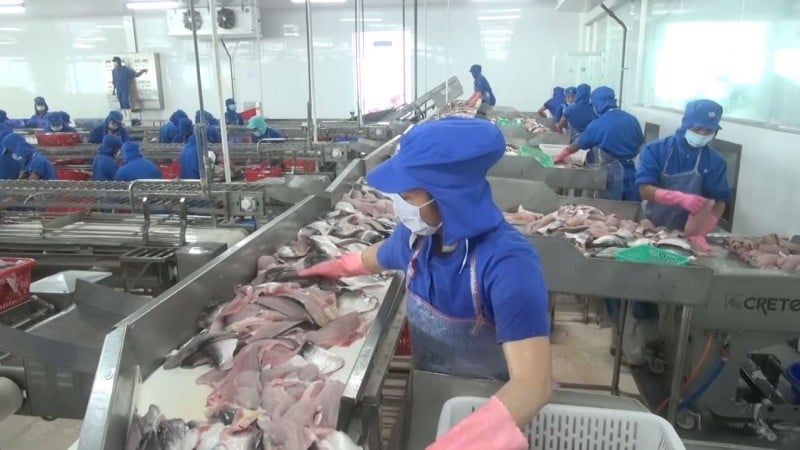 |
| Pangasius exports are showing signs of recovery. |
Sharing the same view, Mr. Huynh Duc Trung, Director of Vinh Hoan Joint Stock Company, said that on average, export orders have decreased by about 30% in all markets, and selling prices have also plummeted. Orders and selling prices have both decreased, while the costs of farming, processing, and exporting have all increased. Feed costs alone, which account for about 70% of the production cost of pangasius, have increased significantly compared to the same period last year; costs related to quality control, logistics, warehousing, and even credit costs have all increased, creating significant pressure on seafood processing and export companies.
According to Mr. Trung, the government has introduced a 15,000 billion VND credit package to support businesses in the fisheries and forestry sectors, but businesses are still finding it very difficult to access this credit. "In reality, businesses are currently in a state of oxygen deprivation, and while the oxygen is there, they don't know how to get it to breathe. Therefore, pangasius businesses are having to tighten costs to the maximum, struggling to maintain production and retain their employees," Mr. Trung said.
According to the Vietnam Association of Seafood Processing and Export (Vasep), in the first seven months of 2023, Vietnam's pangasius production increased slightly by 2.3% compared to the same period last year, reaching 922,000 tons. However, pangasius export revenue decreased by 37% compared to the same period last year, reaching 1 billion USD.
Specifically, pangasius exports recorded a decline in value across all five of Vietnam's largest markets. The Chinese market saw a 32% decrease in value, reaching $325 million; the US market experienced a 59% drop to $159 million; the EU market decreased by 22% to $101 million; Brazil also saw a 16% decrease to $47 million; and the UK market decreased by 16% to $40 million.
Year-end market expectations
Although the market in the first few months of the year was not very bright, according to Vasep, a bright spot in the 2023 picture is the good growth in pangasius exports to some smaller markets. This is considered a ray of hope for pangasius businesses facing difficulties in traditional large markets. For example, exports to Germany increased by 25% compared to the same period last year; New Zealand by 17%; Sweden by 25%; and exports to Finland increased 18 times compared to the same period last year.
According to Mr. Ong Hang Van, Deputy General Director of Truong Giang Seafood Company, pangasius exports are showing optimistic signs. Specifically, in June and July, the company's pangasius exports were on an upward trend. This indicates that the market is recovering in the remaining months of this year and in 2024.
Similarly, Mr. Huynh Duc Trung, Director of Vinh Hoan Joint Stock Company, also shared that the company's major export markets have recorded positive growth again. Specifically, exports to the EU market in July increased by 22% compared to July 2022, to China increased by 13%, and to other markets increased by 20%.
Data from the Ministry of Agriculture and Rural Development shows that in the first eight months of 2023, pangasius exports reached nearly $1.2 billion, a decrease of 34% compared to the same period last year. However, the rate of decline is slowing down, indicating a market recovery.
Mr. Truong Dinh Hoe, General Secretary of the Vietnam Association of Seafood Processing and Export (VASEP), noted that pangasius exports have not yet shown positive growth compared to the same period last year, but are showing good signs of recovery.
In China, Vietnam's largest pangasius export market, the decline is gradually slowing, from -65% in January compared to the same period last year, to -30% in May and down to -7% in July 2023. This raises expectations that pangasius exports to the market of over 1.4 billion people will recover in the last months of the year.
Regarding the US market, current inventories are depleted. They are forced to increase imports in the coming period. Furthermore, at the end of August 2023, a delegation from the US Food Safety and Inspection Service (FSIS) visited Vietnam to assess the food safety and hygiene control system for exported catfish. The inspection revealed that Vietnam's pangasius production system remains compliant. Accordingly, the farms/farms of businesses meet the criteria and conditions of the Food Safety Control Program for fish and Siluriformes fish products exported to the US market. In addition, 100% of the farms/farms have been assigned pond identification codes. This is a favorable condition for businesses to continue exporting pangasius to this market.
In the final months of the year, the decline will gradually narrow compared to the same period last year as the market enters the peak ordering season for year-end consumption and major festivals. "If the market progresses favorably, and people and businesses have sufficient capital to maintain production and processing, pangasius exports for the whole year could reach nearly $1.8 billion," Mr. Truong Dinh Hoe predicted.
Source link



![[Photo] General Secretary and President To Lam meets with National Assembly delegates from ethnic minorities.](https://vphoto.vietnam.vn/thumb/1200x675/vietnam/resource/IMAGE/2026/04/20/1776696701056_a1-bnd-8331-3342-jpg.webp)
![[Image] National Assembly discusses the implementation of the socio-economic development plan.](https://vphoto.vietnam.vn/thumb/1200x675/vietnam/resource/IMAGE/2026/04/20/1776696707422_ndo_br_img-20260420-185419-jpg.webp)



























































































Comment (0)