Ho Chi Minh City – Mr. Nguyen Huu Thanh (68 years old) suffered a stroke due to a blockage of a vital blood vessel in the brainstem, causing dizziness and weakness on one side of his body. He received emergency treatment within 30 minutes.
At 12:30 PM on June 20th, Dr. Nguyen Thi Minh Duc (Head of the Neurology Department, Neurology Center, Tam Anh General Hospital, Ho Chi Minh City) was having lunch when she received an urgent call from the emergency room regarding a suspected stroke case. A few minutes later, the doctor arrived and examined the patient, finding that the patient had a drooping mouth, slurred speech, and weakness on the right side of the body.
Family members said they couldn't remember exactly when Mr. Thanh (from Tan Xuan commune, Hoc Mon district) showed signs of a stroke, estimating it was around 9 am, and they quickly took him to the emergency room.
The hospital issued an emergency "Code Stroke" (red alert) order, prioritizing personnel and equipment to save the stroke patient. The patient underwent magnetic resonance imaging (MRI). After 10 minutes, the results showed a pontine infarction, with no occlusion of large intracranial vessels.
According to Doctor Minh Duc, the patient's injury was located in the crucial brainstem region, where bundles of nerve fibers descend to the spinal cord, forming a network responsible for the human brain's wakefulness and alertness functions. The patient experienced stroke symptoms within 4 to 4.5 hours; although it was still within the "golden hour," there could be no further delay because the longer the delay, the more severe the complications would become.
Mr. Thanh received thrombolytic therapy 30 minutes after his admission. Doctor Minh Duc noted that this speed is quite fast according to international standards for acute stroke emergency care (patients receive emergency treatment within 45-60 minutes of admission before being given thrombolytic therapy).
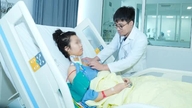

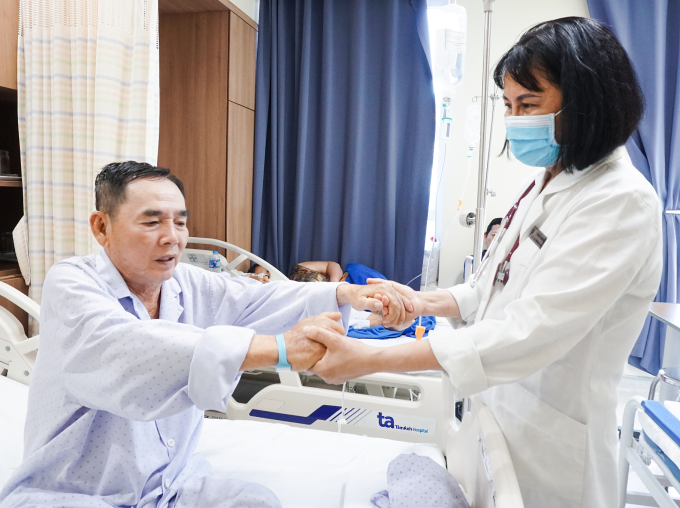
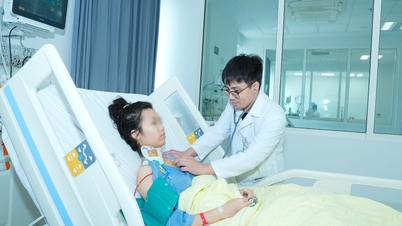
Doctor Minh Duc is examining Mr. Thanh after his treatment. Photo: Provided by the hospital.
Two hours later, the patient was alert, slurred speech and facial asymmetry had decreased. The weakness on one side of the body had improved. After two days, the patient was able to walk, eat, and perform daily activities, and their memory was normal. The doctor continued treatment to stabilize blood sugar levels, prescribed anticoagulants and lipid-lowering medication, and advised the patient to quit smoking to reduce the risk of recurrent stroke.
Mr. Thanh recounted that after waking up that day, he did some light exercise, then took a shower and drank coffee. Afterwards, he felt tired, lay down for a while, and felt weak in one side of his body. He couldn't text, dropped his phone, his speech became slurred, and he felt unsteady. "When I arrived at the hospital, my mind was hazy, I started to feel dizzy, and thinking about it still terrifies me," he said.
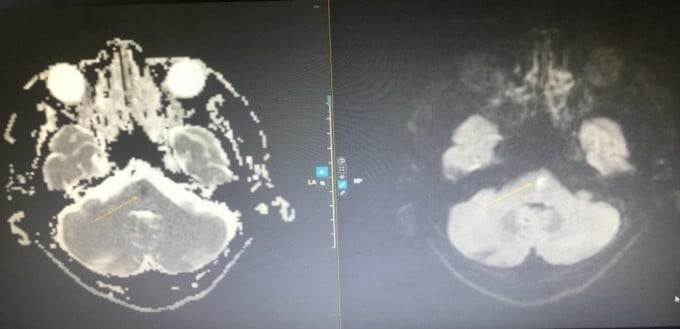
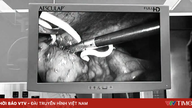
Location of brainstem infarction (left) and post-stroke thrombolytic therapy as shown in MRI images (right). Photo: Provided by the hospital .
Mr. Thanh has a history of hypertension, diabetes, and has smoked for many years, having quit just over a month ago. These are risk factors leading to ischemic stroke. According to Dr. Minh Duc, smoking increases the risk of stroke six times compared to non-smokers and also increases the risk of atherosclerosis. It takes 5 years after quitting smoking for these risk factors to decrease to the level of a non-smoker.



Dr. Minh Duc advises that strokes in the brainstem have very diverse symptoms, and many cases are difficult to recognize, although they can be diagnosed using MRI. Brainstem strokes can lead to many serious consequences; delayed treatment can cause paralysis and death. Symptoms can progress rapidly within hours, posing a life-threatening risk.
Older adults and those with underlying conditions such as hypertension, diabetes, hyperlipidemia, and smoking should proactively undergo regular general health checkups and stroke screenings. Tests and imaging techniques such as brain scans (MRI 3 Tesla, CT 768-slice), and advanced DSA angiography can help detect abnormalities and prevent strokes early.
Peaceful
Source link
![[Image] National conference summarizing one year of operation of the overall organizational model of the political system, the three-tiered government model.](https://vphoto.vietnam.vn/thumb/1200x675/vietnam/resource/IMAGE/2026/07/01/1782882811691_ndo_br_1-jpg.webp)