|
The official ball for the 2026 World Cup is capable of recording a large amount of data. Photo: Reuters . |
At this year's World Cup, Lenovo is providing a dedicated AI assistant for the competing teams. This is FIFA's effort to create a fairer playing field. Whether that will be enough to achieve its goal is another matter.
World Cup in the age of AI
The 2026 World Cup will set a record with its massive amount of data. FIFA will monitor approximately 150 million data points in each match. Inside the ball alone, the IMU (inertial measurement unit) sensor system records 500 measurement data points per second in real time.
"What's special about football is that the number of possible scenarios in a match is greater than the number of atoms in the universe," said Patrick Lucey, chief scientist at Stats Perform, the data and artificial intelligence company that underpins most of the global football ecosystem.
 |
Hundreds of millions of data points are recorded during each football match. Photo: Fullstack. |
Stats Perform's statistics are used in many areas related to football, from assisting in player selection and valuing multi-million dollar transfer fees, to helping coaching staff choose tactics, formations, and design corner kick and free kick drills.
This World Cup is taking place at a time when artificial intelligence (AI) is booming. This cutting-edge technology allows for the collection of data from matches worldwide at unprecedented speeds. Team members are striving to overcome all obstacles to process that data at an unprecedented pace.
“The data is highly detailed, interactive, and adversarial. What we do in sports is very similar to self-driving cars in terms of predicting routes,” Lucey said. Just for 10 players on the field, excluding the goalkeeper, there are 10! (over 3.6 million) ways to arrange the team.
AI in the world of football
Even small nations are finding creative ways to leverage technology. Curacao, a Caribbean island with a population of around 159,000, became the smallest country to qualify for the World Cup after using data and technology to track Curacaoian talent playing abroad.
"Only one of the 26 players on the Curacao team was actually born on the island. The rest were all born in the Netherlands," said Alex Stewart, CEO of data-driven sports consulting firm Analytics FC.
One increasingly popular application of AI is in coaching. Tools can analyze a pool of viable options and identify strategists with the most suitable tactical strengths. Teams can also use AI to help build their lineups before a tournament, based on their opponents in the group stage.


The England team uses AI to analyze penalty kicks. What previously took up to five days to analyze each opposing penalty taker can now be done in just five hours, according to the head of the Football Association's (FA) performance analysis and evaluation department.
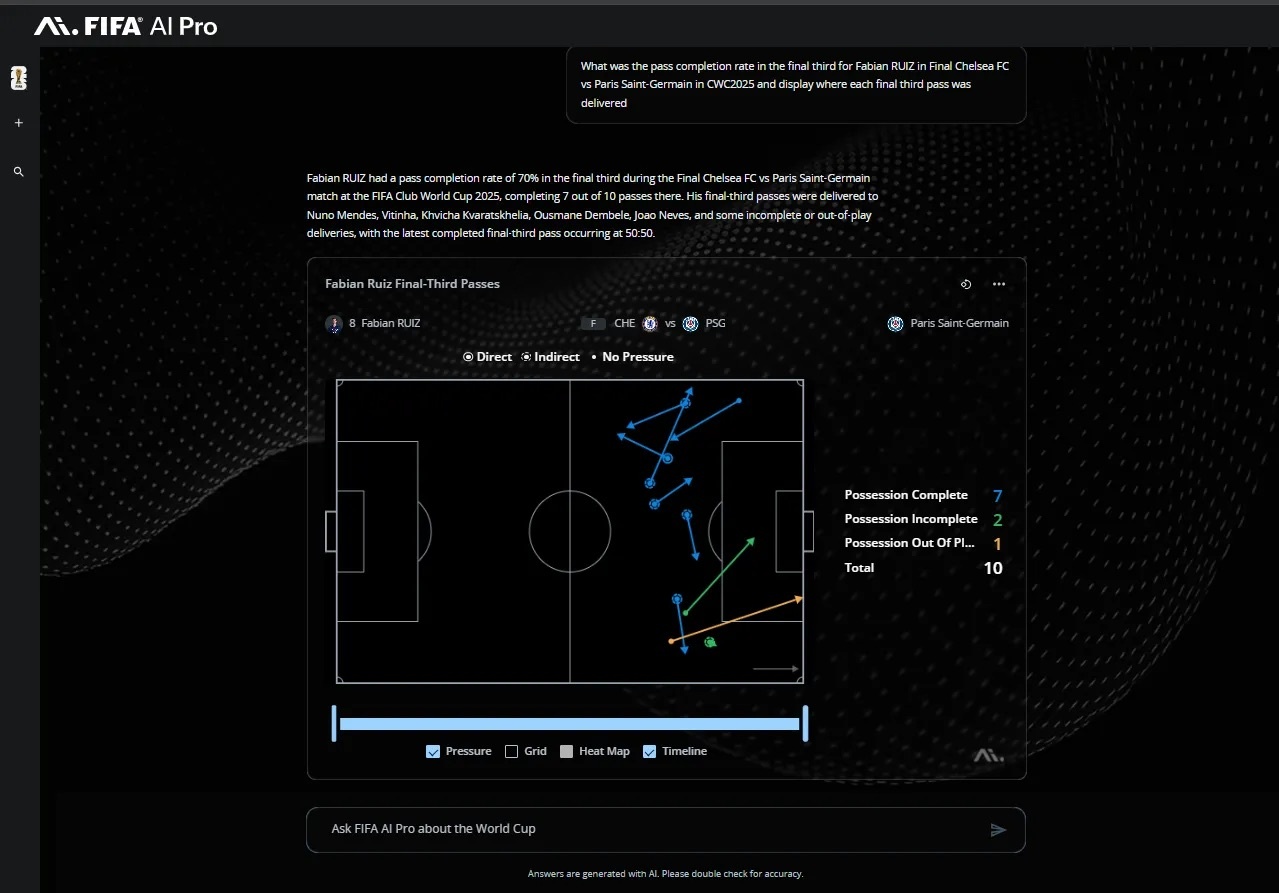 |
Football AI Pro provides specialized AI tools for teams participating in the World Cup. Photo: FIFA. |
When he was managing Leeds United in the Premier League, Uruguay's coach Marcelo Bielsa and his team used to spend around 300 hours analyzing a team about to play. But with AI, this job has become much easier.
“We can do this automatically,” Lucey said. He illustrated with a video showing green and red data points simulating the movement of a player surrounding a yellow ball on the field. Analysts can ask questions, each revealing a new layer of information.
However, the AI tools and personnel needed to build and operate them are very expensive. Not every country has the necessary resources.
Another challenge is that larger amounts of data can make the analyst's job more difficult. Their role is to distill a vast amount of information into a few useful pieces of data for coaches or players.
Technology promises to help teams with limited resources close the gap with football nations that possess large-scale scouting and data analysis systems.
But that also raises a new question: will the competitive advantage ultimately shift to those teams with the resources to build large teams of computer scientists and data analysts?
FIFA's solution
FIFA was so concerned that it partnered with Lenovo to build a dedicated AI system called Football AI Pro, to be provided to all national teams participating in the 2026 World Cup.
 |
Lenovo CEO and FIFA President at the announcement of AI solutions for the 2026 World Cup. Photo: FIFA. |
The system's interface is similar to ChatGPT, where coaches can enter questions and unlock information about their next opponent. Matches are recreated in 3D, allowing for analysis from previously impossible angles.
Everything is quantifiable, from the position of the pass, the distance covered by the players, the way attacks and defenses are deployed, to each shot and goal.
Johannes Holzmüller, FIFA's director of innovation, stated: "We see our mission as providing technology to all teams, so that everyone can access and use it easily without needing additional specialists on the team, because not everyone can afford it."



However, whether this will bridge the gap between a team with a rudimentary data system and powerful forces like the English national team remains to be seen.
"That's the minimum we can do. We see this gap, where some teams use technology and data more than others," he added.
Should FIFA intervene and restrict countries to using only AI tools approved by FIFA? “That’s a big question,” commented Holzmüller.
He said he couldn't answer that question at the moment, but affirmed that AI will play a more significant role in the future of world football.
Source: https://znews.vn/ai-co-the-lam-thay-doi-cuc-dien-world-cup-post1663813.html
![[Image] A look back at the capital's preparations for the century-long master plan.](https://vphoto.vietnam.vn/thumb/1200x675/vietnam/resource/IMAGE/2026/06/29/1782750453122_quy-hoach-100-nam-minh-duy-1-2118-jpg.webp)

![[Photo] National Assembly Chairman Tran Thanh Man attends the Conference to announce the Master Plan for Hanoi Capital City with a 100-year vision.](https://vphoto.vietnam.vn/thumb/1200x675/vietnam/resource/IMAGE/2026/06/29/1782709639728_ndo_br_1-jpg.webp)


![[Photo] General Secretary and President To Lam works with the Party Committee of the Government on the work of preventing and combating storms, floods, extreme natural disasters and climate change.](https://vphoto.vietnam.vn/thumb/1200x675/vietnam/resource/IMAGE/2026/06/29/1782729441945_a1-bnd-0385-9454-jpg.webp)




















































![[Image] Building an elevated road through the Ma Da forest.](https://vphoto.vietnam.vn/thumb/402x226/vietnam/resource/IMAGE/2026/06/29/1782724737750_anh-man-hinh-2026-06-29-luc-16-18-43.png)