---
Widespread impact
With its rapid development and spread exceeding previous predictions, AI is becoming one of the key factors driving profound changes to the global labor market, and Vietnam is no exception. The increasing sophistication of AI, especially when combined with automated systems and robots, puts personnel in many fields and professions at risk of being replaced.
The labor market structure is changing incredibly rapidly. A Microsoft Vietnam report from mid-2025 showed that Vietnam has approximately one million IT engineers, and half of them may have to change jobs due to AI; 91% of business leaders are considering recruiting personnel for specialized AI positions. Regarding the labor market in the AI era, Mr. Nguyen Van Khoa, Chairman of the Vietnam Software and Information Technology Services Association (VINASA), pointed out the reality that many businesses have reduced their workforce by up to 70% after adopting AI.
 |
| Workers need to equip themselves with the ability to learn and improve their skills. (Photo: Xuan Khanh) |
Furthermore, the development of a branch of AI, GenAI (generative artificial intelligence), will pose an even greater threat to workers. Specifically, the report on "Generative Artificial Intelligence and Employment," recently published by the International Labour Organization (ILO) office in Vietnam, stated that the rapid development of GenAI is causing profound changes to the Vietnamese labor market. According to the report, approximately 20.8% of jobs, equivalent to 11.5 million workers, are likely to be affected; GenAI will not replace all professions, but will significantly impact the task structure within each job. This means that many positions will need to be "redesigned" rapidly.
It is clear that the more technology develops, the fewer jobs are available for traditional workers. This inadvertently creates a class of "hidden unemployed," people who still work but do not earn enough and no longer have opportunities for advancement. Therefore, the warning from Dr. Pham Xuan Khanh, Principal of Hanoi High-Tech College, is well-founded. "Vietnam lacks a workforce with high professional qualifications in new fields, and the ability to switch careers is still limited. Workers can no longer remain complacent," Dr. Pham Xuan Khanh emphasized.
In reality, AI not only creates pressure on workers and technicians, but more fundamentally, it also poses a challenge as our country's labor market fails to meet the ever-increasing demand for high-quality digital human resources.
---
Change, or be left behind?



As AI penetrates deeper into the labor market, many people are asking themselves: When will it be my turn to be replaced, and how can I protect myself? Trinh Ba Hung, a former student of Hanoi Polytechnic College, who won second prize in the Hanoi City Vocational Skills Competition and graduated with honors, and is currently working for a mechanical engineering company, also expressed concern about the future. AI is currently replacing many tasks in which he was highly skilled, such as turning and milling. “There’s only one way: workers must be proactive and excel at tasks that machines cannot replace,” Hung confided.
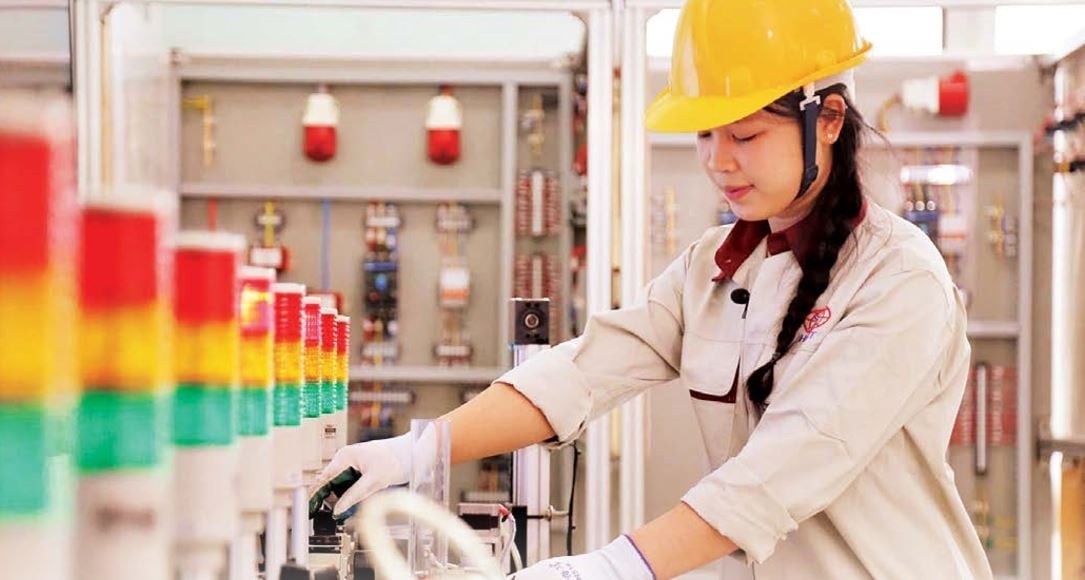 |
| Workers need to equip themselves with the ability to learn and improve their skills. (Photo: Xuan Khanh) |
Sharing the same sentiment, Mr. Nguyen Van Tinh, an information officer at Hai Van Bac station (Hai Van Railway Signal and Information Company), said: “Given the practical demands of the job, the agency is creating opportunities for me to pursue further studies in automation. Without further education, it would be very difficult for people like us to meet the increasingly high demands of railway operation.”
Self-learning, retraining, and skill upgrading are common practices in most developed countries, and they have been doing this for a long time. In reality, while a large number of IT graduates each year fail to meet the practical demands of businesses, especially in emerging fields like AI, big data, and cybersecurity, we cannot completely eliminate the gap between training and market needs. To achieve progress, we must find ways to narrow that gap.
MANY WAYS TO DEVELOP HUMAN RESOURCES
We need to strengthen state management in promoting human resource development, promote synchronized linkages and cooperation in career guidance, recruitment, and training, connecting practical application with labor market needs; create conditions and encourage businesses to invest in technology; invest in vocational training; link school training activities with business production activities, and establish innovation centers in schools and practical training facilities within businesses.
---
Mr. Tran Anh Tuan, Vice President of the Ho Chi Minh City Vocational Education Association
Regarding this issue, Dr. Vu Xuan Hung, a labor and employment expert, suggested: “Vietnam must strengthen governance and implement a competency framework for AI for workers; promote responsible AI application; consolidate the labor market information system; invest in skills training, especially digital and soft skills. At the same time, policies need to focus on gender equality, ensuring that women are not left behind in the technological transformation process…”.



Mr. Tran Anh Tuan, Vice Chairman of the Ho Chi Minh City Vocational Education Association, suggested: “We need to strengthen state management in promoting human resource development, promote synchronized linkages and cooperation in career guidance, enrollment, and training activities, connecting practical application with labor market needs; create conditions and encourage businesses to invest in technology; invest in vocational training; link school training activities with business production activities, and establish innovation centers in schools and practical training facilities within businesses.”
Supporting businesses, especially small and medium-sized enterprises (SMEs), in accessing and applying AI is also considered key to leveraging opportunities to improve productivity and create sustainable jobs. In the long term, AI will continue to be one of the important drivers shaping the labor market. Therefore, Vietnam needs a strategy to support displaced workers, such as retraining, contributing to protecting the role of human beings as key players. At the same time, it is necessary to maintain seriousness in education and skill development, improving the quality of human resources. This is also a necessary foundation for AI to become a driving force for labor productivity, strengthening investor confidence and enhancing the country's competitiveness.
According to Nhan Dan newspaper
Source: https://baotuyenquang.com.vn/khoa-hoc-cong-nghe/202606/ai-dinh-hinh-the-he-lao-dong-moi-74169ff/


![[Image] Overview of the construction site for the underground station of metro line 5 at the Hanoi Ring Road 1 intersection.](https://vphoto.vietnam.vn/thumb/1200x675/vietnam/resource/IMAGE/2026/07/03/1783065595682_ndo_br_z7974930852369-100ca093c306e72675f1d3700966a86b-jpg.webp)