

The Authors' Association of the Ho Chi Minh City Theatre Association recently discussed the issue of "AI's involvement in the creative process." Currently, AI is not limited to the digital environment; AI-powered products have begun appearing in literary and artistic creation competitions.
The "mismatch"
AI can write a complete script in minutes, but can it create a "life on stage"? Answering this question, Associate Professor Phan Bich Lien (Van Lang University) emphasized: AI can provide structure, even build fairly reasonable character arcs, but the stage doesn't operate on pure logic. It needs living conflict, it needs experiences from real life. That's something technology hasn't yet reached.
From another perspective, People's Artist Tran Minh Ngoc argues that while the stage has undergone many technological changes, from lighting and sound to staging techniques, its core remains human. If the script loses the breath of life, the stage becomes merely a simulation. "AI cannot express the emotional words written from the heart's vibrations. With genres like Tuong, Cheo, Cai Luong, and opera, AI cannot compose according to the exact structure of each line and dialogue," People's Artist Tran Minh Ngoc commented.
In reality, many current literary and artistic competitions have rejected entries that involve AI. Some more open platforms allow its use but require clear disclosure of the extent of AI involvement. Author Tran Van Hung, head of the Authors' Association, stated that works that rely too heavily on AI often reveal weaknesses: a lack of depth, repetitive structures, and a language lacking individuality. This is especially noticeable in Vietnamese – a language rich in tones and nuances.
Author Vuong Huyen Co shared: "A good script always has its own identity. Readers can recognize the author through the way situations are constructed, through the rhythm of dialogue, and through the way conflicts are handled. AI can currently imitate, but it cannot yet create a personal imprint." Author Le Thu Hanh pondered: "If AI is overused, writers will gradually lose their own voice. At that point, creativity becomes a process of borrowing."
Composer Le Van Loc, a member of the Arts Council of the Ho Chi Minh City Department of Culture and Sports, added: In some recent music competitions, works with AI support were accepted but failed to leave a lasting impression. In some cases, they were even judged as "off-topic" and lacking emotion.
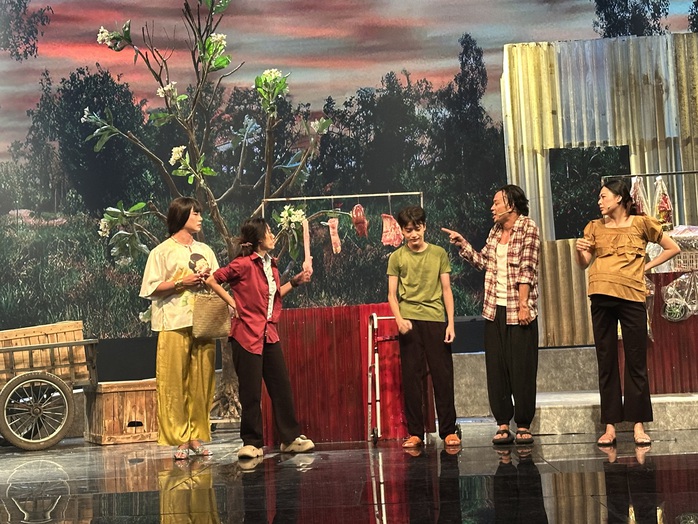
A scene from the play "Who's the Husband, Who's the Wife?" by New Stage - which addresses the issue of using AI in theatrical life.
Things that cannot be programmed
In the field of music, many experts point out that AI often struggles with the Vietnamese language, easily falling into the trap of "forcing words into music," resulting in unnatural lyrics. This limitation becomes even more apparent when adapted to stage performances, where dialogue is highly colloquial.
Director Ton That Can analyzed that Vietnamese theater has very unique characteristics. From Cai Luong (traditional Vietnamese opera) to spoken drama, each genre has its own rhythm, tempo, and way of expression. AI can create a script framework, but to create a performance with rhythm and tempo, real-life experience is needed. This explains why, despite being allowed to experiment, works using AI have not yet won over the judging panel or the public. It's not because the technology is weak, but because of the lack of a human element in the creative process.
The stage is a unique art form. Every element—from the script and acting to the lighting and music—converges in a single, vibrant moment, unfolding before the audience. A line of dialogue might be written by AI, but for it to resonate with the viewers, it requires actors, emotion, and the interplay of the stage space. Many artists believe that AI can hardly replace humans in this field. It can assist, suggest, and even open up new avenues. But to create a work with lasting vitality, experience, memory, and emotion—things that cannot be programmed—are still needed.
The emergence of AI is not just a technological phenomenon. It is forcing the creative world to re-examine itself: What are the core values of a work of art? What is the role of the artist in the digital age? And more importantly: how can one maintain creative identity?
AI can generate a "structured" script, a "formulaic" piece of music, but according to insiders, art is never just about following a formula; it needs surprises, moments that even the creator cannot foresee.
AI has stepped onto the stage, in whatever role it may play. And that presence will undoubtedly continue, perhaps even becoming more widespread. However, ultimately, the stage remains a place where humans tell their stories through their own emotions.
AI is setting the stage for a unique "audition." In this arena, technology can assist, and even challenge. But the main role – until now – still belongs to humans.
(To be continued)
Source: https://nld.com.vn/ai-khong-con-la-khach-la-19626042020112201.htm

![[Photo] General Secretary and President To Lam meets with National Assembly delegates from ethnic minorities.](https://vphoto.vietnam.vn/thumb/1200x675/vietnam/resource/IMAGE/2026/04/20/1776696701056_a1-bnd-8331-3342-jpg.webp)
![[Image] National Assembly discusses the implementation of the socio-economic development plan.](https://vphoto.vietnam.vn/thumb/1200x675/vietnam/resource/IMAGE/2026/04/20/1776696707422_ndo_br_img-20260420-185419-jpg.webp)




































































Comment (0)