

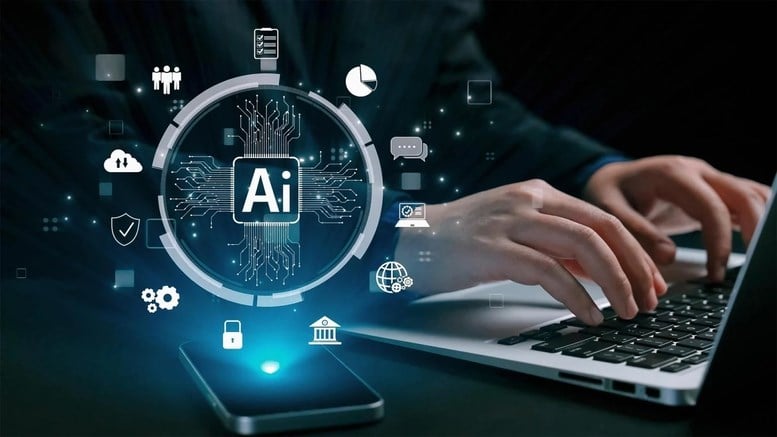
Looking at the numbers, the trend is quite clear. Around 30% of employees report using AI regularly, while another 20% use it only occasionally. However, it's noteworthy that nearly 50% of the workforce barely uses AI, even though many of them work in organizations that have already implemented the technology. In other words, having AI and using AI are two different things.
On the positive side, AI is proving its clear value in terms of productivity. Among those working at companies that have adopted AI, about two-thirds believe the technology has had a positive impact on work efficiency.
This rate is even higher among managers, with approximately 70% of leaders using AI believing it helps them work more efficiently, compared to just over 50% at the employee level. This is not surprising, as AI is particularly well-suited to tasks involving synthesis, decision-making, or processing large volumes of information.
However, the picture isn't all rosy. Even while acknowledging the benefits, many workers remain distant from AI. According to the survey, 46% of those who don't use AI said they simply prefer their current work methods. Another 40% cited deeper reasons such as concerns about data privacy, ethical issues, or a lack of belief that AI would actually be useful for their jobs. Even 25% who tried AI concluded that it didn't deliver the value they expected.
These figures show that the biggest barrier to AI is not technology, but trust. Along with the spread of AI, fear of job loss is also increasing, with 18% of American workers believing they could be replaced in the next five years (up from 15%), and as high as 23% in companies that have already implemented AI.
Clearly, workers aren't completely opposed to AI. Instead, they're approaching it selectively, using AI for repetitive tasks to save time, but still leaving core tasks for humans. This isn't a rejection of the technology, but rather a form of "conditioned adaptation."
For businesses, the challenge is not just about deploying tools. With nearly half of employees still not using them, the benefits of AI are clearly not being fully exploited. Without addressing concerns about reliability, data transparency, and the role of AI, the gap between potential and reality will widen.
It can be said that AI is advancing very rapidly, but humans remain cautious. And it is this caution that will determine whether AI becomes a powerful assistant or merely a powerful tool that is not yet trusted.
Source: https://baovanhoa.vn/nhip-song-so/thich-nghi-co-dieu-kien-220813.html

![[Photo] General Secretary and President To Lam meets with National Assembly delegates from ethnic minorities.](https://vphoto.vietnam.vn/thumb/1200x675/vietnam/resource/IMAGE/2026/04/20/1776696701056_a1-bnd-8331-3342-jpg.webp)
![[Image] National Assembly discusses the implementation of the socio-economic development plan.](https://vphoto.vietnam.vn/thumb/1200x675/vietnam/resource/IMAGE/2026/04/20/1776696707422_ndo_br_img-20260420-185419-jpg.webp)
































































































Comment (0)