

 |
Chinese robot breaks half-marathon record. Photo: Sina . |
On April 19th, the second robotic halfmarathon in Beijing's Yizhuang Economic Zone concluded with surprising results. The "Thunderbolt" robot, developed by Honor and competing under the Monkey King team, finished with a time of 50 minutes and 26 seconds in fully autonomous mode. This was faster than the world record set by Jacob Kiplimo in March of 57 minutes and 20 seconds.
To achieve this progress, China's robotics sector experienced rapid development in 2025. Last year, only 20 teams participated in the world's first humanoid robot half-marathon. The products from a year ago were still running erratically; some fell at the start, others ran in circles without direction. In the end, only 6 robots finished.
Outstanding development
This year, the competition used a more complex scoring system. Honor's remote-controlled robot was the first to finish with a real-time of 48 minutes and 19 seconds. However, according to the rules, the remote-controlled team was given a multiplier of 1.2 to ensure fairness, pushing their time to 57 minutes and 49 seconds. The autonomous robot of the Monkey King team finished later but was also given a multiplier of 1, with a time of 50 minutes and 26 seconds. Honor also came in second with times of approximately 51 minutes and 53 minutes using the autonomous mode.
Du Xiaodi, Honor's experimental development engineer, said the robot was designed to resemble a top track and field athlete, with a leg length of approximately 95 cm and a liquid cooling system developed in-house by the team.
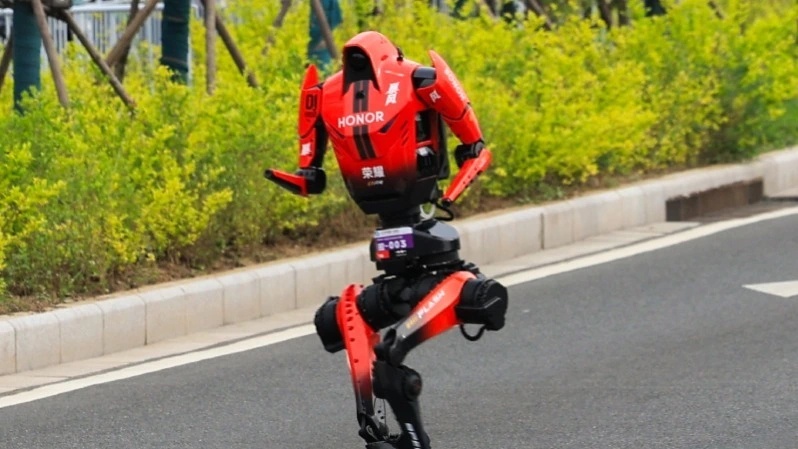 |
Honor's robot is designed to resemble the body of a professional athlete. Photo: Sina . |
"Speeding may not seem to have immediate practical implications, but it allows for the transfer of technology to other areas, such as increasing structural durability and cooling systems. Ultimately, it has applications in industry," said Xiaodi.
This year's competition has increased in scale by nearly five times. More than 300 robots from over 100 teams, representing 13 provinces and cities, have registered to participate. Among them are a team from Hong Kong and five international teams. Approximately 40% of the teams operate using a fully autonomous mode.
A highlight this year is that Alibaba is bringing its four-legged robot, Gaode Map, to the race for the first time, marking the company's first robotics product. The top 10 starting positions in the qualifying round were all taken by robots from Honor and Unittree.
The largest scale ever.
The organizers have submitted an application for a Guinness World Record in the category of "the half-marathon race with the most autonomous humanoid robots participating".
In addition, the live audience was also impressed with the tournament. "I feel the huge change this year. This is the first time a robot has surpassed a human, and that's something I never imagined," Sun Zhigang told Reuters . Another audience member suggested that the robot's speed "could herald the beginning of a new era."
However, experts are also cautious about the practical implications. Running fast on a flat surface is different from working in a factory. It requires manual dexterity, awareness of the real-world environment, and the ability to handle non-repetitive situations. Chinese robotics companies are still struggling to develop AI software so that robots can effectively match human workers in real-world production environments.
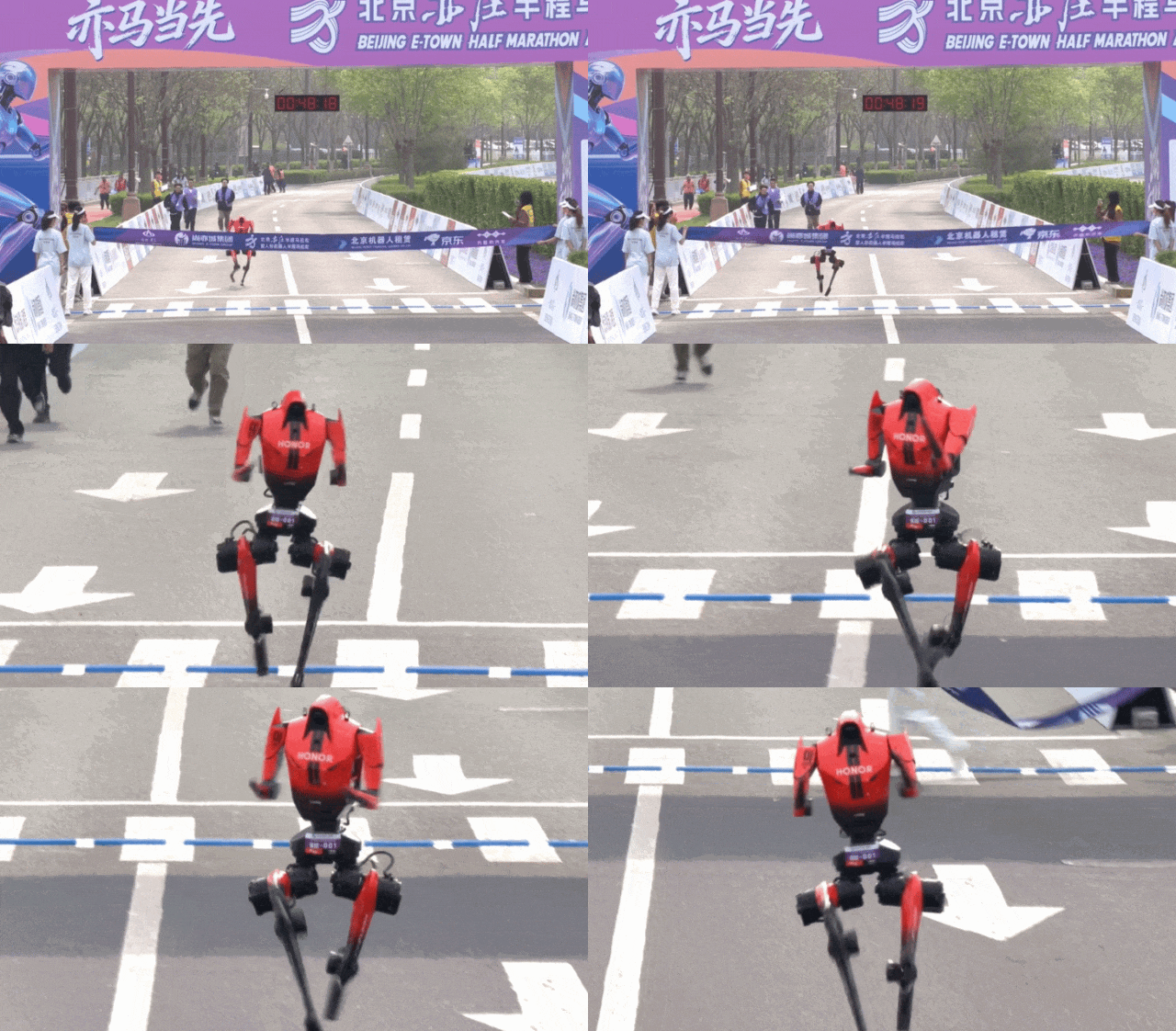 |
The humanoid robot maintains good balance while running at high speed. Photo: Sina . |
Songyan Power recently launched a general-purpose robot priced under 10,000 yuan ( $1,466 ) with thousands of pre-orders. Beijing has also established a 100 billion yuan ( $14.67 billion ) government investment fund focused on future industries with a centerpiece of robotics and AI.
Nevertheless, China's robotics industry is still in its early stages. From technical demonstrations on the racetrack to practical applications in factories, robots still have a significant gap when it comes to everyday life. Beijing is expected to play multiple roles simultaneously, serving as a center for technological innovation, a startup incubator, and a field testing ground for the entire industry.
Source: https://znews.vn/phep-mau-cua-linh-vuc-robot-trung-quoc-post1644849.html


![[Photo] General Secretary and President To Lam meets with National Assembly delegates from ethnic minorities.](https://vphoto.vietnam.vn/thumb/1200x675/vietnam/resource/IMAGE/2026/04/20/1776696701056_a1-bnd-8331-3342-jpg.webp)
![[Image] National Assembly discusses the implementation of the socio-economic development plan.](https://vphoto.vietnam.vn/thumb/1200x675/vietnam/resource/IMAGE/2026/04/20/1776696707422_ndo_br_img-20260420-185419-jpg.webp)



















































































Comment (0)