

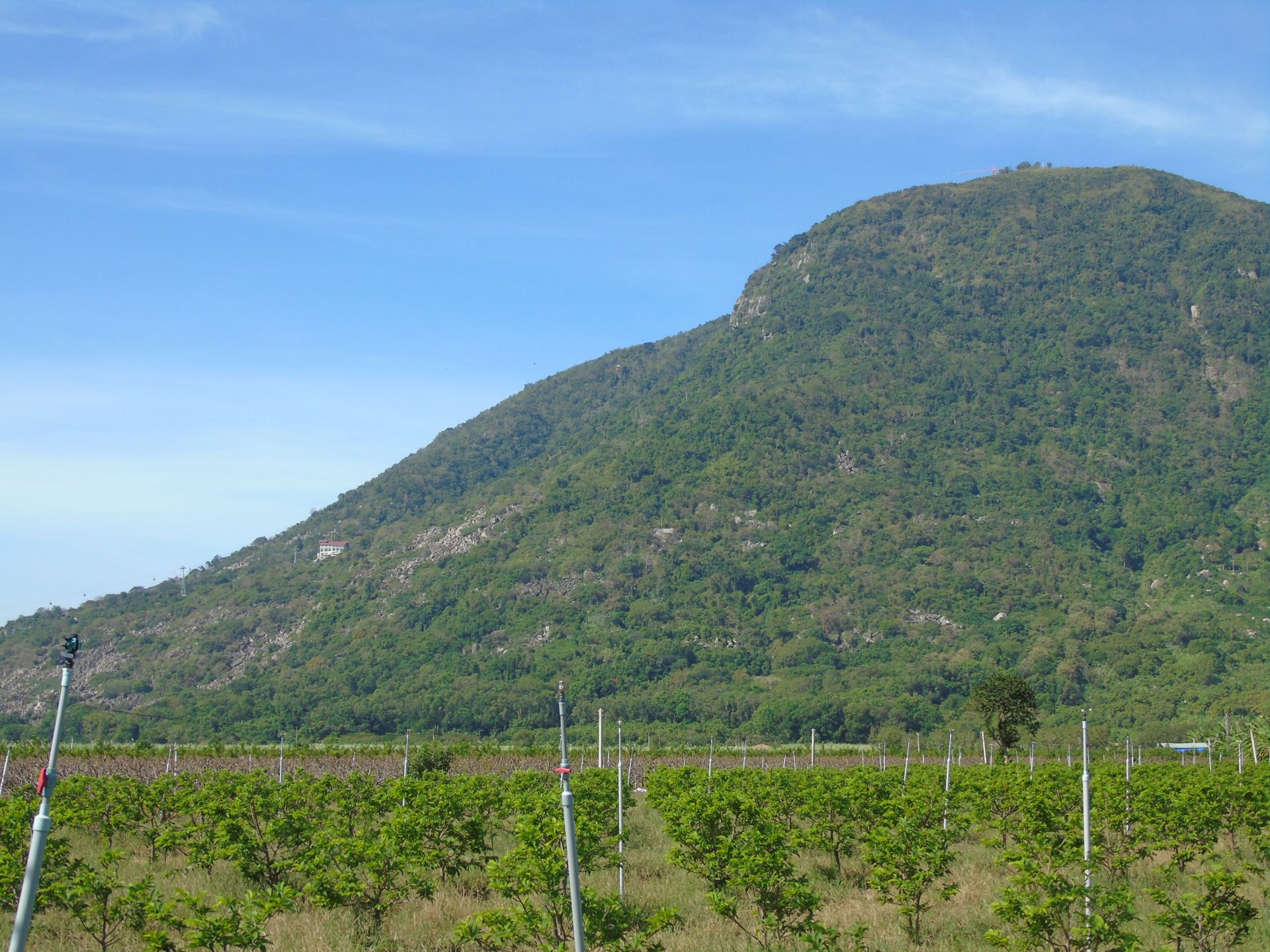
Ba Mountain (also known as Elephant Mountain).
The recent legends are already known to us, as they have been recorded in ancient historical books about Mount Ba Den. For example, in Huynh Minh's fieldwork book on ancient Tay Ninh, or in the book "Historical and Cultural Relics, Scenic Spots of Tay Ninh Province" by the Department of Culture, Sports and Tourism.
These are stories about Lady Đênh or the story of Lý Thị Thiên Hương, who was deified by the Nguyễn dynasty as Linh Sơn Thánh Mẫu (Holy Mother of Linh Sơn). Some documents suggest that she (Linh Sơn Thánh Mẫu) was officially recognized during the reign of Emperor Gia Long. She was then re-recognized during the 10th year of Emperor Bảo Đại's reign (1935). The original decree (if it existed) no longer exists.
However, according to the 1935 royal decree, she was bestowed the title of "Dực Bảo Trung Hưng Long Phù Chi Thần" (Guardian of the Restoration and Prosperity of the Mountain). Even this decree is no longer extant, having been lost or destroyed in the French attacks on the mountain in 1946.
The legends just mentioned are simply stories about characters associated with mythical tales that have been passed down through generations. The historical context of these stories is quite recent, dating back about 200-300 years. For example, the legend of Lady Ly Thi Thien Huong dates back to the war between the Tay Son army and Lord Nguyen Anh in the late 19th century. This is because the story features the character Le Si Triet, a general in Vo Thanh's army under Nguyen Anh… In short, these legends existed after the mountains came into existence.
There is another legend about Mount Ba, less well-known, that explains its appearance since the dawn of time. Naturally, these legends have even older origins. These stories are often associated with the names of Mount Ba that have appeared throughout history.
These include place names such as Elephant Mountain, Dien Ba Mountain, Dat Mountain, Heo Mountain, Ga Mountain, or Phung Mountain. Related to Ba Mountain are other places like Ba Ra Mountain in Binh Phuoc , or Tha La Mountain and Cau Mountain in Binh Duong.
Thirty-two years ago, in 1991, after the Dau Tieng Reservoir irrigation project was completed and put into operation, providing water for irrigation and daily life to Tay Ninh and neighboring provinces and cities, the Dau Tieng Irrigation Management and Exploitation Joint Enterprise collaborated with the Labor Publishing House to publish a small book: "Dau Tieng Reservoir". The two authors, Nguyen Minh Sang and Phan Khanh, also collected folk legends related to Ba Mountain.
According to the story: "In ancient times, the mountain god of Tha La (now Mount Cau) and the mountain god of Ba Den had a contest of skill, so much so that the earth cracked open, forming the Saigon River. They made a pact that in just one night, on opposite sides, whoever created the highest mountain would become the 'supreme ruler'."
The god of Tha La mountain, fearing that Ba mountain was taller, secretly sent the Rooster god at night to dig up the mountain so that it would collapse by dawn, thus securing his victory. The goddess Ba Den, being a celestial maiden and saintly mother, was no less cunning. She sent the Pig god to find a way to destroy her rival's mountain.
Even with its miraculously transforming legs, a chicken could only dig a small corner of the base of Mount Ba. The mound of earth that formed it was just a tiny hill next to the massive granite mass. That hill, which tourists can still see today, is called Mount Phung.
It's comparable to a chicken pecking at grains by the straw mound on Mount Ba. As for the pig god, after a night of action, Mount Cau collapsed like a giant, endless row of potatoes. The defeated god Tha La gnashed his teeth, stomped his feet in anger, and sank into the sandstone rocks. To this day, some people can still count more than five of those mythical giant footprints…”
I wonder if the aforementioned mountain god Tha La is related to the giant who once left his footprints on Mount Ba Den? That giant once stood with one foot on Mount Ba and the other on Mount Cau, throwing a stone at a crow. The stone, weighing about 1 ton, got stuck on an oil tree in Trai Bi (now in Tan Bien). Huynh Minh also recounts in his book "Old Tay Ninh" that in 1972, when he visited Tay Ninh, he still saw that same stone on the fork of an oil tree, so large that it would take "three people to encircle it."
Let's not discuss the truth of the story. But one fact remains: a miracle occurred in Tay Ninh in the 1980s. This miracle was not created by gods, but by the people of Tay Ninh themselves.
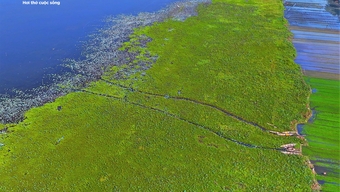
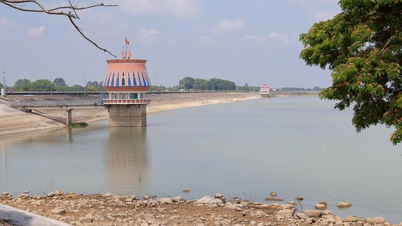
That is the Dau Tieng reservoir - the largest irrigation reservoir in Southern Vietnam with a capacity of over 1.5 billion cubic meters of water, stretching across an area of 270 square kilometers in the land that was once the glorious Duong Minh Chau war zone during the two wars of resistance against France and the United States.
The legends about Mount Ba and Mount Cau mentioned above reveal the origins of the names of Mount Ba Den. These are Mount Phung, 419m high, in the north, and Mount Heo, 341m high, in the west. Phung, the name of a mythical bird from the celestial realm, may have initially been called Mount Ga (Chicken Mountain). Later, due to the sacredness of the mountain and the legends about the Holy Mother Linh Son, the name was changed to Mount Phung (Phoenix Mountain) by believers.
In January 2022, the Ho Chi Minh City General Publishing House published the book "Southern Vietnam and the Inhabitants of the Eastern Provinces" (translated by Huynh Ngoc Linh). The author of the book is J.C. Baurac, a first-class colonial physician. He spent many years conducting epidemiological surveys throughout the provinces of Southern Vietnam in the late 19th century.
The book was first published in 1899. Chapter VII is about Tay Ninh province, which includes a legend about Mount Ba, "recounted in the village by the wisest and most solemn people of the district."
According to the story, it happened when the Cambodian people still had a matriarchal system, where women were forced to ask men for their hand in marriage. A young woman named Mé-Đen decided to rise up and put an end to that custom.
She challenged the most handsome young man to a duel, building a mountain out of sand. After one night, whoever finished first would have to propose marriage. The new custom, as a result of this duel, would be recognized by the community.
The young man, confident in himself, looked down on the small and frail girl. So, he began by drinking and "spending almost the entire night singing seductive songs." Meanwhile, Mé-Đen toiled throughout the night, until, at dawn, the lanterns were burning brightly on the mountaintop.
That lamp also served as a message to the community that Mendel was the victor. At that moment, the young man: “vented his rage into the baskets he had brought for the project and violently tossed them in all directions.”
Those mounds of earth have become small mountains; today they can still be seen stretching far into the distance toward Cai Cung wharf… And the mountain built by Me-Den has become the magnificent peak that we have mentioned, and the Annamese people still retain its name: Mount Ba Den.”
The legend recorded by J.C. Baurac in the late 19th century offered a more complete explanation than the old names of Mount Ba. It was attributed to a young man who used every means possible to thwart his rival. First, he sent a large, white elephant to destroy it.
But with divine help, Lady Black transformed the elephant into a gray rocky mountain, which later generations called Elephant Mountain or Elephant Mountain. The young man then borrowed from the forest spirit "two thousand pigs... the pigs also immediately turned to stone" and transformed them into Pig Mountain.
The final attempt involved using thousands of chickens to peck and flatten the mountain. The chickens shared the same fate as the elephants and pigs, transforming into the mounds that make up Chicken Mountain, or Phoenix Mountain, as we know it today.
Tran Vu
Source link
































































Comment (0)