Cam Ly - "the great guardian" of rice grains and potatoes.
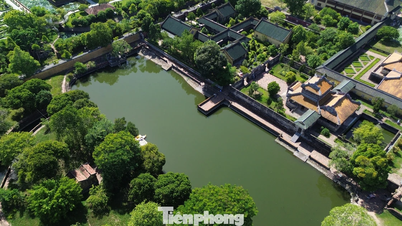
The book "History of the Quang Binh Provincial Party Committee (Volume II, 1954-1975), pages 197 and 198, clearly states: Cam Ly Reservoir was the first large-scale irrigation project of the former Quang Binh province, inaugurated and put into operation on September 10, 1964. The reservoir has an area of 29 km² , a capacity of 41 million m³ of water, irrigating 4,500 hectares of rice fields in most communes of Quang Ninh district, Le Ninh State Farm, and some communes of Le Thuy district.
 |
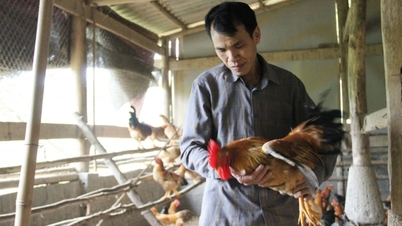
| From the water source of Cam Ly, the people have expanded and developed aquaculture combined with livestock farming to become wealthy - Photo: VM |
During the war against the US, the Cam Ly reservoir endured more than 6,000 cluster bombs, 800 rocket volleys, and 415 cluster bomb volleys. Companies 1, 2, and 3 of the 9th Anti-Aircraft Artillery Battalion took turns guarding this important irrigation project… On April 20, 1965, the enemy concentrated 18 aircraft, divided into many groups and directions, to attack the Cam Ly dam for eight consecutive hours.
The slogan "The battlefield is our home, the Cam Ly River is our mother's milk" further motivated the artillerymen to hold their positions and fight to achieve victories. The army and civilians coordinated their efforts with the soldiers of Battalion 9. The Le Ninh Farm Self-Defense Force stayed close to the battlefield, supplying ammunition and bandaging the wounded. Sixteen female self-defense members of the farm took turns as artillerymen for 15 consecutive days. Within the formation of Battalion 9, Company 3 added another glorious achievement to the list of American aircraft: two AD4 and AD6 planes were shot down by the unit 500 meters from the battlefield.
 |
| From the water source of Cam Ly, the people have expanded and developed aquaculture combined with livestock farming to become wealthy - Photo: VM |
At 8 PM that same day, the self-defense team of the Cam Ly construction site, commanded by Tran Quoc Than, with 27 machine gun rounds, shot down an AD6 aircraft on the spot. This was the first US Air Force plane shot down at night by the Quang Binh militia using infantry weapons in the skies of North Vietnam…
The Cam Ly reservoir is also known as the "Youth Project". To complete the project, the youth volunteer movement from localities including Le Thuy, Quang Ninh, Bo Trach, Quang Trach, Tuyen Hoa, and Dong Hoi (formerly Quang Binh province) contributed a total of 1,477,820 man-days to build the project on schedule and ensure quality.
 |
| Thanks to the water source from Cam Ly, local people have boldly invested in high-tech eel farming, earning hundreds of millions of dong in net profit per year - Photo: VM |
Today, standing on the Cam Ly dam and looking downstream, one can easily observe the cool, sweet waters of the reservoir, supplying the two districts of Le Thuy and Quang Ninh (formerly), still flowing steadily. For more than six decades, the water from the Cam Ly reservoir has diligently fulfilled its mission as a "great guardian," preventing floods and droughts for a vast delta region around the Hac Hai lagoon, nurturing countless rice grains and potatoes to feed many generations of people. The effectiveness of this project is truly something to be proud of and to acknowledge...
Bringing water back to "restore" the green color to the land.
Settling right at the foot of a large irrigation project, many years ago, the people of Cam Ly village relied almost exclusively on this water source for irrigating rice and potatoes in their fields and gardens. As a result, hunger and poverty plagued many families in the area for a long time.
 |
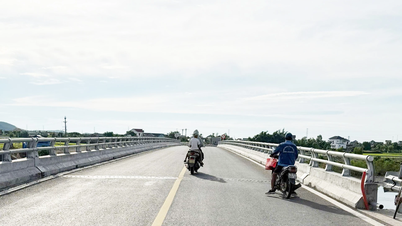
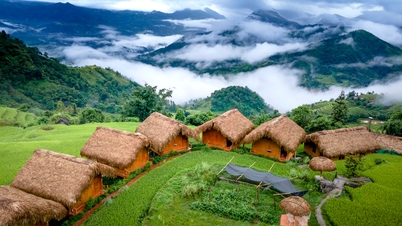
| A view of the Cam Ly large-scale irrigation project - Photo: VM |
Elder Ho Thach of Cam Ly village recalled: “The majority of our villagers rely on agriculture for their main income. Previously, the use of Cam Ly water for aquaculture was mostly on a small scale. On average, each household owned only about 100-300 square meters of ponds, used to raise a few common fish species to improve daily meals, with very little for commercial purposes. Since 2015, thanks to the active support of the government at all levels and specialized officials, most people here have begun to expand the digging of ponds for fish farming combined with integrated livestock farming in their gardens and hillsides. As a result, the village economy has flourished and made significant breakthroughs. Now, reflecting on the old saying, “first water, second fertilizer, third diligence, fourth seeds,” it is absolutely true, especially for Cam Ly…”
 |
| From the water source of Cam Ly, the people have expanded and developed aquaculture combined with livestock farming to become wealthy - Photo: VM |
Mr. Nguyen Dang Thanh, Head of Cam Ly village, shared: “Before 2015, Cam Ly village only had 3 hectares of ponds and lakes, but now it has increased to nearly 10 hectares. Aquaculture activities in Cam Ly have been systematically and scientifically arranged by the villagers to maximize efficiency per unit area.”
Specifically, to integrate the "home garden, hillside garden, and rice field" models, most people build a row of pig pens right above the pond to raise pigs, with a scale of 40-70 pigs per batch (3 batches per year). In addition, people also utilize the space in their home gardens and hillside gardens to raise chickens, ducks, geese, buffaloes, cows, and goats.
In ponds and lakes, people usually raise grass carp and tilapia in the upper layers; catfish and silver carp in the middle layers; and tilapia and whitefish in the bottom layers. Thus, every layer of the water surface is utilized to the maximum. Food sources from rice, potatoes, and corn grown in the fields and in home gardens are fully utilized for livestock farming. Conversely, fertilizer from livestock is also used to fertilize crops, which is very effective.
 |
| A view of the Cam Ly large-scale irrigation project - Photo: VM |
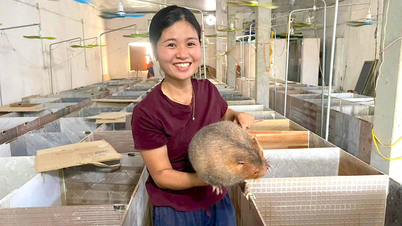
To "use short-term gains to support long-term growth," capital from food crop cultivation and livestock farming is also invested in economic forestry. Currently, Cam Ly village has developed 120 hectares of economic forest, contributing to greening barren hills, increasing income, and improving the environment. Notably, in recent years, some households, such as Nguyen Van Tinh and Nguyen Van Ty, have boldly utilized the Cam Ly water source to build high-tech eel farms, earning net profits ranging from 500 million to over 1 billion VND annually.



“Currently, Cam Ly village has 167 households with 679 inhabitants (including 25 households, with nearly 60 people, who are Bru-Van Kieu ethnic minorities). From a poor area, Cam Ly has now risen to become one of the wealthiest villages in Kim Ngan commune, with an average income of 250-350 million VND/household/year. Currently, the entire village only has 11 poor households and 3 near-poor households, mostly due to old age, illness, and loss of working capacity,” said Cam Ly village head Nguyen Dang Thanh with enthusiasm.
Thanks to the "milk stream" of Cam Ly, and through skillful and creative methods of channeling water to "re-paint" the land green, the economic landscape of Cam Ly village has undergone a significant transformation.
Civilized
Source: https://baoquangtri.vn/kinh-te/202606/am-no-tu-dong-sua-cam-ly-6c0634f/



![[Photo] Strengthening character and expertise: Intense training for artillery soldiers.](https://vphoto.vietnam.vn/thumb/1200x675/vietnam/resource/IMAGE/2026/06/30/1782815602541_lu-368-1875-4571-jpg.webp)