

|
President Ho Chi Minh speaking with students of the Central School of Performing Arts at the Mai Dich cultural complex, Hanoi, on November 25, 1961. Photo: Archival material. |

I believe that achieving those goals requires specific solutions to build a spatial structure based on three constants: family culture, school culture, and social culture.
In family culture, we must focus on protecting three pillars: discipline and order – a fortress preserving the traditional values of the nation – and the exemplary conduct and standards of grandparents, parents, and older siblings.
Regarding discipline and order, the family must be a structure that maintains proper hierarchy, where the words and advice of grandparents and parents carry weight, and children and grandchildren must listen and obey. Children and grandchildren must also show filial piety, care, and love for their grandparents and parents. This standard must be demonstrated among siblings, aunts, uncles, and cousins within the extended family, with mutual care and support, in keeping with the tradition of "blood is thicker than water."
For the family, a stronghold of national traditional values, it must be the place that preserves traditional values such as mutual support, solidarity, love, respect for morality, love of labor, living for compassion and loyalty rather than material gain, and loyalty to ancestors, grandparents, and parents rather than fame and wealth. The family must be the place that preserves the tradition of "being there for each other in times of need," preserving traditional foods, clothing, altars, and rituals, and maintaining the lullabies and songs of mothers from ancient times; the family is the first cradle of moral education … Without preserving the values of family culture, the culture of the village and community will also weaken and crumble.
Regarding the standards set by grandparents and parents, this is considered a moral principle within the family; meaning that grandparents and parents must be exemplary role models for their children and grandchildren. Remember that in every child's journey to adulthood, the family is the cradle, and parents are the first role models for children to follow. As children grow older, their parents' standards become ingrained in their thinking. Therefore, parents are always role models for their children to think about and emulate.
For schools to preserve the cultural values of the nation, I believe it is necessary to implement three pillars: discipline and order - preventing and combating school-related problems - and teachers serving as exemplary role models.
In school culture, discipline and order must be prioritized. Schools must establish ethical standards, from dress code to behavior and interpersonal relationships. All of these must be codified as a frame of reference for school ethics and publicly documented for all members of the school community, from teachers to students, to follow and implement.
School culture must pay special attention to combating moral problems in cyberspace and within the school environment; behaviors such as fighting, violence, and drug use among students are contrary to morality and must be considered dangerous problems that should not exist in the school environment. They not only cause instability but also affect moral culture and the character education of individuals in schools.
In particular, school culture is also reflected in the building of exemplary role models for teachers. If in the family, grandparents and parents are role models, then in school, teachers must be the ideal role models for students to emulate. Teachers should not only be proficient and knowledgeable in their field, but also be role models of morality for their colleagues and students, thereby creating an aura of authority and inspiring students to learn from and follow their example.
For socio-cultural development, three pillars must be built: Stability and development - Preservation of traditional national values - Discipline and standards.
For stability and development, society must be considered a healthy environment, meaning that social relations are peaceful, free from theft, robbery, gambling, and drugs; people love and support each other, respect social norms, work together for development, and their lives are constantly improving.
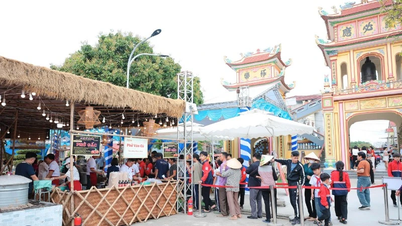
Society must be an environment that preserves the traditional values of the nation, reflected in the moral standards of each member of society, through rituals and organized events. In particular, attention must be paid to ensuring that the traditional values of the nation are disseminated into life, through cultural activities bearing the imprint of tradition within social communities.
Furthermore, society considers maintaining order and discipline in communication culture, traffic culture, and in the organization of village and neighborhood activities as a way to preserve and transmit the traditional cultural values of the nation.
With the three constants approach—family culture, school culture, and social culture—as mentioned above, it will certainly be an effective solution to bring the Resolution of the 14th Party Congress on preserving traditional cultural values into life.
Assoc. Prof. Dr. Nguyen Van Manh
Source: https://huengaynay.vn/van-hoa-nghe-thuat/ba-hang-so-de-van-hoa-soi-duong-163923.html

![[Image] Nguyen Tat Thanh Street is expected to be widened, reducing traffic congestion.](https://vphoto.vietnam.vn/thumb/1200x675/vietnam/resource/IMAGE/2026/03/24/1774326200262_ndo_br_3-6869-jpg.webp)





























































Comment (0)