

In the spirit of contributing another perspective for Ho Chi Minh City, we propose three important issues that Ho Chi Minh City needs to focus on and do well in order to effectively implement Resolution 98 and make this city a leading breakthrough engine.
Clearly define the city's goals and priorities.
It is necessary to clearly and specifically define the city's priority goals and key areas. To accurately and effectively establish these priority goals and key areas, city leaders, heads of departments and agencies, and district/county officials, along with experts, scientists , and specialists, need to sit down together to discuss, analyze, and thoroughly evaluate them through multiple rounds...
Clearly and specifically assign individual responsibilities.
Clearly define responsibilities and tasks, specifying key points and individual accountability, especially personalizing the responsibility of heads of government at all levels and departments in achieving priority and key KPI targets.
For example, district/county-level authorities sign an agreement, committing to achieving priority KPI targets with the city government, agreeing on the measurement scale and method, as well as a specific plan for completion. Issues related to government that fall under the responsibility of the Chairman are signed by the Chairman, while issues related to the Party that fall under the responsibility of the Secretary are signed by the Secretary…
The achievement of priority KPI targets serves as the basis for implementing a fair system of rewards and punishments, both economically and politically, at the individual and organizational levels. Districts/counties are ranked according to their total collective score, and bonuses are paid to all district/county officials corresponding to their ranking. District/county Party Secretaries and Chairmen receive higher bonuses than regular officials, as stipulated by regulations.

It is necessary to clearly and specifically define the priority goals and key areas of focus for Ho Chi Minh City. Photo: VietNamNet
The amount of the bonus is determined by the city, but 30% of the funding comes from the city, with the remaining 70% coming from the local government's or department's budget. Therefore, the bonus amount depends on the financial resources of that local government or department. Local governments and departments are given mechanisms to secure their own salary and bonus funds. Each locality will have its own appropriate approach.
"Political rewards" could include appointments to higher positions within the Party and government... Other political rewards include the top-ranked head of a district/county government or department being awarded the title of exemplary leader, serving as a role model for other district/county and department leaders to emulate, being featured in the city's media, and having the information communicated to all relevant city departments.
Conversely, heads of districts/counties, departments, and agencies with low rankings will be transferred or considered for dismissal.
The inspection, monitoring, and follow-up of the achievement of priority and key KPI targets need to be carried out regularly and continuously. City inspection teams conduct quarterly inspections and evaluations of the results of districts/counties and departments, publicly posting the inspection results on the team's website and issuing warnings if targets are not met.
Comprehensive evaluations are conducted twice a year, with rankings and results publicly announced through mass media for the public to easily monitor and supervise. Results are presented graphically using eye-catching, visually appealing colors so that officials and the public can clearly see the current status of localities and departments, indicating whether they are developing or regressing compared to the previous period, based on each priority KPI and key objective.
Creating motivation and pressure to encourage employees.
Create sufficient motivation and pressure to encourage the team of "officials who want to do, dare to do, and do well" in their work and tasks. Specifically, focus on implementing the following key measures:
Firstly, supplement the salary and bonus system based on the level of achievement of priority and key KPI targets. Those who achieve good results will receive high salaries and large bonuses. Those who perform poorly will receive lower salaries and smaller bonuses, with a significant difference; high achievers will receive much larger rewards than low achievers. Those who do not meet the minimum targets will not receive this salary and bonus system.
Secondly, it is necessary to establish a fair and open promotion mechanism for everyone, giving everyone a chance to compete fairly for advancement, but only the most outstanding individuals will be selected.
This will strongly motivate individuals to strive their best, maximize their talents to achieve excellence, and build successful careers. With each individual's continuous effort and striving, the city will develop steadily and accomplish extraordinary things.
Therefore, it is essential to promote the implementation of an open and transparent competitive examination mechanism for leadership and management positions in administrative agencies. This mechanism not only selects the most outstanding individuals but also gives those who pass the rigorous and competitive examination a sense of legitimacy and pride in their work.
From then on, they cherished, respected, and felt more responsible for their duties. At the same time, they prevented those who were greedy for fame and fortune, lacking ethics, from climbing the ranks and harming the reputation and competence of the city government...
This selection mechanism allows anyone to participate if they meet the criteria, and the exam results are the basis for admission. Information about the competition is published at a sufficient length to reach a wide audience and give candidates enough time to prepare thoroughly.
Transparency is needed regarding the number of positions, qualification standards, how and when the best candidates are selected… Regulations are needed to define specific positions and the minimum percentage of leadership and management personnel selected through this mechanism.
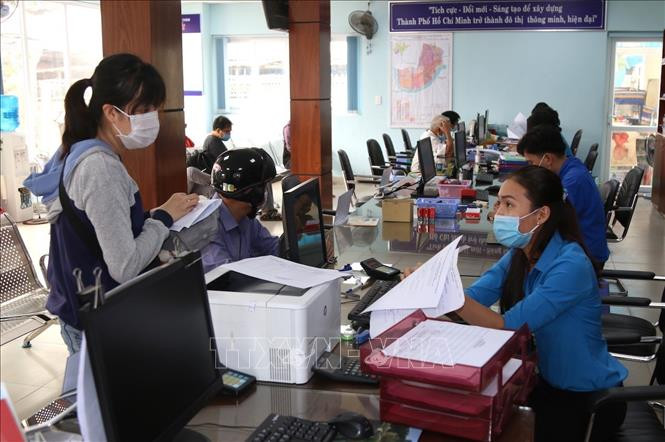
Officials from the People's Committee of Hiep Binh Chanh ward, Thu Duc city, guide citizens through administrative procedures. (Illustrative photo: TTXVN)
Implement an internal competition mechanism for leadership and management positions within the Party. This mechanism helps select talented and clean leaders, and weed out incompetent personnel because the applicants themselves have already screened their candidates; only those with genuine talent and clean personal lives dare to run for office...
The process is as follows: All party members who meet the prescribed criteria can apply for leadership and management positions within the Party. Step 1: Candidates must pass the selection committees to participate in the election. Step 2: Candidates campaign publicly to select the most outstanding individuals. For important positions, the campaign presentation may be broadcast on city television. Initially, the process is tested at the district/county level, then the results are summarized and lessons learned. If successful, it will be implemented at the city level...
Thirdly, there needs to be a mechanism to protect officials who dare to think and act for the common good. The city needs a Resolution on protecting officials who dare to think and act for the common good. First and foremost, this should apply to those in leadership positions in implementing priority and key KPI objectives.
They need to be equipped with a "shield" to confidently and boldly overcome the "encirclement" of a "mountain" of processes and procedures, along with a "forest" of laws, to effectively fulfill their role as "conductor" and leader in achieving priority KPI targets, creating new vitality and dispelling the "fear of responsibility" among current officials.
Otherwise, with the current institutional and policy shortcomings and lack of legal consistency, the risk of being wrong or accused of "intentionally acting against the law" or "negligence causing serious consequences" is a reality, especially for matters without precedent or where existing regulations are outdated and inadequate.
Fourth, establish mechanisms to ensure that agencies and officials proactively and effectively address the legitimate requests and aspirations of businesses and citizens.
Training and professional development need to be strengthened so that officials are imbued with a spirit of service and have a deep understanding that businesses and citizens come to government agencies not to ask for favors or cause trouble, but as customers, providing opportunities for officials to serve them.
At the same time, a deadline mechanism with strict penalties should be applied in the city's public service system to ensure that agencies and officials proactively and effectively address the legitimate requests and aspirations of businesses and citizens.
For example, regarding construction permits, instead of stopping at the regulation of receiving complete and valid documents, the competent authority should review the application and issue the permit within 20 days. There should also be a regulation stating that if, after 20 days, the authority does not issue the permit and does not provide written notification of the reason, the applicant is allowed to commence construction and must send written notification to the licensing authority. In this case, the construction permit issuing authority would be held responsible as if they had already issued the permit. This would encourage the relevant agencies and officials to be more proactive and diligent in issuing permits on time for businesses and individuals.
In addition, a "One-stop shop, no wrong choice" mechanism should be implemented, stipulating that when agencies and officials receive requests from businesses and citizens, if it is outside their responsibilities or duties, they must contact the competent authority so that businesses and citizens can go to the correct place for resolution.
In cases where it is unclear which agency falls under the function or responsibility of a particular issue, the first agency to receive the request must investigate, clarify, and coordinate with other agencies to respond and resolve the matter.
Thus, it overcomes the problem of shirking responsibility, facilitates coordination, and minimizes the limitations regarding boundaries between agencies,...
In short, Resolution 98 is very timely, not only correct but also very effective. For the Resolution to be implemented and for Ho Chi Minh City to become a leading breakthrough city, it requires the city's officials to "want to do, dare to do, and do well" in their work and tasks.
Let me quote President Ho Chi Minh's teachings from his lifetime: "Cadres are the foundation of all work," and "The success or failure of all endeavors depends on whether the cadres are good or bad." This is the time when the cadres of Ho Chi Minh City need to "burn brightly" and give their all to successfully fulfill the challenging and noble historical mission of making the city a leading breakthrough engine, worthy of being named after President Ho Chi Minh.
Pham Manh Hung
Recently, the National Assembly issued Resolution 98/2023 on piloting a number of specific mechanisms and policies for Ho Chi Minh City, with the expectation that the city will become a leading engine of breakthrough development. Resolution 98, with 10 articles, stipulates 44 mechanisms and policies across 7 sectors, many of which are being granted to Ho Chi Minh City for the first time. The resolution takes effect on August 1, 2023. |


























































































Comment (0)