When President Ho Chi Minh boarded the Admiral Latouche-Tréville ship en route to France , his "position" was that of a kitchen assistant. Being a kitchen assistant on a ship was a very arduous job. President Ho Chi Minh accepted this job in order to be able to go to France.
When writing and publishing the book Ho Chi Minh : The Missing Years 1919-1941, Dr. Sophie Quinn-Judge of LSE University, London, gave an interview to a Western radio station in which she emphasized:
"Based on French documents about Ho's siblings and their assistance to Phan Boi Chau, I believe their family was involved in patriotic anti-colonial activities from an early age."
I believe that Ho Chi Minh would also have participated in anti-colonial activities in one way or another. But because he couldn't stay at the National School, he went abroad to find ways or learn more to devise strategies to fight the French."
Writing it that way is honest and fair. But it needs to be added: Uncle Ho's trip to France was not easy at all; he worked as a kitchen assistant, like a menial worker, doing heavy work for low pay.
I suddenly remembered a line from the great poet Tan Da:
"The burden on my shoulders is heavy, the road is long."
Perhaps we only know ourselves.
That was the situation President Ho Chi Minh was in when he set out to find a way to save the country. Perhaps it was only after arriving in France that he met figures like Phan Chu Trinh and Phan Van Truong, and received their help, but while adrift at sea, it was truly a case of "Only I know myself."
The journey of such a solitary individual in search of a way to save his country was a great one, because no one, not even the person who left, could foresee all that they would encounter and overcome in a foreign land.
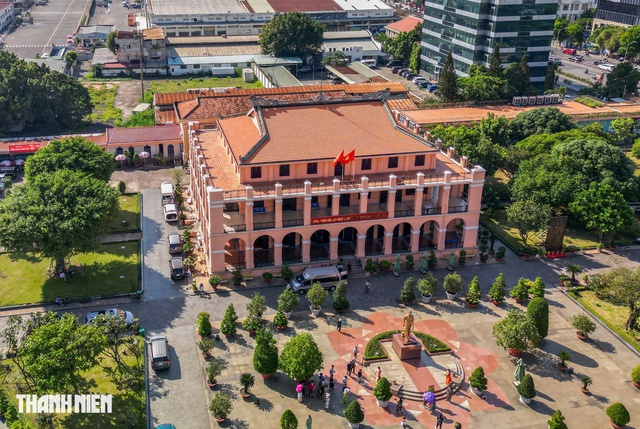
Ho Chi Minh Museum - Ho Chi Minh City branch at Ben Nha Rong
PHOTO: PHAM HUU
Uncle Ho's trip to France was not for the purpose of studying abroad, although he requested to be accepted as a student. The French colonial government flatly refused.
Staying in France was difficult enough, but to become fluent in French, to be able to communicate, campaign, promote, and write articles in French, was truly incredibly challenging.
Uncle Ho overcame those initial challenges, of course, thanks to the help of patriotic elders and mentors. But it was primarily his own efforts that made the difference.
It has been calculated that, both in France and in America, President Ho Chi Minh worked many jobs, both to earn a living and to expand his network, thereby raising awareness among upright people in France and America about the horrific enslavement of the Vietnamese people. He worked many jobs, but excelled at each one – that's what's remarkable.
In 2003, when I had the opportunity to visit Paris (France), I happened to stay very close to an old house where President Ho Chi Minh had lived for a time as a photographer.
Although there are no longer any signs or artifacts preserving the place where President Ho Chi Minh once lived, his Vietnamese friends in Paris know this house very well.
The house was located on a small street whose name I can't remember, very close to Monge Street (5th arrondissement, Paris), where at that time there was Foyer Viet Nam, a purely Vietnamese restaurant owned by a friend of mine.


That place was also known as the Latin Quarter – a "university village," clustered with some of the most prestigious universities in France. Thus, in Paris alone, President Ho Chi Minh stayed in many places, not just at house number 9, Compoint Lane, 17th arrondissement.
Back then, in 1911, Uncle Ho went to Paris to work as an ordinary laborer. This illustrates that the path taken by many great figures around the world, including Uncle Ho, in realizing their ideals was the path of labor.
Working as a laborer, doing manual labor, learning a trade, never shying away from any arduous task – that was President Ho Chi Minh's path to national salvation.
It was through hard work and diligent apprenticeship, from photography to baking, from France to America, that President Ho Chi Minh simultaneously worked and studied, wrote articles, and mobilized enthusiastic people from different nationalities he knew to support Vietnam in its search for a way out of colonial rule and regain independence.
Great ideals are forged through small, ordinary tasks—that's our President Ho Chi Minh. Without the opportunity for formal education, President Ho Chi Minh learned from the school of life, alongside his fellow workers, and while working to earn a living.
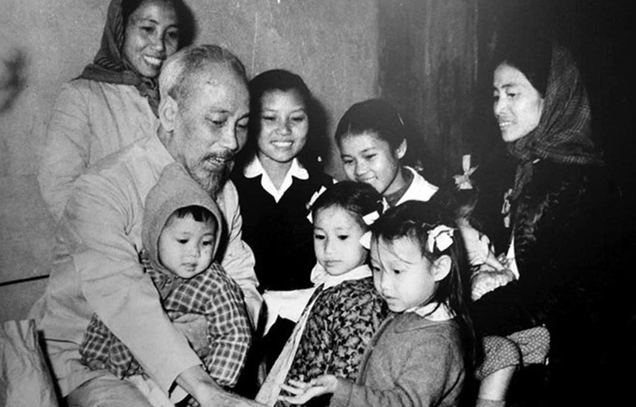
President Ho Chi Minh affectionately visited and inquired about the well-being of children in Tam Son commune, Tien Son district, Ha Bac province (formerly) during his visit to extend New Year greetings to the people there on February 9, 1967.
Photo: Archival material/VNA
On one occasion, a delegation from Vietnam visited The Omni Parker House hotel in Boston, USA, to see the bakery where President Ho Chi Minh once worked. The hotel representative quoted Susan Wilson, a writer and journalist for the Boston Globe , as saying: "It is interesting to note that a renowned revolutionary once spent time working as a baker at the Omni Parker House bakery from 1911 to 1913. That exceptional chef brought honor to this place…"
That "extraordinary chef" never once claimed to be a "blessing to the nation," even though he himself was a blessing to the nation. Uncle Ho was humble but very proud.
Those who become geniuses through hard work are all like that. They know their own worth, but they always know the greater values of their community, their people, and their country.
They "even a delicious meal tastes bitter because of the Fatherland" (a poem by Chế Lan Viên), although President Ho Chi Minh himself rarely got to enjoy delicious meals. And that wasn't the purpose of his life. His ultimate desire was for all Vietnamese people "to have enough food and clothing, and to receive an education."
While it's true that most of our people now have enough food and clothing, albeit at a low level, the idea of "everyone having access to education" reflects the fact that President Ho Chi Minh's heartfelt concern has not been fully realized. Throughout his time abroad, President Ho Chi Minh never stopped learning. If not in school, then from friends, comrades, the people, and ultimately, through self-study.
International journalists who had the opportunity to interview President Ho Chi Minh were amazed by his ability to converse intimately yet profoundly in their own languages. For great figures, the spirit of self-learning is always paramount. Only through self-learning can one learn and think simultaneously, and only through learning and thinking simultaneously can one be creative.
Of course, for a worker like President Ho Chi Minh, the "school of life" is always a great university. Experience, contemplation, sensitivity to the outside world, quietly delving into his own inner world, to understand the people, understand his comrades, replace selfishness with altruism, know how to live for others, and find joy and happiness in serving his people.
At that time, the main "burden" was love for the homeland and the people, while the "long road" had to be the path of struggle to realize the ideal. President Ho Chi Minh's "great ambition" was manifested in his own life: gentle yet fierce, enduring and burning, sharing and accepting the least for himself.
When Uncle Ho passed away, the great Cuban poet Félix Pita Rodríguez wrote the famous poem "Ho Chi Minh, His Name Is a Source of Poetry ," which included the following lines:
"Poet Ho Chi Minh,
The pure-hearted Vietnamese farmer: Ho Chi Minh
The one who sacrificed himself renounced all names.
until it is nothing more than a voice, a breath, a glance
So all that's left is... nothing else...
"It is the country, it is the blood and bones of the Fatherland."
And our poet Viet Phuong, in his famous poem "Innumerable Affection Envelops the Homeland," wrote:
"It was raining, people were waiting to visit Uncle Ho's memorial, and I got wet."
"Uncle, you love your people, and I know you're not happy about it."
Even until his death, he still cared deeply for his people; that was our infinitely beloved Uncle Ho. Despite being a leader, he still possessed the soul and lifestyle of a peasant, something the sensitive Cuban poet recognized. And the Vietnamese poet understood it.
From opposite hemispheres, two poets who had never met wrote about President Ho Chi Minh in this way.
That says it all.
Source: https://thanhnien.vn/bac-ho-cua-chung-ta-la-nhu-the-1852606051645245.htm