The sower
Having dedicated nearly 20 years to teaching Quan Ho folk songs of Bac Ninh, artist Chu Phuong Anh (born in 1990), an officer at the Provincial Center for Culture and Tourism Promotion, is one of the passionate and persistent individuals who sow the "green seeds" of this heritage.
From a young age, she was taught Quan Ho folk songs by her mother, and later received direct instruction, guidance, and vocal correction from veteran Quan Ho artists from Thi Cau village.
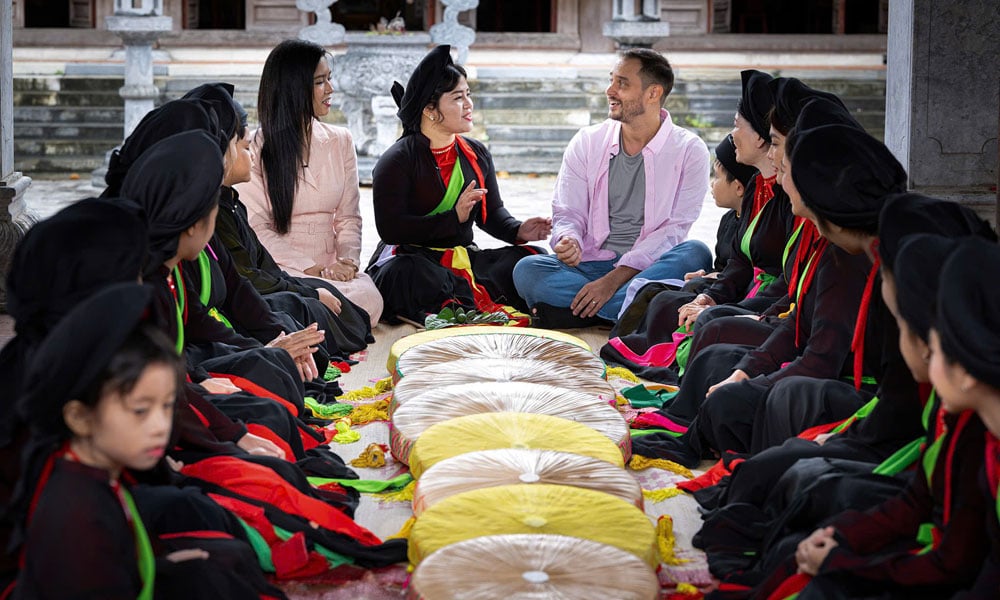 |
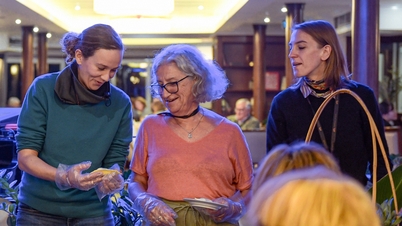
A Quan Ho folk singing lesson for foreign tourists under the guidance of artist Chu Phuong Anh. |
Inheriting a valuable legacy from previous generations, she quickly recognized her responsibility to continue and pass on this heritage. While still a student, she actively participated in teaching Quan Ho folk singing in clubs and later opened classes at her home. Currently, her classes regularly have 10 to 15 students; during the summer, the number can increase to 20-30.
Ms. Phuong Anh expressed: "What keeps me confident on my journey of 'sowing seeds' is that more and more students, even after becoming university students or graduating and starting work, still love Quan Ho folk music very much."
Having diligently studied with Ms. Chu Phuong Anh for the past two years, young singer Nguyen Minh Quan from Song Lieu ward shared that he initially studied out of curiosity, but the more he learned, the more he fell in love with Quan Ho folk singing and aspired to pursue a professional artistic career. For artist Chu Phuong Anh, Minh Quan is one of the precious "seeds" that needs further nurturing to create a successor generation to preserve the Quan Ho heritage.
Every summer, the original Quan Ho villages and Quan Ho practicing villages in the province open free classes to teach Quan Ho folk songs to young people. This is not only a meaningful activity that helps children have a healthy cultural environment and access the heritage from an early age, but also an effective way to discover and nurture the next generation.



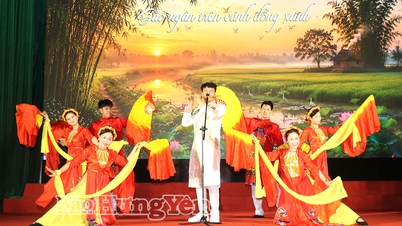
Since 2011, the young Quan Ho singers' class of the Hoai Trung Quan Ho Club (Lien Bao commune) has attracted a large number of children in the village. From initially having only 4-6 participants, in recent years, each summer, the class has had about 40-50 teenagers aged 5 to 15.
According to Duong Duc Thang, Deputy Chairman of the Hoai Trung Quan Ho Club: "About 40 years ago, I was the only child in the village who knew how to sing Quan Ho. Now, almost every child in the village loves and knows how to sing it." This change is vivid evidence of the effectiveness of persistently passing on the heritage within the community.
Along with Quan Ho folk singing, many other traditional art forms such as Tuong, Cheo, Ca Tru, and Then singing are also actively passed on by artisans and grassroots cultural figures. As a kindergarten teacher passionate about Then melodies, Ms. Chu Thi Cham, Deputy Head of the Nung Ethnic Folk Song Club in Bien Son commune, has dedicated much time and effort to practicing and teaching the Then singing tradition of the Tay and Nung people. Ms. Cham shared: "This summer, along with opening free ethnic language classes, I will combine teaching Then singing to help children better understand the cultural identity of their homeland. These feelings nurtured from childhood will create a foundation for the younger generation to gradually develop an awareness of continuing and preserving this heritage."
Nurturing the next generation
In recent years, along with the implementation of intangible cultural heritage preservation programs, many localities in the province have focused on introducing traditional arts into schools.
In addition to integrating music into lessons and extracurricular activities, schools also collaborate to organize heritage experience programs, school theater, exchanges with artisans and artists, and create opportunities for students to directly participate in practical activities.
 |
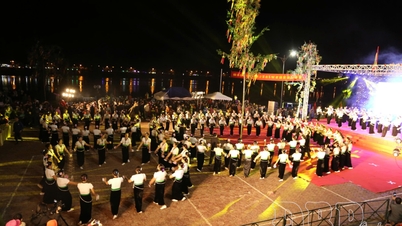
Members of the Then Singing Club in Truong Son commune are preserving the Then singing heritage. |
Nevertheless, the teaching and transmission of traditional arts currently faces many difficulties. Most forms of folk performance require learners to practice diligently for a long period. Funding for organizing classes, purchasing musical instruments, costumes, and venues for performances is limited in many places.
For example, in the Then singing style, learners need to practice directly with the Tinh lute and Xoc Nhac percussion instruments. However, in some areas, the economic conditions of the people are still difficult, so they cannot afford to buy musical instruments to learn. This is also a reason why organizing the teaching and attracting learners faces obstacles.


To ensure the sustainable effectiveness of heritage preservation and promotion, localities need to focus on providing financial support, musical instruments, costumes, facilities, and living spaces for clubs and training classes in the community. Identifying and nurturing young talents should be strengthened through competitions, festivals, and art playgrounds for youth. Leveraging the advantages of digital technology to bring Quan Ho, Hat Then, Cheo, Tuong, and Ca Tru closer to young people through multimedia products such as short videos, online experiential programs, podcasts, and documentaries is also crucial.
Heritage cannot endure without successive generations cherishing and preserving it. Every teaching class, every club, every dedicated artisan "passing on the torch" today is contributing to sowing the "seeds" for the future of heritage, so that the stream of national culture will continue to flow through the years.
Source: https://baobacninhtv.vn/bac-ninh-uom-nhung-mam-xanh-di-san-postid447780.bbg