

VHO - Recently, the Department of Culture and Sports of Thua Thien Hue province held a ceremony to receive the certificate recognizing the folk knowledge of "Hue's traditional craft of sewing and wearing ao dai" as a national intangible cultural heritage.
This is considered the result of over four years of local efforts to promote and preserve the historical and cultural values of traditional ao dai costumes from the past to the present, building new values and "transforming heritage into cultural assets".
From the "history of medicine"...
Mr. Phan Thanh Hai, Director of the Department of Culture and Sports of Thua Thien Hue province, acknowledged that Hue's Ao Dai (traditional Vietnamese dress) is a "typical example" in the local government's policy and direction to honor, preserve, and develop sustainable cultural values throughout history, while simultaneously protecting traditional achievements and updating and developing new, more contemporary values.
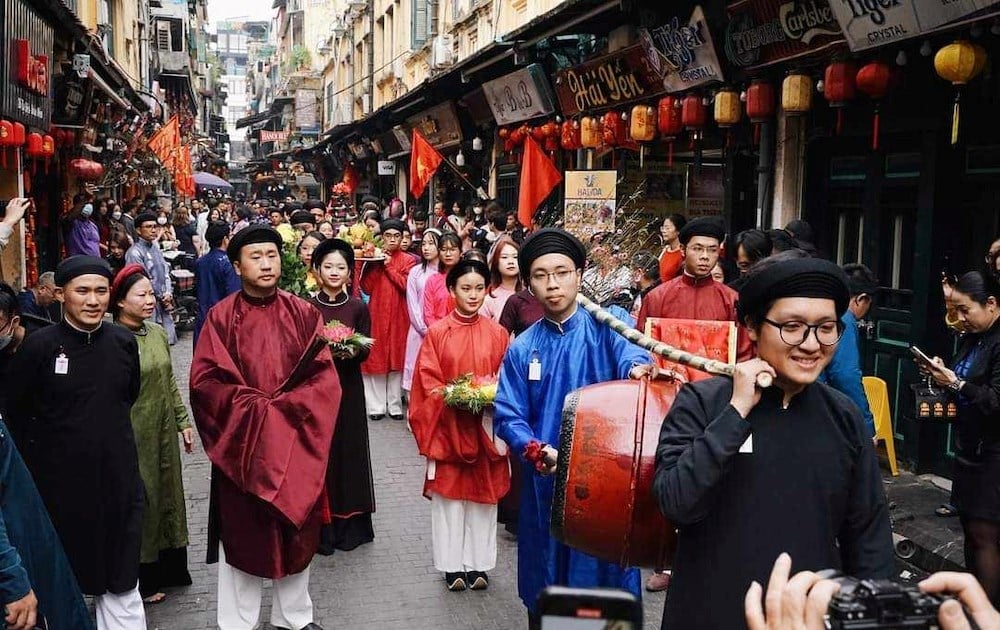
According to researchers, the story of the Hue Ao Dai, representing the traditional Vietnamese Ao Dai, has unfolded over several centuries, linked to the historical shaping of cultural values since the Nguyen dynasty.
To date, the Department of Culture and Sports of Thua Thien Hue, based on the practical experience of the local ao dai tailoring industry and the socio-cultural aspects of the promotion of traditional clothing in Hue, has boldly campaigned and fostered opportunities to revive traditional ao dai designs, creating innovative variations, turning this into a long-term development story.
From 1744, after declaring himself King in Phu Xuan, Lord Nguyen Phuc Khoat, wishing to demonstrate his administrative power and build his political system in the territory he controlled, implemented many reforms in the administrative apparatus and applied policies to develop the economy, culture, and society.
One of his most notable examples was his decision to select the five-panel ao dai (traditional Vietnamese tunic) from folk traditions, modify some details, and establish it as the official attire for officials and commoners. The five-panel ao dai thus became the primary garment of the people of Dang Trong (Southern Vietnam), affirming their cultural independence and distinguishing them from the people of Dang Ngoai (Northern Vietnam).
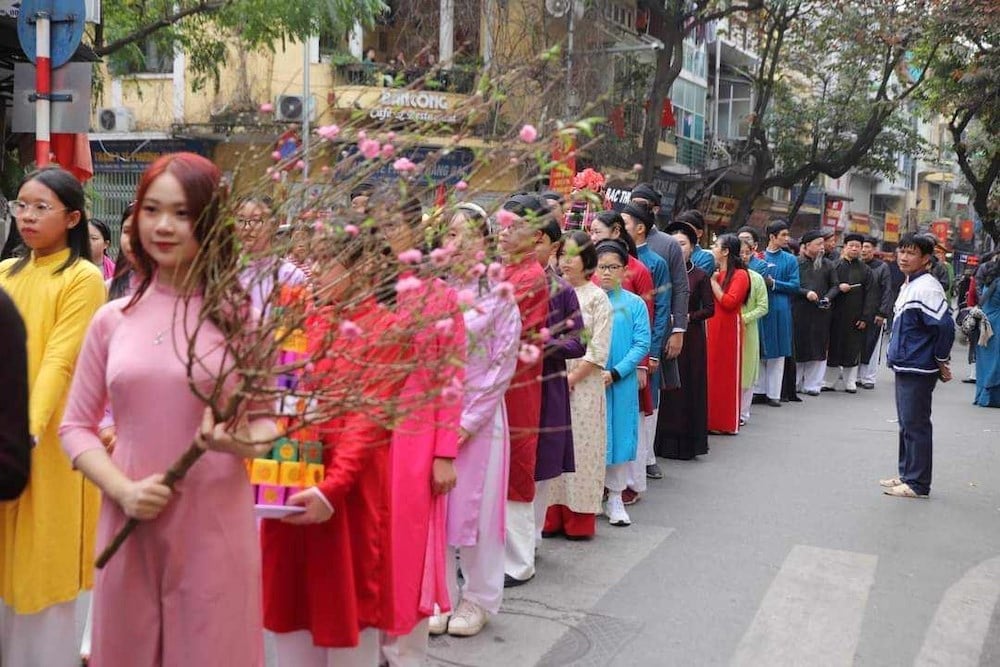
However, it was not until 1826, after the stability of the court inherited from his father, Emperor Gia Long, that Emperor Minh Mạng resolutely implemented policies to improve the national culture, establishing the five-panel áo ngũ thân as the national costume, and applying it widely and uniformly throughout the country.
This style of clothing, inspired by folk traditions, has become a "standard of attire" that fits the size and build of Vietnamese people, adapted to suit customs and rituals, for use in various circumstances and for different groups, serving cultural activities, both for the general public and for official ceremonies.
It wasn't until the French colonial policy, when the country's monarchy declined, that Vietnamese clothing styles began to change, gradually becoming Westernized as part of the integration process, and then further modified to suit each historical period, resulting in gradual differentiation. However, in terms of folk rituals, ancient cultural traditions were still preserved by the people.
The traditional five-panel dress (áo ngũ thân) is still preserved in rural villages. During festivals and holidays, it is often worn by officials and the general public as their primary attire. Thus, over time, through war and peace, the five-panel dress has remained a part of the people's sense of dress.
Particularly in Hue, a land of royal and imperial power, despite countless turbulent changes, the cultural essence of the dynasty is still preserved by the people as a way to maintain the rituals and customs of life. No matter how difficult their circumstances, the people of Hue still maintain their traditional family customs and manners, preserving all family traditions and rituals.
Thanks to this, the five-panel dress in Hue culture has been preserved and is respectfully used by the people of Hue on all occasions and ceremonies throughout the year. Hue people, in a sense of etiquette, remain serious and proper when they see the traditional five-panel dress, and in every cultured family, they always keep these five-panel dresses as a proud symbol of their family's achievements and prestige.
From the project proposal to the actual development
Dr. Thai Kim Lan, one of Hue's leading cultural researchers, is also a Hue woman who, despite living and working abroad for many years, has always maintained the dignified demeanor embodied in the traditional five-panel ao dai. Now, having returned to Hue, she continues her work promoting national culture, once again participating in the revival of traditional attire and advocating for the development of the national ao dai.
The involvement of individuals like Dr. Thai Kim Lan has had a strong impact on the cultural and ceremonial movement in Hue, and the local Department of Culture and Sports has actively promoted its development. More than three years ago, with the consensus of researchers, clans, villages, cultural artisans, and traditional costume tailoring establishments, an action program to rebuild cultural values from the Hue Ao Dai (traditional Vietnamese dress) was launched.
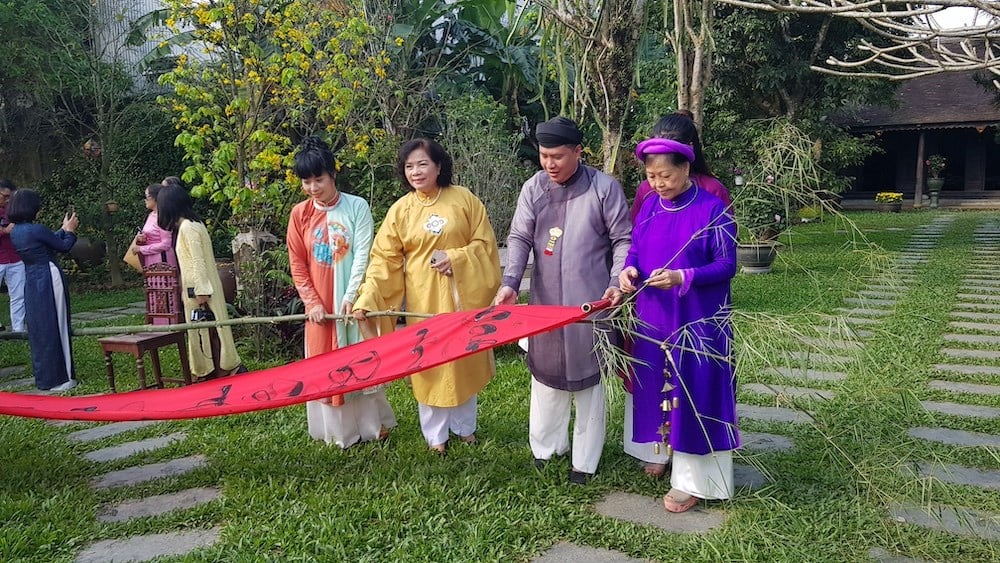
Accordingly, the image of Hue people wearing the five-panel ao dai (traditional Vietnamese dress) has gradually become popular, recreated, and honored in all community and social activities, from Tet (Lunar New Year) celebrations to local cultural events. During international festivals in Hue, and at all traditional folk events, the five-panel ao dai is chosen as the main attire for organizers to conduct ceremonies solemnly, and all participants strictly adhere to the rules.
The Thua Thien Hue Department of Culture and Sports is the strongest advocate for this activity, with the policy of wearing traditional five-panel robes to the flag-raising ceremony at the beginning of each week and at official conferences and meetings in local administration.
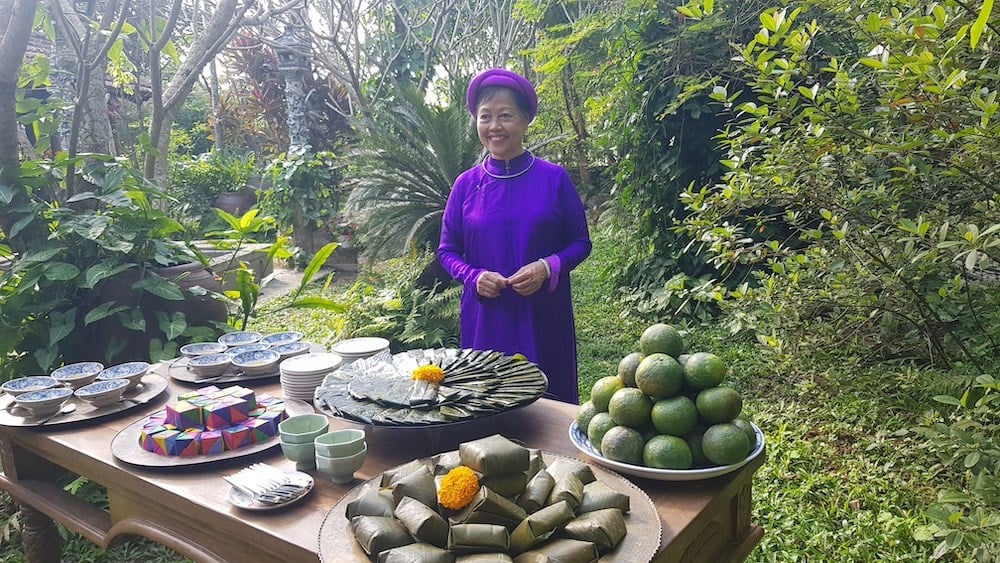
Moreover, through cultural campaigns, the traditional ao dai movement originating from Hue quickly spread to other localities, boldly promoting itself at fairs and cultural events from Hanoi to Ho Chi Minh City.
Hue's Ao Dai artisans have not shied away from long journeys, participating in many major programs and events, such as the spring festival in Hanoi's Old Quarter, large cultural and trade weeks in Ho Chi Minh City; and cultural exchanges in Da Nang and the Central Highlands.
Some national diplomatic activists and Vietnamese trade attachés abroad also recognized the importance of national attire and joined this campaign, gradually spreading the image of the traditional Ao Dai dress far and wide.
On March 29, 2023, the People's Committee of Thua Thien Hue province issued a decision approving the project "Hue - The Capital of Vietnamese Ao Dai," officially recognizing the promotion and development of the traditional five-panel Ao Dai in the locality. This event provides a further legal basis for promoting and honoring Hue's Ao Dai, aiming to boost economic and tourism development, and affirm the image of Hue's Ao Dai in community culture and international relations.
A stronger direction for the development of Hue's Ao Dai (traditional Vietnamese dress) was thus established, with a significant milestone being the Ministry of Culture, Sports and Tourism's recognition of the Hue Ao Dai tailoring craft as a cultural heritage and folk knowledge. The story of "transforming heritage into assets" officially began.
Source: https://baovanhoa.vn/van-hoa/bai-1-dua-de-an-vao-cuoc-song-113818.html

![[Photo] General Secretary and President visit the China-ASEAN AI Application Cooperation Center](https://vphoto.vietnam.vn/thumb/1200x675/vietnam/resource/IMAGE/2026/04/17/1776404277677_vna-potal-tong-bi-thu-chu-tich-nuoc-tham-trung-tam-hop-tac-ung-dung-ai-trung-quoc-asean-8706616-2286-jpg.webp)


















![[Photo] National Assembly Chairman Tran Thanh Man attends the policy seminar to promote Vietnam-Türkiye cooperation.](https://vphoto.vietnam.vn/thumb/1200x675/vietnam/resource/IMAGE/2026/04/16/1776351415367_vna-potal-chu-tich-quoc-hoi-tran-thanh-man-du-toa-dam-chinh-sach-thuc-day-hop-tac-viet-nam-tho-nhi-ky-8705791-jpg.webp)


























![[Video] Preserving the "green gold" on Hong Thai Mountain](https://vphoto.vietnam.vn/thumb/402x226/vietnam/resource/IMAGE/2026/04/18/1776468522858_a1-jpg.webp)



Comment (0)