

To commemorate the 85th anniversary of President Ho Chi Minh's return to Vietnam (January 28, 1941 – January 28, 2026), the People's Police Newspaper is publishing a series of articles about the profound affection of the people of Pac Bo – where every home is a "fortress of the people's hearts," and every memory of President Ho Chi Minh is a flame passed down through generations.
Nestled amidst the mountains and forests of Cao Bang's border region, Pac Bo is where, in the spring of 1941, President Ho Chi Minh returned to his homeland after more than 30 years of wandering in search of a way to save the country. Here, revolutionary families like the Duong family silently sheltered President Ho Chi Minh and revolutionary cadres, contributing to the historic victory, and today, that memory is still preserved and passed down through many generations.
The image of "Grandpa Ké" is deeply ingrained in the memories of many generations.
In mid-January 2026, Pac Bo bustled with visitors seeking to connect with its historical roots. From the winding mountain roads to historical sites like Milestone 108, Coc Bo Cave, Khuoi Nam Hut, Lenin Stream, and Karl Marx Mountain, the story of President Ho Chi Minh was not only told through tour guides but also vividly lived in the memories of the families who sheltered and hid him.
Eighty-five years ago, on January 28, 1941, leader Nguyen Ai Quoc crossed Milestone 108 to return to his homeland after more than 30 years of exile. From Pac Bo, he directly led the revolution, convened the 8th Central Committee Conference, established the Viet Minh Front, and laid the foundation for the August Revolution of 1945.
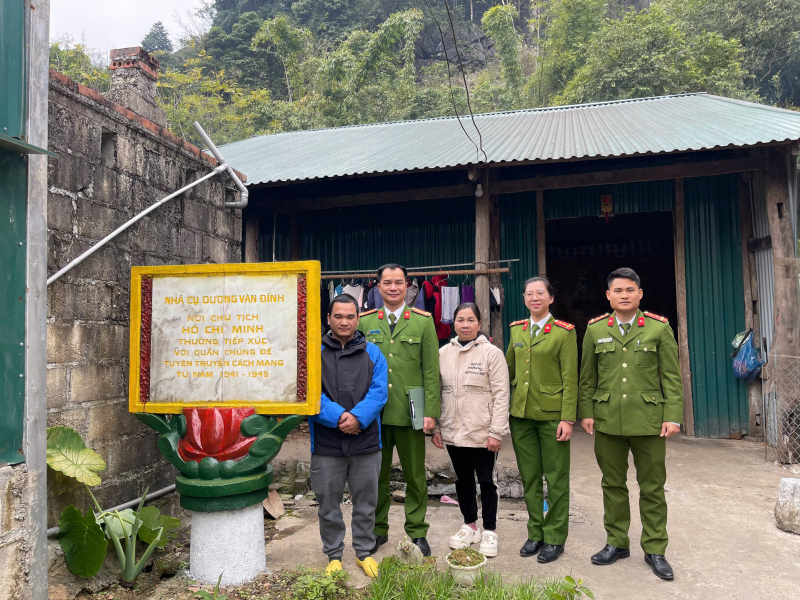
The family of Mr. Duong Van Dinh (commonly known as Tao Senh) was one of the first revolutionary bases. Their small stilt house not only sheltered President Ho Chi Minh but also served as a place to teach literacy and instill revolutionary awareness in the local people. The image of the simple "Old Man," eating rice balls and corn porridge, living amidst the mountains and forests, has been deeply etched in the memories of many generations.
The entire family of Mr. Duong Van Dinh participated in the revolution and received numerous awards for their contributions. His children were given new names by President Ho Chi Minh: Duong Dai Vinh, Duong Dai Phong, Duong Dai Long, Duong Dai Lam, Duong Thi Lieu, Duong Dai Hoa, and Duong Thi Bay. Among them, Mr. Duong Dai Long was one of the 34 soldiers of the Vietnam Propaganda and Liberation Army; Mr. Duong Dai Lam later became a Colonel and Deputy Political Commissar of the Viet Bac Military Region, now Military Region I.
Mrs. Dinh Thi Ha, the youngest daughter-in-law of Mr. Duong Dai Hoa and granddaughter-in-law of Mr. Duong Van Dinh, proudly recounts her family's memories of President Ho Chi Minh's time in Pac Bo. Her family currently lives on the site of Mr. Duong Van Dinh's old stilt house – a crucial stop for President Ho Chi Minh during his early days back in Vietnam in 1941. Here, he not only worked but also taught the Vietnamese language and spread revolutionary ideas; Mr. Dinh's family repeatedly supplied him with food and provisions during extremely difficult times.
Mr. Duong Van Dinh embraced the revolutionary cause early on, serving as the Chairman of the Elderly National Salvation Association in Pac Bo; his children, including Mr. Duong Dai Hoa and Mr. Duong Dai Lam, all became revolutionary cadres who dedicated their lives to the Party's cause.
Currently, the Management Board of Special National Monuments of Cao Bang Province is preserving the family's dining table, the one President Ho Chi Minh used to eat at whenever he visited the home of Mr. Duong Van Dinh. Today, the old house is a familiar historical site; the remaining artifacts, such as the ironwood table and the stilt house frame, hold sacred value and are preserved by Mrs. Dinh Thi Ha's family as historical evidence.
Despite being 94 years old, Mrs. Mac Thi Siem, daughter-in-law of Mr. Duong Dai Phong (and also granddaughter-in-law of Mr. Duong Van Dinh), remains lucid and deeply moved when speaking about President Ho Chi Minh. She clearly remembers the days when President Ho Chi Minh was in Pac Bo, working while teaching literacy, bringing the light of knowledge to the villages, and giving meaningful names to the children and grandchildren. Specifically for Mr. Duong Dai Phong's family, President Ho Chi Minh named his children Toan, Dan, Doan, and Ket, including her husband, who was named Duong Viet Dan.
Born and raised in Pac Bo, Mrs. Siem joined the revolution early on, carrying ammunition and tending to the wounded on the battlefields of Dong Khe and That Khe, contributing silently but persistently to the nation's common struggle. For elderly people like Mrs. Siem, memories of Uncle Ho remain vivid, and from those homes, the flame of revolution in Pac Bo continues to be preserved and passed down through generations.
Preserving traditions as a sacred part of life.
In the heart of the borderlands, as night falls and mist blankets the mountain paths, the hearths in each house of Pac Bo village blaze brightly. In that warmth, generations gather together, recounting stories from over eight decades ago, from the memories of their ancestors sheltering and hiding revolutionaries to the changing rhythm of life in Pac Bo today.
At 77 years old, Mrs. Hoang Thi Khinh slowly recalled: "From the time of my grandparents and my husband's parents, when Uncle Ho taught us to read and write and enlightened us, everyone in Pac Bo village wholeheartedly followed the revolution." Time has passed, many have passed away, but the memories of those years of hunger, cold, and danger are still passed down in each family, so that the children and grandchildren understand that today's independence was bought with countless silent sacrifices.
Life in the highlands still presents many challenges, but the care and attention of the Party, the State, and all levels of government are always a source of support. "I recently received capital support from the Cao Bang Provincial Police to start a business, giving me an additional livelihood. This care has been invaluable for generations," Mrs. Khinh shared emotionally.
Sharing the same memories, Mrs. Luc Thi Lien recounted with emotion: “In Pac Bo, many families are families who contributed to the revolution. My parents-in-law also participated in revolutionary activities, and there is an uncle in the family who is a martyr. In Pac Bo, revolutionary memories are not found in dry, rigid books, but live in every home, in every person, where loyalty to the revolution is passed down silently and persistently, like the mountains and forests of the border region itself.”
Within that stream of memories, the story of the family of Mrs. Hoang Thi Khin (who has passed away) – who cooked meals, supplied food, and protected President Ho Chi Minh during his time in Pac Bo – is still preserved by her descendants as a sacred part of their lives.
Mrs. Hoang Thi Phan and Mr. Nong Van Nan, daughter-in-law and son of Mrs. Khin, could not hide their emotions when recalling the past. “Thanks to the Party and the State, my family now has a stable life,” Mrs. Phan said. According to Mrs. Phan, Mrs. Hoang Thi Khin joined the revolution in 1937. In the years 1940-1941, when she was just over 20 years old, she served as a liaison, delivering letters, supplying food, and protecting President Ho Chi Minh and revolutionary organizations.
“Back then, Pac Bo village was very small, sparsely populated, and transportation was difficult. Uncle Ho lived in a cave, close to the village, so whenever there was any activity, my mother-in-law would run to inform him so he could quickly take refuge deep in the forest,” Mrs. Phan recounted. The memories of Uncle Ho are still recalled with utmost respect. Uncle Ho once named Mrs. Khin's husband Nong Quoc Phong, with the alias Son Long; and he named Mrs. Khin Hoang Thi La. Mrs. Hoang Thi Khin's family had many veteran revolutionaries. Now, they have passed away, leaving only their memories, cherished and passed down to the next generation.
Ms. Hoang Thi Phan is proud to be a daughter-in-law in a family with a revolutionary tradition. As a retired teacher, she considers setting a good example and teaching her children and grandchildren unity and compassion as the most practical way to continue the tradition. The spacious stilt house where her family lives today, according to Ms. Phan, is the result of the care and attention that the Party, the State, and the authorities at all levels have given to Mr. Khin. “As descendants, we have inherited not only the house but also the tradition that he left behind. The family focuses on developing the household economy , increasing income, so that life is getting better and better,” Ms. Phan shared.
Three generations of Khin's descendants still live in Pac Bo, diligently working and developing the economy on their homeland. According to Mrs. Phan, she remembers most vividly the times her mother-in-law recounted her youth, the days she went into the forest to bring corn porridge to Uncle Ho. The stories about the mesh bag, the bamboo tube containing the porridge, and the sickle disguised as a field-picking vegetable to supply Uncle Ho, are still told with respect and pride.
Following that tradition, Vi Thi Hong Thoa, granddaughter of Mr. Khin, currently a tour guide at the Management Board of Special National Monuments in Cao Bang province, chose to return to her hometown after studying in Hanoi. For Thoa, it was not just a career choice, but a responsibility.
“Each story I tell is not just in books, but lives on in the memories of the people of Pac Bo,” Vi Thi Hong Thoa shared. Her work as a tour guide requires continuous learning so that history is not dry and boring, but touches the emotions, especially of the younger generation. Vi Thi Hong Thoa always remembers her grandmother's advice: “You must remember the source of your blessings, you must preserve the flow of history, don't let it be interrupted.” These words remind me to live more responsibly towards my profession, my homeland, and its history. Besides honing my professional skills, I also strive to cultivate my personal ethics, study and follow the thoughts, morals, and style of Ho Chi Minh, to be worthy of being a young person of Pac Bo, contributing a small part to the development of Cao Bang province.
Source: https://cand.com.vn/doi-song/bai-1-giu-lua-pac-bo-tu-nhung-mai-nha-cach-mang-i794942/














































Comment (0)