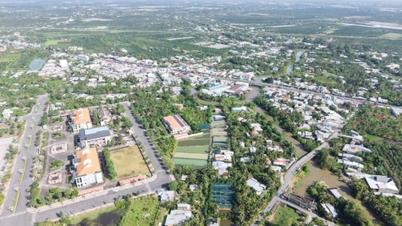
After more than half a century of effective operation, the Go Cong Freshwater Project is still considered an important "shield" protecting the eastern part of the province from the threat of saltwater intrusion. However, in the context of increasingly extreme climate change and ever-increasing water demand, the irrigation system, once considered one of the most successful in the Mekong Delta, is facing unprecedented challenges.
REVEALING SHORTCOMINGS
According to the Department of Agriculture and Environment of Dong Thap province, after more than 50 years of investment, the Go Cong Freshwater Project has formed a comprehensive network of interconnected works.

However, new challenges arose during implementation as the river's water regime and waterway transportation system underwent significant changes compared to the time of the project's design and construction.
While previously the freshwater supply in the Tien River was quite abundant, allowing for water intake through the Xuan Hoa sluice gate for many months of the year, the situation has now changed significantly. Saltwater intrusion is occurring earlier, lasting longer, and penetrating deeper into the inland areas.
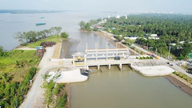
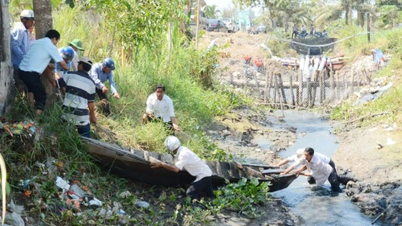
According to the Department of Agriculture and Environment, following the damage caused by saltwater intrusion in 2015-2016, the Ministry of Agriculture and Rural Development (now the Ministry of Agriculture and Environment) invested in an additional complex of four gates at the Xuan Hoa sluice gate to operate and support the extraction of freshwater when the tide recedes. Provincial budget funds have also been used to dredge over 20 first-level and main canals, with a volume exceeding 3 million cubic meters, to improve water storage. In addition, every year, from the budget allocated for production support and public services related to irrigation and rice cultivation, the province also provides funds to localities to invest in dredging inland canals, actively contributing to water storage to serve the people in drought and salinity control efforts. Thanks to this investment, even if saltwater intrusion during the 2026-2027 dry season is as severe as in 2015-2016, the Go Cong Freshwater Project area in the province will basically still be able to prevent saltwater intrusion and store freshwater, serving production and the livelihoods of people in the area. |
Meanwhile, water flow from the upper Mekong River is declining due to the impacts of climate change and the increase in hydropower projects on the main channel.
These changes have led to a progressive reduction in the system's ability to obtain fresh water.
On many occasions, the sluice gates have to be closed early to prevent saltwater intrusion, significantly reducing the amount of water stored for the dry season. This places immense pressure on the vast agricultural area of over 54,000 hectares, which is almost entirely dependent on the existing irrigation system.
According to Nguyen Thi My Hung, Head of the Rural Development Sub-Department of the Department of Agriculture and Environment of Dong Thap province, although the project plays an important role, the irrigation infrastructure of Go Cong still has many significant shortcomings.

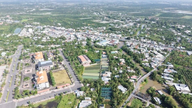

Specifically, the irrigation system is capable of preventing saltwater intrusion, but it does not fully guarantee drought prevention and control within the region, especially in the latter half of the dry season.
During years of severe drought and salinity, such as 2015-2016 and 2019-2020, this area experienced a shortage of irrigation water for some areas of winter-spring rice cultivation.
When the Vam Gong sluice gate is closed to prevent saltwater intrusion, and the Xuan Hoa sluice gate draws in freshwater, diverting water through the main canals to the downstream area (approximately 40-50 km) by gravity flow becomes very difficult.
In particular, many control sluices along the water transfer canals here have not been invested in, leading to a situation where there is excess water at the upstream but a shortage at the downstream.
EXPENSIVE LESSONS
In fact, the historic droughts of 2016 and 2020 caused significant damage to agricultural production in the province and affected the drinking water supply for many households.

The images of elderly farmers carefully collecting every drop of water to save their rice crops, canals and ditches drying up completely, and people waiting to get fresh water still haunt many.
When recalling the drought and salinity intrusion at the beginning of 2020, Mr. Ha Tan Gioi (Phu Thanh commune, Dong Thap province) cannot forget the image of his rice fields, which were in bloom, suffering from a lack of water. At that time, his family's 8.5 acres of rice were in bloom when a severe drought and salinity intrusion occurred.
Mr. Gioi said: “That year, the drought and salinity came very early. Although the government had given us an early planting schedule, we couldn't make it in time. My rice fields were affected, with about 80% of the yield lost. That was the most severe drought and salinity year and caused the most damage.”
Not only Mr. Gioi's family, but many other households in the project area also suffered heavy losses due to the prolonged lack of irrigation water. During the 2020 drought and salinity season, 2 hectares of winter-spring rice belonging to Mr. Tran Binh Tan's family (Gia Thuan commune) were completely lost due to lack of irrigation water.
Mr. Tran Binh Tan recalled: "In 2020, when the rice was flowering, there was no irrigation water. I and the villagers had to carefully collect every drop of water from the canal to pump onto the fields."
However, even pumping up water heavily contaminated with alum couldn't save the rice crop. My family and many other households around us had no choice but to watch our rice wither and die in the fields. That year, several hundred hectares of rice in the area around my house were completely lost due to lack of irrigation water. My family lost about 50 million dong that season.”
In addition to the lack of water for production, during the drought and salinity seasons of 2016 and 2020, thousands of households in the eastern part of the province faced shortages and difficulties in accessing water for daily use.
Mr. Dinh Trung Quoc's family is one of the households in Tan Dien commune that has not yet had access to a centralized piped water supply. To have water for daily use, his family collects rainwater in tanks and reservoirs.
During the historically severe droughts and saltwater intrusion of 2016, 2020, and 2024, when water reserves were depleted, his family had to carry plastic containers to public water taps to fetch water for their use.
Mr. Quoc shared: "Because we are at the end of the water supply, during the dry seasons of 2020 and 2024, the public water taps in the area had very weak water flow, and sometimes did not flow at all."
Because so many people came to get water, they had to wait their turn, and it took a long time to get it. Besides this water source, the people here also received support from water brought in by philanthropists. In general, during those years, access to clean water here was very difficult.”
According to statistics, during the 2015-2016 dry season, severe drought and salinity occurred in the province, causing 17,937 households to lack access to clean water, and damaging 3,775 hectares of winter-spring rice, 124 hectares of vegetables, and 113 hectares of fruit trees.
During the 2019-2020 dry season, drought and salinity caused damage to 8,568 hectares of winter-spring rice, 810 hectares of vegetables, 4,459 hectares of fruit trees, and approximately 92,000 households faced difficulties with access to clean water.
During the 2023-2024 dry season, despite saltwater intrusion being at approximately the multi-year average, about 17,650 households still lacked access to clean water. The figures on losses over the drought and salinity seasons demonstrate that the Go Cong Freshwater System continues to play a crucial role in preventing saltwater intrusion and protecting agricultural production.
However, practical experience also shows that the capacity for water storage and internal regulation is gradually approaching its limit in the face of increasingly extreme natural events.
The challenge now is not only to prevent saltwater intrusion more effectively, but also to proactively seek additional water sources to ensure long-term water security.
T. DAT
Source: https://baodongthap.vn/bai-2-nhung-thach-thuc-a242358.html

![[Photo] General Secretary and President To Lam attends the 13th National Congress of the Ho Chi Minh Communist Youth Union](https://vphoto.vietnam.vn/thumb/1200x675/vietnam/resource/IMAGE/2026/06/25/1782356968989_ndo_br_1-jpg.webp)























![[Photo] General Secretary and President To Lam receives Palestinian Ambassador Saadi Salama](https://vphoto.vietnam.vn/thumb/1200x675/vietnam/resource/IMAGE/2026/06/25/1782365384740_a1-bnd-9423-8322-jpg.webp)