

Lesson 1: When the fields are unprofitable
The fields are a money-making venture.
Few would believe that in Son Thuy commune, dozens of hectares of previously unproductive rice and corn fields have now become a source of income for the people, bringing in hundreds of millions, even billions of dong each year.
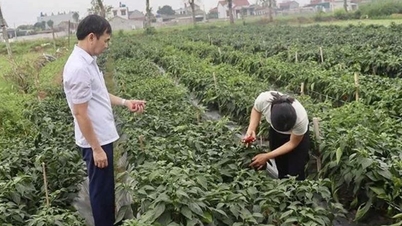
Since 2016, Ms. Nguyen Thi Tu's family in Thac Nong village decided to switch from growing corn and rice to growing chili peppers. When the yield of food crops had reached its limit and the market value had become saturated, with each hectare only yielding about 60-70 million VND per year, chili peppers opened up a completely different path. With 5 sao (approximately 0.5 hectares) of land, she grows chili peppers with a yield of about 1 ton per sao, selling at around 60,000 VND/kg, bringing her family 300-400 million VND annually.
Comrade Tran Van But, Chairman of the People's Committee of Son Thuy commune, said: from a small-scale model, the entire commune now has about 70 hectares of chili peppers. The locality is continuing to expand the area to 150 hectares, while forming a production and product consumption chain.
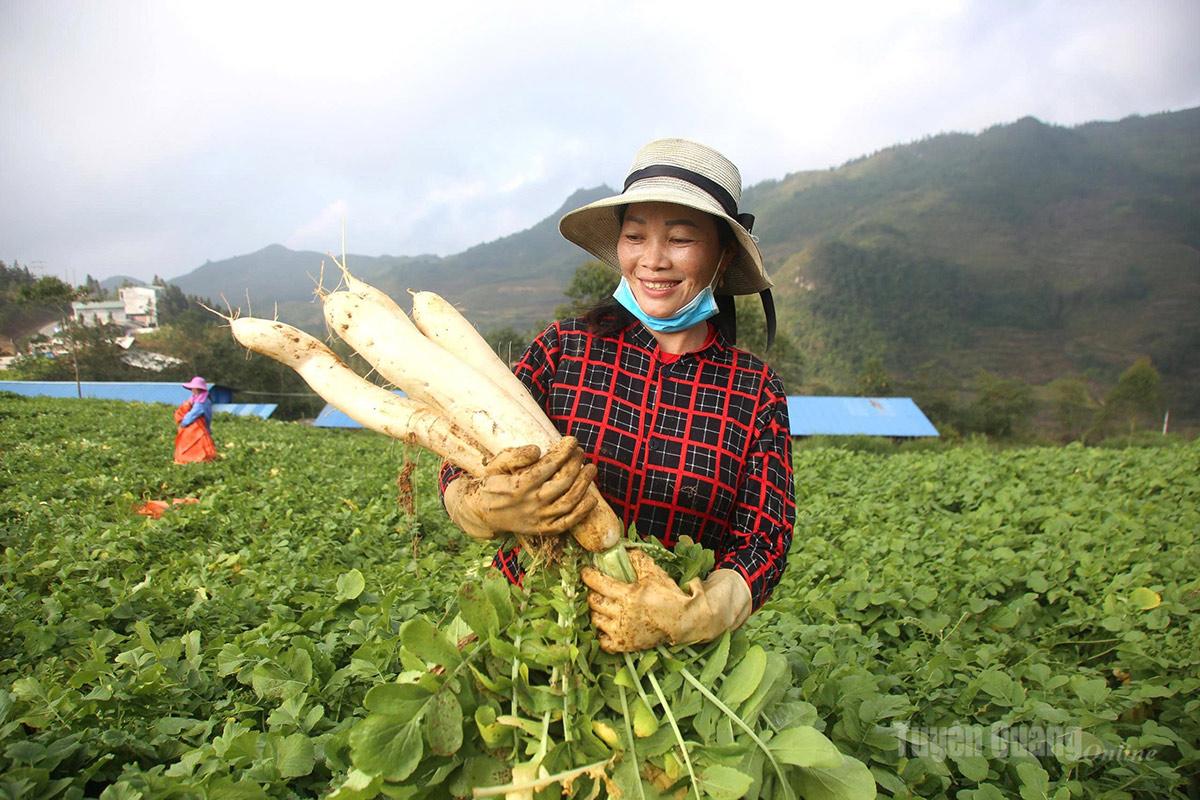 |
| Radishes are considered the "white ginseng" of the locality by the people of Xín Mần commune. |
Not only in Son Thuy, but also in the border region of Xin Man, the white radish crop is creating a surprising transformation, bringing in income and becoming a well-known export brand of the province. Since 2021, the locality has connected with Vietnam - Misaki Co., Ltd. to implement a model of growing and guaranteeing the export of white radishes. Initially, only a few households participated with a trial area of 7 hectares. Through testing, the radish crop showed suitability to the soil, growing well and yielding high productivity of 40-60 tons/ha, bringing in income of 80-120 million VND/ha for the people, a profit 3-4 times higher than growing corn and rice before.
Currently, the area planted with radishes here is maintained at about 40 hectares per year. For many households, this crop has become a means of escaping poverty. "Before, we were always struggling to make ends meet, but now we can earn 70-80 million VND per year, and life is getting better and better. The radish is now considered the 'white ginseng' of the people here," said Giang Ban Quang, from Quan Din Ngai village, excitedly.
In Vi Xuyen commune, from a swampy area, 35 households in village 29 have become prosperous by switching to growing climbing vegetables such as green squash, chayote, and loofah. Average income reaches over 100 million VND per household per year, with many households earning 200-300 million VND. Mr. Pham Manh Hung shared: "Previously, our family's land was only used for growing corn. Since 2017, we have switched to specializing in growing climbing vegetables for fruit. Each year we earn about 200 million VND, almost double that of growing oranges and 4-5 times more than growing corn."
In the rocky highlands of Dong Van, where rocks are more abundant than soil, the sweet potato plant is making a strong impact. From relying solely on a precarious corn crop, many households have now escaped poverty thanks to this plant, which yields 4-5 times more income . Currently, the entire commune has about 50 households growing sweet potatoes, covering a total area of over 15 hectares, with a yield of approximately 50 tons per hectare, providing a stable source of income for the people.
Mr. Vang Mi Say, from Ta Lung village, shared: "My family was the first in the commune to plant sweet potato ginseng. Although we initially registered for a trial planting without knowing the effectiveness, for the past 5 years, sweet potato ginseng has helped my family escape poverty and become increasingly prosperous."
Earning billions from new pets
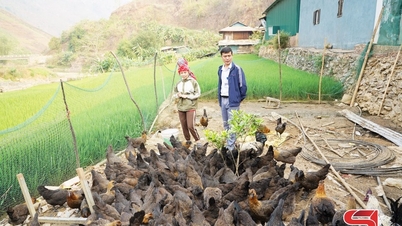
Not only in crop farming, but also in livestock farming, the transformation is yielding significant results. In Vinh Tuy commune, the civet farming model is becoming a bright spot. Bui Anh Phuong's family, the first household to raise civets in Vinh Tuy, shared: "Initially, we just thought of trying it out because we saw that many localities in the lowlands not only successfully raised them but also established large-scale farms. Since our mountainous region is the natural habitat of this species, why couldn't we raise them?" From 10 breeding pairs in 2021, Bui Anh Phuong's family has now expanded their herd to nearly 400 civets, generating nearly 2 billion VND in revenue annually.
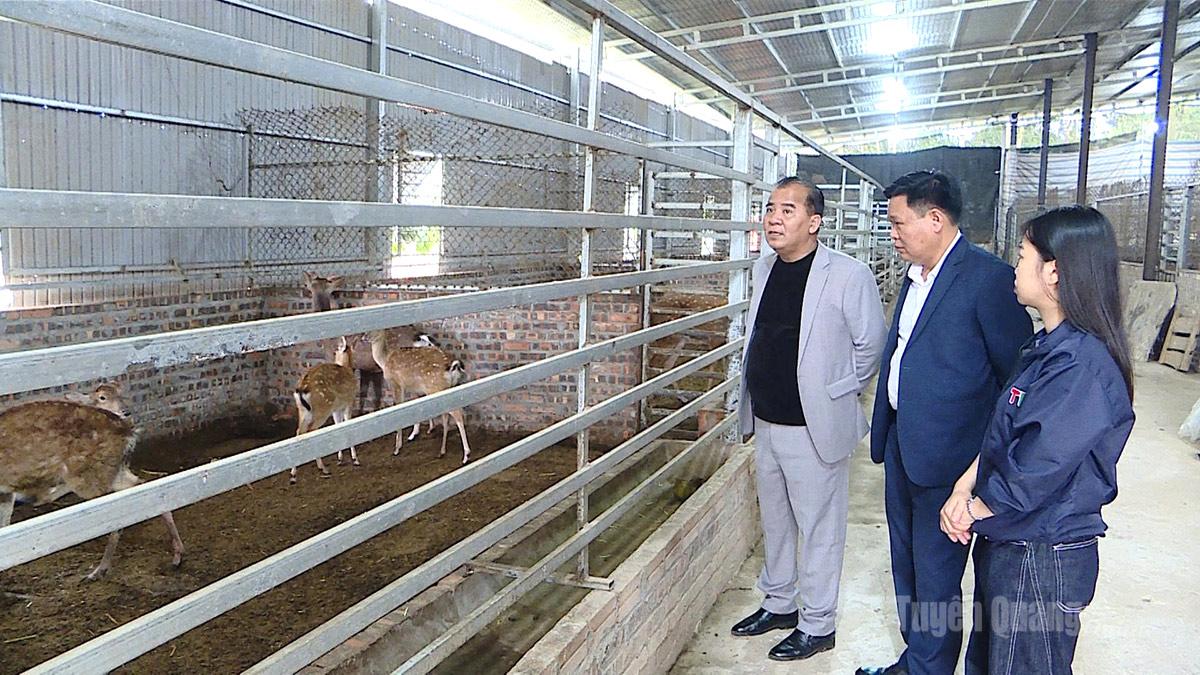 |
| The model of raising deer, frogs, and coconut beetles by Mr. Tran Van Dang, Tan Trao commune. |
Currently, the civet farming interest group in Vinh Tuy has 37 participating households, with a total herd of nearly 1,500 civets. Civets breed twice a year, with 3-4 offspring per litter; the selling price for commercial civets is 1.5-2 million VND/kg, and breeding pairs cost around 9 million VND. High market demand helps farmers earn an income of 300-700 million VND per household per year.
According to Nguyen Van Cuong, Chairman of the People's Committee of Vinh Tuy commune: "The households raising civets in the commune are those with small agricultural land areas, so switching to this breeding model is very suitable. The market demand for this species is very high. Therefore, the commune has planned to establish a Civet Breeding Association to both expand the scale and build it into a brand for the commune's agricultural products."
In Hung An commune, the model of raising spotted bamboo rats by young man Dang The Hung in Gian Thuong village has also proven effective. Starting with 40 breeding pairs, after one year the herd has increased to 200 animals. Currently, this model brings in an income of over 100 million VND per year.
Hung shared: "Raising bamboo rats is easy, requires little effort, and doesn't need much space for building cages. Over the past 5 years, I've been expanding the size of my herd, selling commercial products, and selling breeding stock to maintain my income. In the future, I plan to further expand the herd to 500 animals, including about 200 breeding females."
Meanwhile, Mr. Tran Van Dang's integrated livestock farming model in Tan Trao commune is a clear example of large-scale production thinking. His farm currently raises nearly 300 deer, 20,000 coconut beetles, and 15 tons of frogs, generating over 50 billion VND in revenue annually. According to Mr. Dang, the key to success is choosing livestock with a large market demand, low risk, short rearing time, and reasonable feed costs.
The key to enhancing agricultural value.
After directly surveying production models and listening to the thoughts and aspirations of farmers in the province, Professor and agricultural expert Nguyen Lan Hung assessed that effective crop and livestock farming models are those that select the right types of crops and livestock suitable for the local soil, meet market demands, and build a production and product distribution chain.
According to Deputy Director of the Department of Agriculture and Environment Trinh Van Binh, new models and methods in restructuring crop and livestock production are suitable for local conditions, bringing high economic efficiency and gradually changing the production mindset of farmers. They contribute to shaping new, high-value crops and livestock to focus on encouraging their development into characteristic, specialty, and key agricultural products of the localities, increasing land use value, increasing income per land area, and improving people's income.
In reality, success doesn't come from "doing what you have," but from boldly shifting to "doing what the market needs." More importantly, it's about changing the mindset from agricultural production to agricultural economics. This is also the inevitable direction in the new context, where agriculture is no longer just about ensuring food security, but must also become a high-value production sector contributing to sustainable economic growth.
(to be continued)
Text and photos: Nguyen Dat, Doan Thu, Duy Tuan
Source: https://baotuyenquang.com.vn/kinh-te/202604/bai-2-tu-duy-moi-tren-dong-dat-cu-1cf274e/
![[Photo] Mrs. Ngo Phuong Ly meets and exchanges views with Mrs. Peng Li Yuan](https://vphoto.vietnam.vn/thumb/1200x675/vietnam/resource/IMAGE/2026/04/16/1776277858080_phu-nhan-1-jpg.webp)
![[Photo] General Secretary and President To Lam and his wife, along with General Secretary and President Xi Jinping and his wife, attending a tea party.](https://vphoto.vietnam.vn/thumb/1200x675/vietnam/resource/IMAGE/2026/04/15/1776245678527_vna-potal-tong-bi-thu-chu-tich-nuoc-to-lam-va-phu-nhan-cung-tong-bi-thu-chu-tich-nuoc-tap-can-binh-va-phu-nhan-du-tiec-tra-8702812-9829-jpg.webp)
![[Photo] National Assembly Chairman Tran Thanh Man concludes official visit to Italy, departs for IPU-152](https://vphoto.vietnam.vn/thumb/1200x675/vietnam/resource/IMAGE/2026/04/15/1776253436109_vna-potal-chu-tich-quoc-hoi-ket-thuc-tham-chinh-thuc-italy-len-duong-du-ipu-152-tai-tho-nhi-ky-8702876-7969-jpg.webp)
![[Image] Overview of the Tam Trinh-Giai Phong connecting road section after land clearance is completed.](https://vphoto.vietnam.vn/thumb/1200x675/vietnam/resource/IMAGE/2026/04/15/1776245679644_ndo_br_dji-0195-jpg.webp)
![[Image] Current status of the land area of over 5.5 hectares that Ho Chi Minh City is considering reclaiming.](https://vphoto.vietnam.vn/thumb/1200x675/vietnam/resource/IMAGE/2026/04/15/1776245690095_1-3102-8409-jpg.webp)
![[Photo] General Secretary and President To Lam and General Secretary and President Xi Jinping meet with youth from both countries.](https://vphoto.vietnam.vn/thumb/1200x675/vietnam/resource/IMAGE/2026/04/15/1776245687540_vna-potal-tong-bi-thu-chu-tich-nuoc-to-lam-va-tong-bi-thu-chu-tich-nuoc-tap-can-binh-gap-go-thanh-nien-hai-nuoc-8702371-jpg.webp)













![[Photo] Capturing each moment at the "People We Meet" photography exhibition.](https://vphoto.vietnam.vn/thumb/1200x675/vietnam/resource/IMAGE/2026/04/15/1776245695648_1-8944-jpg.webp)











































Comment (0)