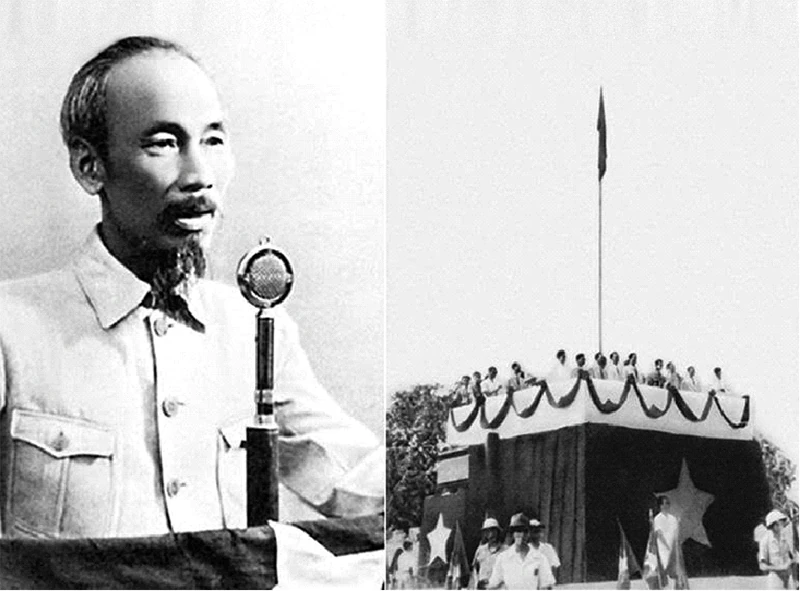
President Ho Chi Minh solemnly read the Declaration of Independence at Ba Dinh Square on September 2, 1945. Photo: Archival material.
The Declaration of Independence - The Voice of the Nation
(Baothanhhoa.vn) - The clear, high, and transparent sky, along with the golden sunlight illuminating the landscape in autumn, fills the heart with a sense of tranquility and wistfulness... For the Vietnamese people, the autumn days of August also hold special significance, reminding them of the event when President Ho Chi Minh read the Declaration of Independence (September 2, 1945), giving birth to the Democratic Republic of Vietnam.
 Báo Thanh Hóa•02/09/2025
During those months, "The Old Man" sat down to draft the Declaration of Independence.
On the second floor of the house at 48 Hang Ngang Street, "a small, dimly lit room in a secluded house nestled among the thirty-six ancient streets of Hanoi," during the historic autumn days of 1945, "The Old Man" (the nickname of President Ho Chi Minh at the time), a thin man with a long, sparse beard, but with bright, intelligent eyes and a high, broad forehead, was pouring his heart and mind into drafting the first words of the Declaration of Independence. This was President Ho Chi Minh – the national liberation hero, a world cultural figure, the brilliant and respected "captain" who steered the Vietnamese revolutionary ship to success.
The Declaration of Independence began to be drafted by President Ho Chi Minh after a meeting of the Central Party Standing Committee at 48 Hang Ngang Street on August 26, 1945. Prior to that, on August 25, 1945, President Ho Chi Minh returned to Hanoi from Tan Trao. At the meeting, President Ho Chi Minh agreed with the principles regarding domestic and foreign affairs in the new situation, and the early announcement of the list of government members... Along with that, President Ho Chi Minh proposed: “The composition of the government must be further expanded to include representatives of all strata of the people, patriotic parties, and independent intellectuals; the Declaration of Independence must be drafted and a large rally organized in Hanoi for the Provisional Government to be presented to the people; the day of the government's presentation will also be the day Vietnam officially declares its independence and establishes a democratic republic.”
Despite the tight deadline and fatigue from the long journey and recent recovery from a serious illness, President Ho Chi Minh worked diligently, sometimes writing by hand, sometimes typing. During the drafting of the Declaration of Independence, he still exchanged ideas and listened to suggestions from close comrades, carefully considering, adjusting, and adding points to the draft.
You may also like

Launch of the photo book "Nguyen Ai Quoc - Ho Chi Minh and Russia"On the afternoon of June 1st, the Ho Chi Minh Presidential Palace Historical Site launched a bilingual photo book titled "Nguyen Ai Quoc - Ho Chi Minh with Russia" to commemorate the 76th anniversary of the establishment of diplomatic relations between Vietnam and the Russian Federation (1950 - 2026).
Strictly manage retail electricity prices in rental accommodations to protect the rights of tenants.Given the increasing number of workers, students, and laborers renting accommodation in Thanh Hoa province, ensuring compliance with regulations on retail electricity prices is not only a legal requirement but also a crucial solution to protect the legitimate rights of citizens, contributing to social welfare and building a transparent and fair business environment.
Dispensing justiceIn recent days, several opposition organizations and individuals abroad have been simultaneously spreading rhetoric about so-called "transnational repression" in Vietnam. A series of articles, online discussions, petitions, and lobbying efforts have been launched with high frequency to create the impression that this is an internationally recognized "human rights issue." However, upon closer examination, this is merely a familiar propaganda tactic, repeatedly presenting unproven claims to create the illusion of truth.
On August 31, 1945, President Ho Chi Minh invited the ministers of the Provisional Government to the Northern Government House to approve the content of the Declaration of Independence. As the clock in the Northern Government House solemnly struck eight times, the doors opened, President Ho Chi Minh stepped in, and immediately began the work: “Time is of the essence. I propose that in early September, our Government present itself to the nation and read the Declaration of Independence. I have prepared it. Please submit the draft for your review. I request a thorough review. Because we will read it not only for our compatriots throughout the country, but also for the French Government and people, and for all the Allied nations.”
The Declaration of Independence was drafted and perfected in such a special way, in preparation for a landmark event, to be proclaimed during the most moving and sacred moment in the nation's history. “Just over a week before, Hanoi was a protectorate city, swarmed with spies; the mere sight of the red flag would send the entire enemy's ruling apparatus into a frenzy like wild beasts. Yet now, the red flag fluttered throughout the streets. That night, leader Nguyen Ai Quoc was sitting in the heart of Hanoi drafting the Declaration of Independence, ushering in a new era for the nation: the era of independence and freedom. It was truly miraculous. Revolution is a miracle. And it was He, from Nguyen Ai Quoc to Ho Chi Minh, who, together with the entire nation, created that miracle,” – Comrade Vu Ky's recollections evoke deep emotions.
The birth certificate of the Democratic Republic of Vietnam
General Secretary Truong Chinh, who participated in the rally at Ba Dinh Square on September 2, 1945, recounted that momentous occasion with heartfelt emotion, gathering all the excitement, joy, and boundless happiness: “The whole of Hanoi was a forest of flags and flowers. A gigantic rally, unprecedented in the history of the capital. Nearly a million people of all social classes, ages, and backgrounds flocked from all directions to Ba Dinh Square to attend the great national celebration. More than 20 million people nationwide joyfully looked forward to the occasion. Friends from around the world eagerly awaited. The new regime was born, life had changed, a new era for the nation had begun, and the future of the nation, of each Vietnamese person, was firmly in our hands.”
In the presence of a large and enthusiastic nation, President Ho Chi Minh, on behalf of the Provisional Government, solemnly read the Declaration of Independence. “Fellow countrymen!” – President Ho Chi Minh’s warm, resonant voice echoed from the platform. The two words “fellow countrymen” sounded so familiar and endearing. The people of Vietnam, the “descendants of Lac and Hong,” who share a common origin, born from the hundred eggs of Mother Au Co, now gathered here in a shared joy and spirit.
After his opening remarks, which served as a greeting to the nation, President Ho Chi Minh began the Declaration of Independence by citing the views and ideas on human rights and equality in the 1776 American Declaration of Independence and the 1791 Declaration of Human Rights and Citizen Rights of the French Revolution. President Ho Chi Minh's subtlety, skill, and sharpness lay in using the very views and ideas of the enemy to argue and clarify the "two-faced," deceitful nature of colonialism. Those who always considered themselves the "mother country," always preaching freedom, democracy, and "civilizing enlightenment," were in fact the invaders, brazenly plundering wealth, trampling on human dignity, and plunging the lives of countless people into misery. From there, President Ho Chi Minh arrived at the important point: "Broadly speaking, that statement means: all nations in the world are born equal, every nation has the right to live, the right to happiness and the right to freedom," "these are undeniable truths."
With eloquent, coherent, and forceful language, and rigorous argumentation, President Ho Chi Minh condemned and denounced the crimes committed by the French colonialists against our country and our people. President Ho Chi Minh's arguments consistently revealed the two opposing dimensions between us and the enemy. While the French colonialists "absolutely denied our people any freedom or democracy," "implemented barbaric laws," "built more prisons than schools," "ruthlessly slaughtered our patriotic and nationalistic people," and "drowned our uprisings in rivers of blood,"... on the other side of conscience and compassion, "the Viet Minh repeatedly called on the French to form an alliance against Japan," and "our people maintained a tolerant and humane attitude," helping many French people escape across the border, rescuing many French people from Japanese prisons, and protecting their property and lives.
It was brutal colonialism that forced a nation that cherished peace, a nation whose people were honest, gentle, and full of compassion and forgiveness, to take up arms and fight. “A nation that has bravely resisted French enslavement for over 80 years, a nation that has bravely stood with the Allies against fascism for several years, that nation must be free! That nation must be independent!” The Declaration of Independence concludes with a firm affirmation, a resounding declaration before the Vietnamese people and the whole world, of the unwavering determination to protect the independence and freedom of the entire Vietnamese nation: “Vietnam has the right to enjoy freedom and independence, and in fact has become a free and independent nation. The entire Vietnamese nation is determined to dedicate all its spirit and strength, its life and property, to uphold that right to freedom and independence.”
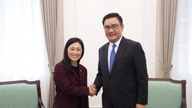
The Ministry of Foreign Affairs received a copy of the Letter of Credence for the U.S. Ambassador to Vietnam.On the afternoon of July 2nd, at the Ministry of Foreign Affairs headquarters, Mr. Le Cong Dung, Director of the State Protocol and Foreign Interpretation Department, received a copy of the Letter of Credence from Ms. Jennifer Wicks, Ambassador of the United States of America to Vietnam.

Ambassador Nguyen Quoc Dung visits and works in Minnesota, USA.From June 28-30, the Vietnamese Ambassador to the United States, Nguyen Quoc Dung, paid a visit and worked in Minnesota.

Vietnam encourages US businesses to expand investment in high technology.On the morning of June 26th, at the Government Headquarters, Deputy Prime Minister Ho Quoc Dung received Mr. Jeff Place, Supply Chain Director of Coherent Group (USA). During the meeting, the Deputy Prime Minister affirmed that Vietnam encourages US businesses to expand investment, especially in high-tech, innovation, and semiconductor industries.
If President Ho Chi Minh was "a man who became the embodiment of the historical encounter between a nation and an era," then the Declaration of Independence, with its more than 1,000 words, encompassed issues concerning humanity, the nation, and the people, as well as arguments of epochal significance. The Declaration of Independence is a model of political writing, a document of profound historical significance, high theoretical value, distilled from turbulent realities, and its value remains intact to this day. The sound of President Ho Chi Minh reading the Declaration of Independence amidst the autumn sunshine of Ba Dinh Square is the most beautiful sound in the nation's heroic epic. Every sentence, every word in the Declaration of Independence is the voice of the nation for millennia, a solemn oath of loyalty and devotion to the path towards Socialism, to the aspiration of Independence, Freedom, and Happiness.
This article uses material from the book "Uncle Ho Wrote the Declaration of Independence" (Kieu Mai Son, Kim Dong Publishing House, 2025).
Huong Thao
Source: https://baothanhhoa.vn/ban-tuyen-ngon-doc-lap-loi-nuoc-non-258675.htm

Trending by Category
![[Live] Exchange program “80 Years of Keeping the Oath” commemorating the 80th anniversary of the People's Security Force's traditional day.](https://vphoto.vietnam.vn/thumb/402x226/vietnam/resource/IMAGE/2026/07/02/1782997764964_truc-tiep-nbsp-w1200t0-di2626d272d4194258t13840l1-banner-80-nam-n2.webp)
Most Read









Google Trends






Same author







































New planting season

Hmong Flute Festival