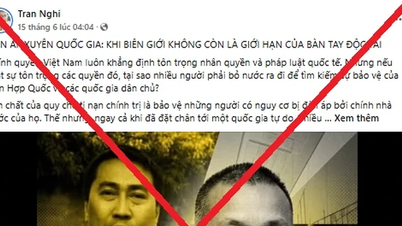
This is not a new tactic. For many years, exiled reactionary organizations like Viet Tan, along with some anti-government websites such as Thoibao.de, Chan Troi Moi Media, Nguoi Thuong vi Cong Ly (Montagnards for Justice), etc., have consistently used the same "script." They deliberately construct elaborate narratives with complete characters, settings, and euphemisms such as "democracy activist," " human rights defender," "dissident voice," etc., to conceal the true nature of individuals who have committed serious violations of the law.
Their tactic is not to completely deny the truth, but to selectively choose the most favorable pieces, omitting the entire legal context and relevant evidence, thereby creating a distorted picture. Decisions regarding prosecution, arrest warrants, extradition, or trials conducted in accordance with the law are deliberately interpreted as "repression"; the handling of criminals is misrepresented as "silencing dissenting voices." This is a fallacy of conceptual manipulation aimed at confusing public perception.
One typical case is that of Y Quynh Ddap. Opposition websites deliberately portray him as a "human rights activist" being "hunted across borders." However, the reality is quite the opposite. Vietnamese prosecuting authorities determined that Y Quynh Ddap was involved in the particularly serious terrorist attack in Cu Kuin (Dak Lak) in June 2023, which resulted in numerous deaths and injuries. After fleeing abroad, he was investigated by Thai authorities in accordance with Thai law and international cooperation principles in combating crime before being extradited to Vietnam. This is a normal judicial process between sovereign nations, and not a "transnational repression" campaign as reactionary organizations deliberately distort.
Similarly, Nguyen Van Dai has been praised by opposition groups for many years as a "symbol of democracy." However, the sentences against him all stem from violations of the law that were investigated, prosecuted, and tried according to legal procedures. In 2007, Nguyen Van Dai was prosecuted for disseminating anti-state propaganda. After serving his sentence, instead of abandoning his subversive activities, he continued to organize and connect with reactionary forces, receiving funding from abroad to build a network of activities aimed at opposing the State. Nguyen Van Dai himself admitted to receiving financial resources from foreign organizations to support his activities. Given these actions, criminal prosecution is inevitable according to the law and cannot be equated with "suppressing dissidents."
The case of Le Trung Khoa is similar. Under the guise of operating an "independent news" website, for many years, he continuously posted and disseminated distorted, fabricated, and defamatory information against Party and State leaders; colluding with many reactionary organizations abroad to carry out activities against Vietnam. Given these actions showing signs of criminal activity, the Security Investigation Agency of the Ministry of Public Security has initiated criminal proceedings, issued arrest warrants, and launched a manhunt in accordance with the provisions of the Criminal Procedure Code and the Criminal Code. When a person is prosecuted for violating the law, it is a process of administering justice, not "repression" as deliberately fabricated by opposition organizations.





The distorted narratives of hostile forces.
It is noteworthy that subversive forces consistently blur the lines between freedom and illegal acts. They attempt to turn criminals into "prisoners of conscience," and transform acts of sabotage against the State into "exercising freedom of speech." However, in any rule-of-law state in the world, no freedom is unlimited. The 2013 Constitution of Vietnam clearly affirms that human rights and civil rights are recognized, respected, protected, and guaranteed according to the Constitution and laws. At the same time, the Constitution also stipulates that the exercise of these rights may be restricted when necessary for national defense, national security, social order and safety, social morality, and public health. The freedom of religion, freedom of the press, and freedom of speech are all guaranteed, but no one may abuse these rights to infringe upon national interests or the legitimate rights and interests of other organizations and individuals.
This is also a universal principle enshrined in many international human rights conventions to which Vietnam is a signatory. No country accepts the use of "freedom of speech" to incite the overthrow of the government, propagate terrorism, divide the nation, or infringe upon national security. Therefore, Vietnam's handling of violations according to the provisions of the Penal Code, the Cybersecurity Law, the Press Law, the Law on Beliefs and Religions, etc., is entirely consistent with national law as well as international practice.
Practical experience completely refutes the claims that Vietnam "controls the Internet" or "silences dissenting voices." After nearly 40 years of reform, Vietnam is one of the countries with the fastest digital infrastructure development in the region; tens of millions of people use social media daily, hundreds of media outlets operate, and millions of opinions are openly exchanged online. People easily access information, online public services, education, healthcare, e-commerce, and many modern digital platforms. These achievements are vivid evidence of the expansion of people's access to information and their right to participate in social life, completely contradicting the accusations of "total Internet control."
Moreover, Vietnam has been repeatedly elected by the international community to the United Nations Human Rights Council with a high number of votes. This is not merely a formal recognition but reflects Vietnam's substantive efforts in promoting and protecting human rights, improving the legal framework, enhancing social welfare, and ensuring the right to development for all citizens. The practical achievements in economic development, poverty reduction, education expansion, healthcare, digital transformation, and improving the quality of life for its people are the most convincing evidence of this commitment.
Ultimately, the so-called "transnational repression" is merely a propaganda product fabricated to serve the subversive agenda against Vietnam. The essence of the issue is not repression but the administration of justice; not silencing dissidents but strictly punishing acts that violate the law, infringe upon national interests, and harm the legitimate rights and interests of others.



In a socialist rule of law state, all citizens are equal before the law. Freedom is always respected and guaranteed, but it must be exercised within the framework of the Constitution and laws. No individual or organization can stand outside the law or exploit universal values of democracy and human rights to cover up acts of sabotage against the country. This is not only a principle of Vietnam but also a standard of all civilized nations. Therefore, all actions taken against those who violate the law are acts of justice, protection of social equity, and safeguarding national interests, and are absolutely not what hostile forces deliberately distort as "transnational repression."
Trung Tin
Source: https://baophutho.vn/thuc-thi-cong-ly-256954.htm


































![[Photo] Thousands of people participate in a run to show their support for the campaign "Sharing a common determination to build drug-free communes, wards, and special zones".](https://vphoto.vietnam.vn/thumb/1200x675/vietnam/resource/IMAGE/2026/06/27/1782554475933_0673e2a3df7b5e25076a-8283-jpg.webp)







































![[Live] Hanoi in motion: "Don't leave the elderly and children alone in their own families"](https://vphoto.vietnam.vn/thumb/402x226/vietnam/resource/IMAGE/2026/06/27/1782561963792_screenshot-2026-06-27-183612.jpeg)