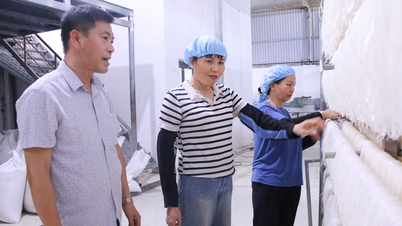
To make authentic Vietnamese rice rolls, the artisans of Kênh village demand meticulous attention to detail in every step of the process. The rice used must be of high quality and soaked for 3-4 hours before grinding. The flour is only ground using a stone mill to maintain its smoothness, glossiness, and natural whiteness. After grinding, the flour is soaked overnight, and the next morning the old water is drained off and replaced with fresh, clean water to preserve its whiteness and elasticity. On hot days, ice is added during soaking to keep the flour fresh and delicious.
Adjusting the temperature in the kitchen is also very important. When starting to cook the rice rolls, the cook must increase the heat to create a large amount of steam. When the lid is opened, the roll should puff up; only then is it considered to be up to standard. Besides that, the process of storing the rice rolls also requires skill. Because the rice rolls are very thin, when storing them, the cook must be both quick and skillful to avoid tearing them.

The accompanying condiments are one of the key elements that make Kênh village's rice rolls so appealing. The fried shallots are made from local onions, thinly sliced and fried in a pan with plenty of oil until they expand and release their aroma. Finely chopped wood ear mushrooms are thoroughly fried in pork fat, resulting in a chewy yet crispy texture. The cinnamon-flavored pork sausage served alongside is fragrant, rich, and smooth.
Hot steamed rice rolls are dipped in a skillfully prepared fish sauce made from water, vinegar, sugar, and a little caramel coloring in a specific ratio, creating a light brown sauce with a sweet and sour taste. When eating, diners can add a few drops of lime juice for a refreshing sourness and a few thin slices of chili for a spicy kick. All these elements combine to create a rustic yet rich and unforgettable dish.
With its traditional values and elaborate preparation techniques, in 2022, Kênh village's rice rolls were recognized by the Vietnam Record Organization as one of the Top 100 Vietnamese specialty dishes (2021-2022), affirming its position as a specialty dish with a distinct local flavor.



Source: https://dulichninhbinh.com.vn/item/3265



![[Photo] Strengthening character and expertise: Intense training for artillery soldiers.](https://vphoto.vietnam.vn/thumb/1200x675/vietnam/resource/IMAGE/2026/06/30/1782815602541_lu-368-1875-4571-jpg.webp)