

The Southwestern region of Vietnam is famous for its hundreds of unique, rich, and diverse traditional cakes. Whether they are cakes associated with Tet (Lunar New Year), ancestral worship ceremonies, or everyday snacks, each cake carries its own meaning. Among these cakes, puffed rice cakes seem to embody both the fragrant and refined qualities, perfect for offerings on New Year's Eve and the third day of the Lunar New Year; and the familiar, rustic charm, often used to wrap sticky rice or as a wrapper for candy.
In the Mekong Delta, there are two types of puffed rice cakes. One is savory, made from tapioca flour, wheat flour, and shrimp. The other is sweet, made from glutinous rice (or cassava), sugar, coconut milk, and other local ingredients. There is no definitive answer as to when puffed rice cakes originated, but many elderly people believe that sweet puffed rice cakes likely came first, and savory puffed rice cakes are a later variation.
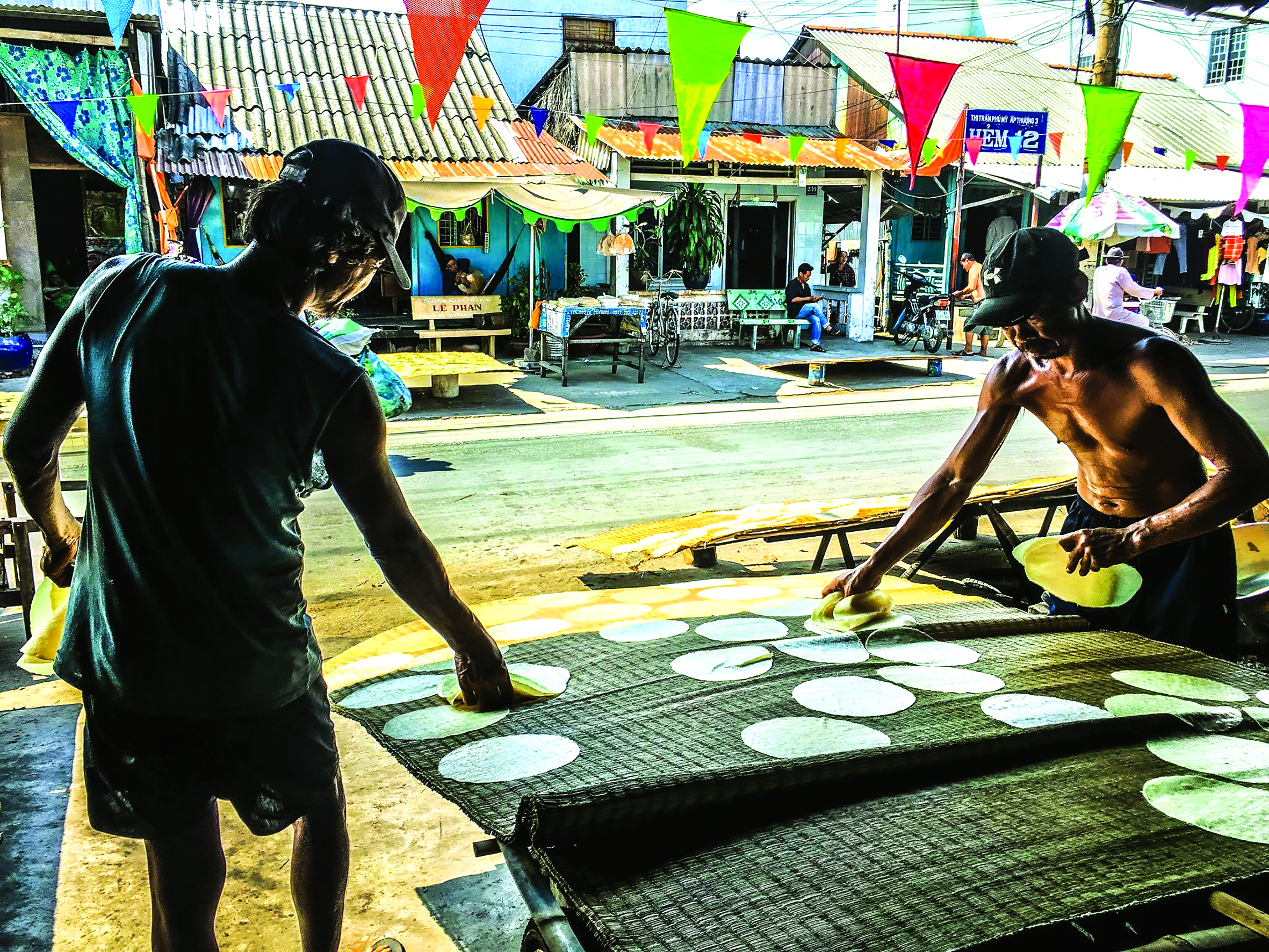
Drying puffed rice cakes at Phu My Puffed Rice Cake Village (Phu Tan district, An Giang province). Photo: PHUONG HUYNH
Just like the tradition of making banh chung and banh giay (traditional Vietnamese rice cakes) for Tet (Lunar New Year) in Northern Vietnam, people in Southern Vietnam also have their own Tet cakes. During the migration and settlement of new lands, producing food in these new territories was a difficult and challenging process. Therefore, food and grains were considered extremely precious and sacred. A folk song says: "Oh, whoever holds a bowl of rice, each grain is fragrant and delicious, yet contains countless hardships." With that meaning, after each harvest, our ancestors used the harvested grains from their fields to prepare simple dishes to express their gratitude to their forefathers. Besides banh tet and banh u, banh phong (puffed rice cakes) also originates from this mindset of the riverine agricultural culture .
The Phu Tan Island region (An Giang province) has a long tradition of growing glutinous rice, giving rise to glutinous rice puffs. The Bay Nui region, favorable for growing wild cassava, produces cassava puffs. The Son Doc area (Ben Tre province), with its abundant coconut plantations, produces coconut puffs containing both wheat flour and glutinous rice flour, and especially a very rich coconut milk flavor… Depending on the natural resources and fruits of each region, puffs will have different variations, both suitable for the available ingredients and diverse in form and taste to suit the local population.
Besides, making puffed rice cakes requires the cooperation of many families. Families with good quality glutinous rice or freshly harvested cassava, families with freshly cooked palm sugar, families with bundles of dried coconut, families with freshly dried sesame seeds… they all pool their resources to make the rice flour batter. At that time, the villagers gather around a stone mortar, the young men take turns pounding the flour, and the women take turns rolling the cakes. The atmosphere during these cake-making days is truly lively, and the bonds of community are strengthened through these shared efforts.
After being rolled into a round, flat shape, the cakes are left to dry, absorbing the essence of heaven and earth. As Tet approaches, they are baked over a fire fueled by straw or coconut leaves. This type of fire burns cleanly, smokeless, and intensely, like the fires of the pioneering era. The baker must be skilled, able to withstand the intense heat; they must know how to control the fire and how to ensure the cakes rise evenly. A small fire will burn the cakes if not turned evenly; a large fire will burn them if not turned quickly enough. In the blazing fire illuminating the courtyard, the baker's nimble hands move like a dancer in a space filled with the light of the fire, the sound of the cakes rising, and the aroma of cooked starch… These things blend together to become vivid memories in the hearts of many, a highlight of Tet, and whenever the monsoon winds arrive, the heart yearns for these puffed rice cakes…
People in the Mekong Delta are straightforward, honest, and outspoken; they say what they see and think. The "u-shaped" cake is called "bánh ú," the cake that needs to be "cut" into slices with string is called "bánh tét," and the cake that puffs up when baked is called "bánh phồng." This mindset is reflected in the simple offerings during the three days of Tet (Lunar New Year), symbolizing their wishes and aspirations. They display a five-fruit platter containing custard apple, fig, coconut, papaya, and mango, with the intention of "wishing for enough to use." They offer "bánh phồng" with the hope that the new year will be prosperous, abundant, and that good things will "puff up" abundantly… However, many elderly people believe that, like the simple yet profound nature of the people of the Mekong Delta, the "puff" cake, besides its name signifying wishes for the new year, is a cake made from grains, absorbing the sun and dew of the earth, imbued with the warmth and neighborly affection of the community, and baked over a vibrant fire. These things are considered to be a wholehearted achievement, imbued with profound philosophical meaning, offered as a tribute to our ancestors.
I remember the years when our family was poor. During Tet (Vietnamese New Year), we couldn't afford delicious candied fruits for the New Year's Eve offering or chicken for the third day's offering. My grandfather told us to just use puffed rice cakes. These cakes not only united the community but also bridged the gap between rich and poor in the village. Though we didn't have much, my grandfather contributed his labor making the cakes, so the neighbors shared dozens of them with us. In the village, regardless of wealth, as long as we weren't lazy, we would still have puffed rice cakes to offer to our ancestors during Tet. With the hope of "plumping up" and the teachings of our ancestors, "no matter how poor you are, if you work diligently, you'll have puffed rice cakes to eat during Tet," my whole family worked hard cultivating the land. A year later, besides contributing to the making of the cakes, my family was able to contribute more rice, sweet potatoes, and other things… And alongside the puffed rice cakes, there were also candied fruits for a prosperous and abundant Tet.
Like the character of the people of the Mekong Delta, puffed rice cakes carry very special meanings, closely linked to agricultural life. Whether used as an offering in religious ceremonies, a snack for children, or added to candy or sticky rice, puffed rice cakes always exude a fragrant and unmistakable essence.
Source
![[Photo] General Secretary and President To Lam presides over a meeting with the Central Organizing Committee.](https://vphoto.vietnam.vn/thumb/1200x675/vietnam/resource/IMAGE/2026/06/03/1780482764658_a1-bnd-4741-3342-jpg.webp)
![[Photo] Secretary of the National Assembly Party Committee, Chairman of the National Assembly presides over the meeting of the Standing Committee and Executive Committee of the National Assembly Party Committee.](https://vphoto.vietnam.vn/thumb/1200x675/vietnam/resource/IMAGE/2026/06/03/1780480353201_ndo_br_bnd-2585-jpg.webp)
![[Photo] First session of the 14th Congress of the Vietnam Trade Union](https://vphoto.vietnam.vn/thumb/1200x675/vietnam/resource/IMAGE/2026/06/03/1780465947883_ndo_br_img-3852-jpg.webp)





























![[Video] Sunset at Lap An Lagoon – Where the sun sets over the fishing nets](https://vphoto.vietnam.vn/thumb/1200x675/vietnam/resource/IMAGE/2026/05/31/1780192137701_beach-landscape-sea-water-nature-grass-745871-pxhere-com.jpeg)






















Comment (0)