Although it's no longer purely "rural," the market still retains the delicious treats from decades ago. And even though you buy so much that your hands are heavy, from vegetables and fruits to meat, you still have to lug along a "bunch" of traditional cakes, especially a few dozen sticky rice dumplings.
Anyone who has never made sticky rice dumplings before might think they're not too complicated at first glance. However, sticky rice dumplings are considered a labor-intensive dish, requiring many steps in the preparation process.
The main ingredients of banh u (rice dumpling) are glutinous rice and mung beans. Thanks to the skill of the person wrapping them, banh u from rural markets have their own unique flavor.
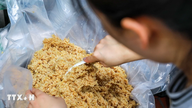
The person making the cakes must pick out any unripe grains mixed in, then wash the glutinous rice thoroughly with clean water and drain. Small mung beans are soaked in water until they swell, then carefully peeled. The pork used for the filling must be pork belly marinated with ground pepper and several characteristic spices of the countryside kitchen. Besides the glutinous rice and beans, banana leaves and string for tying the cakes are also prepared several days in advance. Each time they wrap the cakes, everyone spreads out a mat, gathers around, and each person quickly wraps each cake.
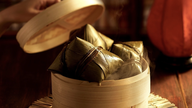

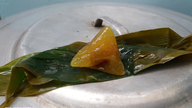
Wrapping the rice cake is also an art form. If the wrapper isn't skillful, the cake will be uneven in size and won't look appealing. Careful and skillful placement of the glutinous rice into the banana leaf is essential; it must be neatly and evenly distributed before wrapping the leaf and folding the edges at both ends of the cake to ensure a tight, even, and balanced fit.

The cake must be perfectly shaped, with sharp edges and a slender form, four pointed corners, and six equal sides. The string used to tie the cake should not be too tight so that the glutinous rice grains can expand and cook evenly when boiled.
After preparing the dough, gently fill the pot with the mixture and place it over a charcoal fire. Cook for several hours until the cakes are evenly cooked, then remove them from the pot.
With each bite, you'll experience the full flavor of the marinated meat, the soft, cooked mung beans blended with sticky rice, and the rich, chewy, and crispy texture of the pork.
Sticky rice dumplings are not only the product of the skillful hands of the maker but also the fragrant aroma of the countryside, from the scent of banana leaves and string. Half a dozen dumplings cost only twenty thousand dong, not too expensive to give as gifts to guests near and far.
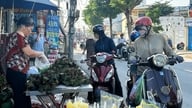
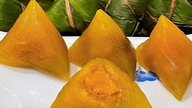
In times of economic hardship, sticky rice dumplings were only found at ancestral worship ceremonies. Gradually, they became a popular snack sold in local markets. Occasionally, they even graced the elaborate menus of feasts and gatherings in Quang Nam province.
This just goes to show that the flavors of one's homeland never fade.
Source: https://baoquangnam.vn/banh-u-cho-que-3137590.html

![[Photo] Opening Ceremony of the 13th National Congress of the Ho Chi Minh Communist Youth Union](https://vphoto.vietnam.vn/thumb/1200x675/vietnam/resource/IMAGE/2026/06/24/1782286753905_ndo_br_1-8510-jpg.webp)
![[Photo] General Secretary and President To Lam attends the Central Public Security Party Committee Conference](https://vphoto.vietnam.vn/thumb/1200x675/vietnam/resource/IMAGE/2026/06/24/1782302063612_a1-bnd-9302-9166-jpg.webp)
![[Photo] The 13th National Congress of the Youth Union conducts personnel work.](https://vphoto.vietnam.vn/thumb/1200x675/vietnam/resource/IMAGE/2026/06/24/1782299943080_ndo_br_1-6868-jpg.webp)