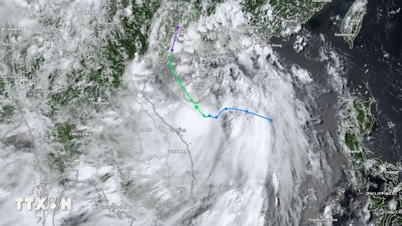
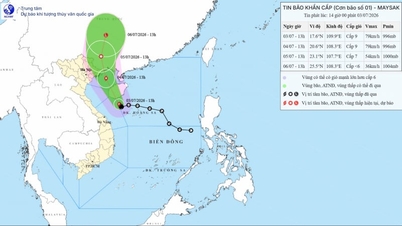
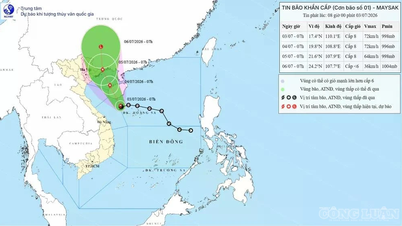
According to the National Center for Meteorological and Hydrological Forecasting, by 10:00 AM on July 3rd, Typhoon No. 1 had intensified. The typhoon's center was located at approximately 17.5 degrees North latitude and 110.0 degrees East longitude, about 90 km south of Hainan Island ( China ).
The strongest winds near the center of the storm reached levels 8-9 (62-88 km/h), with gusts up to level 11. The storm is moving slowly in a west-northwest direction at a speed of about 5 km/h.
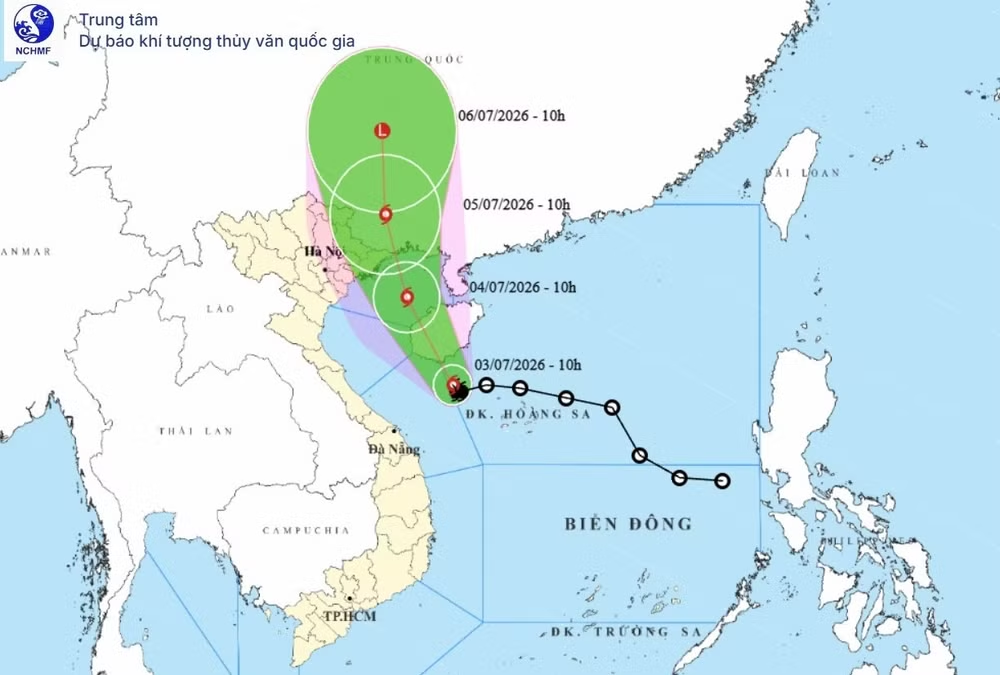
Forecasts indicate that by 10:00 AM on July 4th, the storm's center will be located in the northern part of the Gulf of Tonkin, approximately 170 km south-southeast of Mong Cai ( Quang Ninh ). The storm will maintain its intensity at level 8-9, with gusts up to level 11, and will shift north-northwest at a speed of 10-15 km/h.
By 10:00 AM on July 5th, the storm's center had entered the southern part of Guangxi province (China), its intensity reduced to level 8, with gusts up to level 10.



By 10:00 AM on July 6th, the storm continued to weaken into a tropical depression over southern Guangxi province, then further weakened into a low-pressure area and moved northward at a speed of 10-15 km/h.
Regarding the impact at sea, the western sea area of the North East Sea (including the Hoang Sa special zone) and the northeastern sea area from southern Quang Tri to Quang Ngai will be at risk of strong winds of force 6-7. Near the center of the storm, winds will be strong at force 8-9, gusting to force 11; sea waves will be 2-4 meters high, and the sea will be very rough.
From the night of July 3rd, the area of strong winds expanded across the Gulf of Tonkin, including the areas of Bach Long Vy, Van Don, Co To, Cat Hai, and Hon Dau Island.
Meteorological agencies warn that dangerous weather conditions could cause fishing boats, cargo ships, tourist boats, and other vessels operating at sea to capsize, sink, or be damaged. Aquaculture cages, mooring areas, and coastal structures also face the risk of damage, while fishing, transportation, and tourism activities at sea may be disrupted.
For inland areas, from the afternoon of July 4th, coastal areas of Quang Ninh, Hai Phong, and Hung Yen provinces are forecast to experience strong winds of level 6, with winds near the storm's center reaching levels 7-8, gusting to levels 9-10. Sea waves will be 2-3 meters high, and storm surge will be approximately 0.2-0.4 meters.



Strong winds can rip off roofs, damage temporary structures, knock down trees and billboards, and affect power, communication, and transportation systems. Large waves combined with storm surges can also cause localized flooding in estuaries, tidal flats, low-lying areas, and impact dikes, seawalls, and coastal structures.
Source: https://congluan.vn/bao-so-1-manh-len-gio-giat-cap-11-post352275.html



![[Image] Overview of the construction site for the underground station of metro line 5 at the Hanoi Ring Road 1 intersection.](https://vphoto.vietnam.vn/thumb/1200x675/vietnam/resource/IMAGE/2026/07/03/1783065595682_ndo_br_z7974930852369-100ca093c306e72675f1d3700966a86b-jpg.webp)