

On August 9th, the People's Committee of Thanh Hoa province organized a scientific conference titled "Dong Son Culture - 100 Years of Discovery, Preservation and Promotion of Values," aiming to assess the achievements and current state of conservation and research work on Dong Son culture.
Metallurgical techniques in the Dong Son culture reached their peak.
2024 marks the 100th anniversary of the discovery of the Dong Son culture, since the first excavation by the French in 1924 at Dong Son village (now Ham Rong Ward, Thanh Hoa City). After many years of research, experts have confirmed that the Dong Son culture spanned a very wide area, distributed across foothills, along rivers and streams, at the confluence of large rivers, and in narrow plains between river and stream tributaries, forming clusters in mountainous provinces, coastal plains, and border provinces in the north, extending as far as the Deo Ngang Pass in Quang Binh.

Researchers visit the excavation site in Dong Son village (Ham Rong ward, Thanh Hoa city).
PHUC NGU
According to Associate Professor Bui Van Liem (Vietnam Institute of Archaeology), since the discovery of the Dong Son culture, 452 relics belonging to this culture and more than 300 bronze drum relics have been found. The distribution of these relics is uneven, concentrated densely in the plains and deltas of the Red River and Ma River basins, areas that provided favorable conditions for the Dong Son people to live, develop, and build the ancient Vietnamese civilization.
According to Mr. Liem, the distribution of the relics demonstrates the gradual process of the ancient Vietnamese people's conquest and control of the Red River, Ma River, and Ca River deltas. Finally, the distribution of these relics, forming the Dong Son economic and cultural centers, has helped to establish a connection with written historical records to understand the tribes and clans that formed the early state during the Hung Kings era.
Regarding the metallurgical techniques of the Dong Son culture, Mr. Liem believes they reached their peak. Bronze objects were used in all aspects of material and spiritual life, including production tools, weapons, household items, musical instruments, and jewelry. Typical examples include bronze jars, bowls, and drums.
A joint study by Associate Professor Dr. Nguyen Khac Su and Associate Professor Dr. Bui Chi Hoang (Vietnam Archaeological Society) suggests that the Dong Son culture communities were concentrated in the basins of three major rivers: the Red River, the Ma River, and the Ca River. However, they shared a common agricultural community structure, primarily engaged in rice cultivation, raising buffalo, pigs, and chickens, and developing handicrafts such as carpentry, lacquerware, pottery, and especially metallurgy and the crafting of copper and iron.
The Dong Son culture community in the Ma River region (Thanh Hoa province) has its own unique characteristics and multifaceted relationships. Among these, the Dong Son, Thieu Duong, and Nui Nap sites in Thanh Hoa are representative of the Dong Son culture system in the Ma River region.
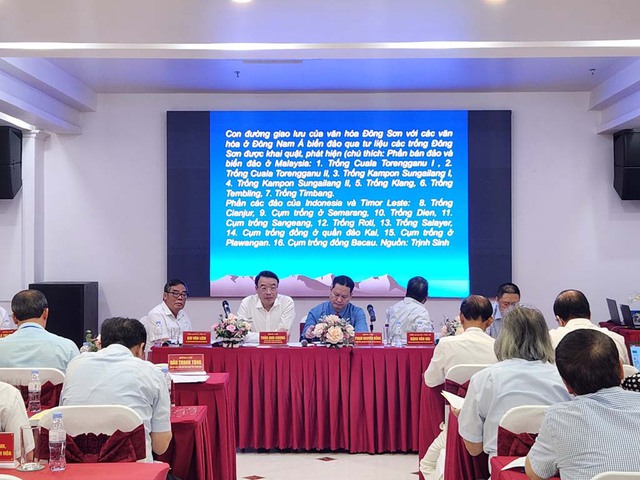
The workshop aimed to assess the achievements and current state of conservation and research work on Dong Son culture.
PHUC NGU
Continue research for future generations.
Based on research findings, experts assess that the Dong Son culture made significant and fundamental contributions to the early history of the Vietnamese nation, forming the basis for the first state of the ancient Vietnamese people. The emergence and development of the Hung King era state was the greatest contribution of the Dong Son culture. Archaeological evidence and legends also indicate that during the Dong Son period, the economy flourished, and society underwent profound and comprehensive transformations.
At the workshop, many experts and researchers argued that to preserve and promote the values of Dong Son culture effectively, further research is needed to clarify many issues, such as: deeper research into the pre-Dong Son period in the Ca River type; the time of origin and the type/form/model of the early Dong Son state; why Dong Son bronze drums in Central Vietnam, especially the Central Highlands, have been discovered in such large numbers, even more than in the original Dong Son bronze drum region; why many boat burial sites have been discovered in the Red River Delta but the connection between the residential area and the burial site remains unclear…
At the workshop, Mr. Dau Thanh Tung, Vice Chairman of the People's Committee of Thanh Hoa province, stated that the Dong Son culture is a source of pride for Vietnam in general and Thanh Hoa in particular. Therefore, the management, preservation, and promotion of the value of Dong Son cultural relics in Thanh Hoa are of urgent importance.
According to Mr. Tung, organizing the seminar has practical significance in supplementing sound scientific arguments to affirm the position, role, and important historical significance of the Dong Son culture in the overall history of the nation and, in particular, for Thanh Hoa province over the past 100 years. This will help generations, especially the younger generation in Thanh Hoa, gain a deeper understanding and pride in the traditions, history, and culture of their homeland and country.
The first excavation was carried out in 1924 in Thanh Hoa province by a Frenchman. It was published in 1929 in a report by V. Golubew in the Far East Antiquities journal , volume 19 (The Bronze Age in Tonkin and North Central Vietnam), and it was not until five years later that the concept of Dong Son culture was established.
The Dong Son culture is generally dated from around the 8th century BC to the 2nd century AD. Within this period, the early Dong Son period spans from the 8th to 6th centuries BC, the typical Dong Son period from the 5th to 3rd centuries BC, and the late Dong Son period from the 2nd century BC to the 2nd century AD. Dong Son is a village located on the banks of the Ma River (now in Ham Rong Ward, Thanh Hoa City, Thanh Hoa Province). The name Dong Son is used to name the famous early Iron Age archaeological culture in Vietnam – the Dong Son culture.
Source: https://thanhnien.vn/bao-ton-phat-huy-van-hoa-dong-son-185240809181439343.htm
























































































Comment (0)