

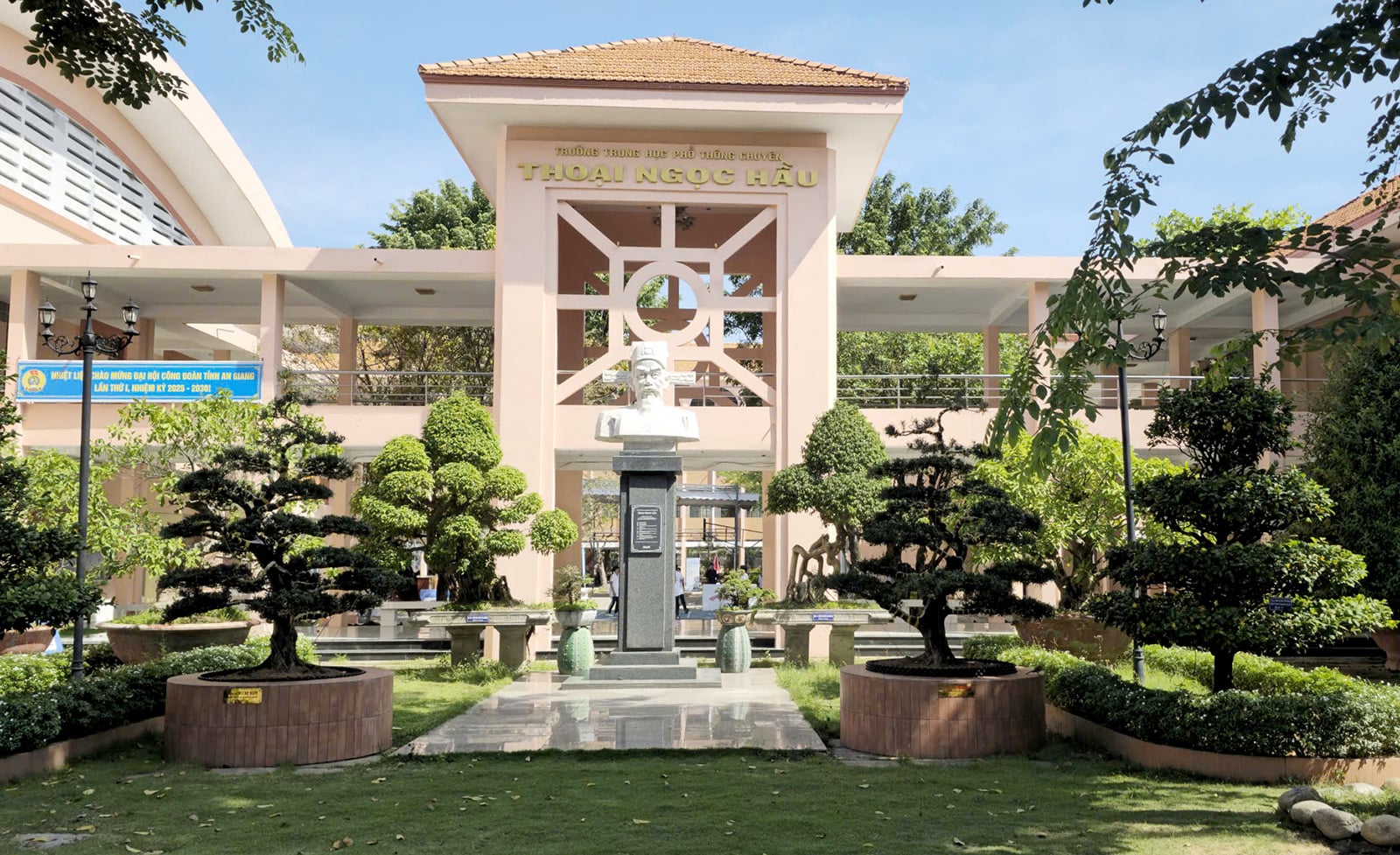
The statue of Thoại Ngọc Hầu has been rebuilt in the grounds of Thoại Ngọc Hầu Specialized High School. Photo: NGÔ CHUẨN
Paying tribute to meritorious officials.
In mid-November 2024, the Provincial People's Committee organized a national-level scientific conference and a ceremony commemorating the 200th anniversary of the completion of the Vinh Te Canal (1824 - 2024). Honoring the Vinh Te Canal and establishing a record for the longest canal in Vietnam, dug entirely by human labor, is a testament to the creativity and ingenuity of the Vietnamese people in transforming nature. The project demonstrates the strategic vision of the Nguyen Dynasty in economic development and strengthening national defense. During the two wars of resistance against French colonialism and American imperialism, the Vinh Te Canal served as a vital link for troop transport to the battlefields of the Southwestern region. In the Southwestern border war, the Vinh Te Canal halted the advance of Pol Pot's genocidal forces, becoming a counter-attack line for our army.
After the completion of the Vinh Te Canal under the command of Emperor Minh Mang (1824), the name of the renowned official Thoai Ngoc Hau was engraved on the Nine Dynastic Urns in the Hue Imperial Palace, and the canal was named after his principal wife (Vinh Te). Prior to that, upon the completion of the Thoai Ha Canal (1818), Thoai Ngoc Hau was granted the name of the river (Thoai Ha) and the mountain (Thoai Son) by Emperor Gia Long. For over 200 years, the Vinh Te and Thoai Ha canals have continued to play a vital role in irrigation, facilitating trade from the Hau River to the sea in Ha Tien and Rach Gia. Following in the footsteps of his predecessors, the late Prime Minister Vo Van Kiet ordered the construction of the T5 - Tuan Thong Canal in 1997 (now the Vo Van Kiet Canal, connecting to the Vinh Te Canal), initiating the flood drainage project to the Western Sea and opening up the Long Xuyen Quadrangle region.
Although Thoại Ngọc Hầu is remembered in history, there was a time when his statue was pulled down by students at the school named after him due to extreme anti-feudal sentiments before the Doi Moi (Renovation) period. When Thoại Ngọc Hầu's reputation was restored, his statue was erected in the middle of Ông Thoại Lake, Thoại Sơn commune, and placed prominently in the courtyard of Thoại Ngọc Hầu Specialized High School, Long Xuyên ward. It was also solemnly brought to the temple during the procession of Bà Chúa Xứ Núi Sam (Lady of Sam Mountain), Vĩnh Tế ward.
Similarly, on February 4, 2008, the full-body statue of General Le Van Duyet was officially enshrined at the Le Van Duyet Mausoleum, commonly known as the Ong-Ba Chieu Mausoleum ( Ho Chi Minh City). The placement of his statue served as an affirmation of the contributions of this founding national hero of the Nguyen dynasty, as there had previously been many accusations that he was a collaborator with the enemy.
Arbitrary judgment is a disservice to our ancestors.
In Vietnamese history, it is not uncommon for individuals with great achievements to be falsely accused and then have their honor restored. A prime example is Nguyen Trai, a founding father of the Le Dynasty, a national hero, and a world cultural figure. He was once sentenced to the extermination of his entire family in the Le Chi Vien incident, but during the reign of Emperor Le Thanh Tong, he was exonerated and his contributions were rightfully recognized. Nguyen Cong Tru, a great military strategist, economist, and poet, also suffered numerous demotions and injustices. Later history affirmed his stature and immense contributions to the nation.
Despite his many great contributions to maintaining security, stability, and development in the Southern region of Vietnam, Le Van Duyet also suffered many injustices. After his death, under the reign of Emperor Minh Mang, he was accused of crimes and his tomb was leveled. During the reign of Emperor Tu Duc, the court officially exonerated him and restored his honor. General Le Van Duyet is respectfully referred to by later generations as "Great Lord Thuong." His mausoleum is a cultural and spiritual site, a place where people in Ho Chi Minh City and surrounding provinces and cities can express their respect for this founding hero of the Nguyen dynasty.
However, recently, on platforms like YouTube and TikTok, some accounts have posted content displaying disrespectful and offensive attitudes towards King Gia Long and General Le Van Duyet. Previously, when invited to a seminar on the historical figure Le Van Duyet, the late Prime Minister Vo Van Kiet only offered modest remarks. The late Prime Minister stated that, based on historical research, Le Van Duyet was a great talent in politics, economics, and military affairs, with many meritorious achievements...
Protecting the objective truth of history is preserving our cultural roots and showing gratitude to previous generations. President Ho Chi Minh clearly stated: "We must consider a person and an event within its specific historical context, and we must be able to distinguish between merit and fault objectively." Using limited knowledge and personal prejudices to arbitrarily judge our ancestors is a disservice to the nation and its people.
Source: https://baoangiang.com.vn/bao-ve-tinh-khach-quan-cua-lich-su-a471150.html
![[Photo] Speaker of the National Assembly meets with the Vietnamese community in Türkiye](https://vphoto.vietnam.vn/thumb/1200x675/vietnam/resource/IMAGE/2026/04/18/1776483346102_1-8136-jpg.webp)
![[Photo] General Secretary and President visit the China-ASEAN AI Application Cooperation Center](https://vphoto.vietnam.vn/thumb/1200x675/vietnam/resource/IMAGE/2026/04/17/1776404277677_vna-potal-tong-bi-thu-chu-tich-nuoc-tham-trung-tam-hop-tac-ung-dung-ai-trung-quoc-asean-8706616-2286-jpg.webp)























































Comment (0)