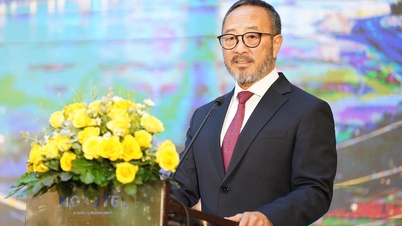
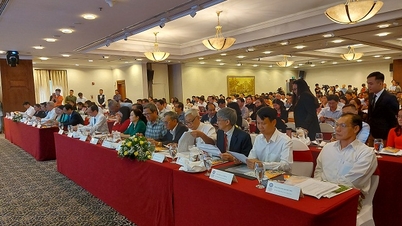
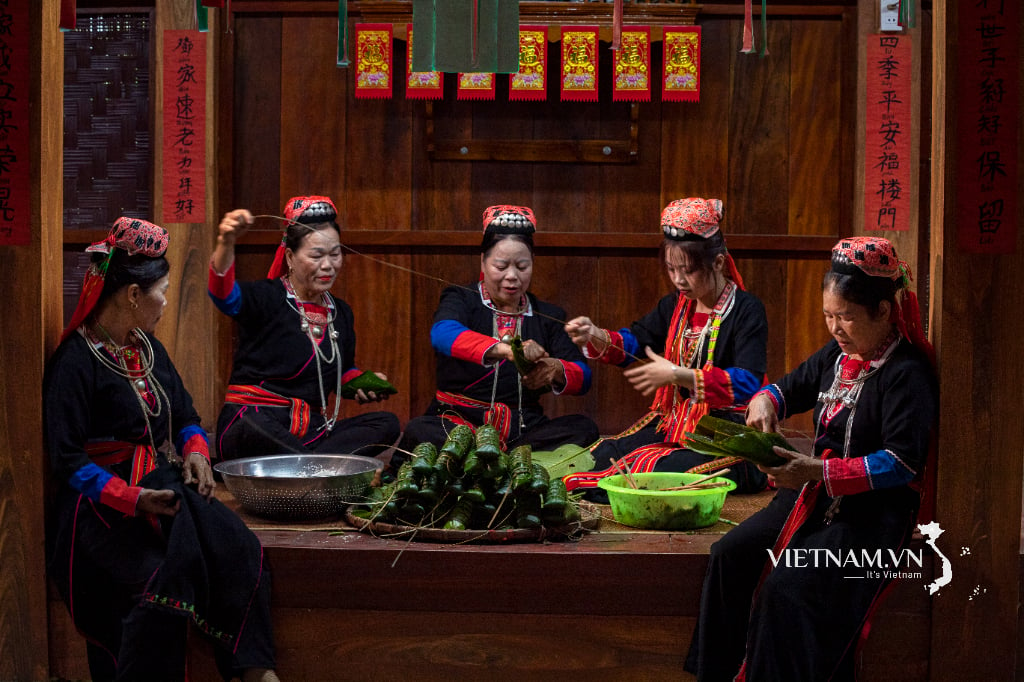
At the Ton Duc Thang Museum, the Ho Chi Minh City Department of Culture and Sports successfully organized the Ho Chi Minh City-wide Cultural Heritage Conference, marking the first time that all management agencies and heritage workers from the former Binh Duong and Ba Ria-Vung Tau provinces have come together under one roof.
A RICH URBAN HERITAGE SYSTEM
Compared to other provinces and cities, Ho Chi Minh City is very rich in heritage: the city currently has 321 historical and cultural relics and scenic spots; including 4 special national relics, 99 national relics, and 218 city-level relics. The system of 25 museums houses 23 national treasures, along with more than 500 religious establishments, many French-Indochinese architectural areas, the special national relic Independence Palace, and the old town of Cholon, home to the Chinese community. The Binh Duong Museum also houses two national treasures: the Phu Chanh wooden jar tomb with a bronze drum lid and bronze animal statues from the Dong Nai culture, contributing to the formation of a diverse and potentially rich urban cultural heritage system for Ho Chi Minh City.
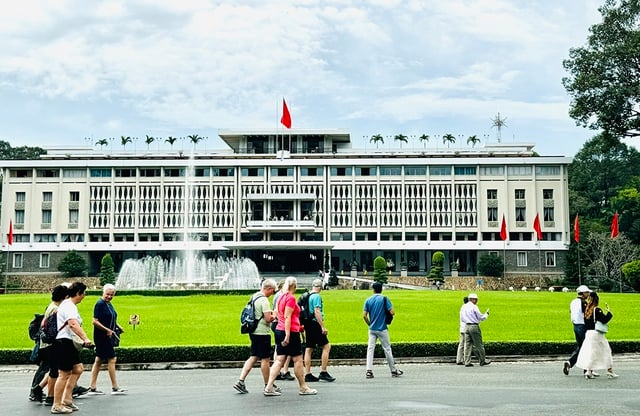
Foreign tourists visit the Independence Palace, a special national historical site.
PHOTO: LE CONG SON
"Saigon - Ho Chi Minh City is also a typical riverine city: where the Saigon River meets the Dong Nai River, creating the Nha Be junction with a complex network of canals and waterways, creating a 'riverside' landscape, along with rich festival activities of the Chinese, Khmer, and Cham communities... which are being integrated into cultural tourism products, becoming a unique brand of the Southern region," shared researcher Nguyen Mai Huy (University of Social Sciences and Humanities, Ho Chi Minh City).
Acknowledging the significance of Catholic church architecture as prominent landmarks contributing to the architectural landscape and the formation of a unique urban identity, making Ho Chi Minh City an attractive destination for tourists, Dr. Tran Thi Tuyet Suong (Ho Chi Minh City University of Education) affirmed: "Typical structures such as Notre Dame Cathedral, Tan Dinh, Huyen Si, Cha Tam, Cho Quan, Thu Thiem, Hanh Thong Tay... are not only symbols associated with the collective memory of urban residents but also vividly reflect the process of cultural exchange and transformation between Vietnam and France from the late 19th to the early 20th century."
![[Video] Path of low pressure system entering the South China Sea, likely to strengthen into a typhoon](https://vphoto.vietnam.vn/thumb/192x108/vietnam/resource/IMAGE/2026/06/30/1782832701190_bao-jpg.webp)


DEVELOPMENT PLAN BASED ON HERITAGE
Although Ho Chi Minh City possesses a diverse and rich heritage, restoration and reconstruction efforts have faced numerous difficulties due to a lack of funding. These historical sites have yet to become a "golden goose" for investment.
Having been involved with museums for many years and referencing several international models, Dr. Hoang Anh Tuan, Director of the Ho Chi Minh City History Museum, suggested that Ho Chi Minh City should establish a Heritage Center – a centralized coordinating institution. "Established in 1846, the Smithsonian Institution (USA) is a model of an integrated heritage center, with the most profound influence in the world , successfully combining centralized management and professional autonomy, traditional preservation and innovative creation. The National Heritage Board (NHB, Singapore) has a modern approach to heritage management: centralized – synchronized – technological – community-based. Looking at their examples, Ho Chi Minh City needs to focus on building the brand ' Heritage of Ho Chi Minh City' or 'Ho Chi Minh City Heritage Network' as a collective brand, similar to Smithsonian or NHB, to affirm the position of the city's museum system in Southeast Asia," Dr. Tuan emphasized.
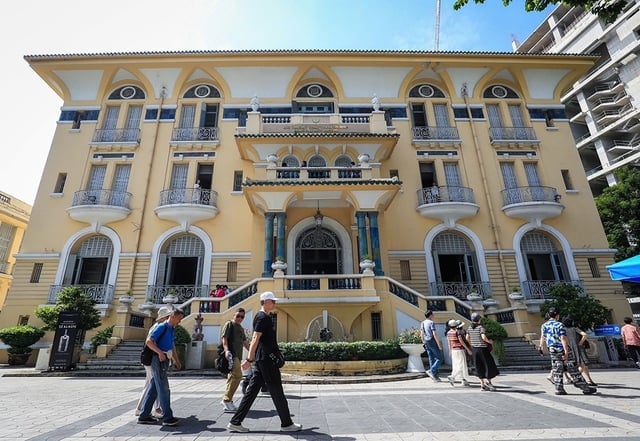
The Ho Chi Minh City Museum of Fine Arts is home to national treasures and is also a city-level architectural and artistic heritage site.
PHOTO: NHAT THINH
Ms. Nguyen Thi Thu Nhi (Regional Political Academy II - Ho Chi Minh National Political Academy) suggested the need to develop heritage tourism routes such as "Independence Palace - Nha Rong Wharf - Ho Chi Minh Museum" or "French Architecture in the Heart of Saigon," opening up a new direction combining the exploitation of historical values and the development of tourism. These tours would not only create livelihoods for the people but also contribute to raising social awareness of the value of urban heritage.
The leaders of the Ho Chi Minh City Department of Culture and Sports stated: "In the near future, we will establish and effectively operate a Cultural Heritage Fund, focusing on investing in the restoration and preservation of historical and cultural sites that are seriously deteriorating. We will research and apply technology to promote the value of cultural heritage in general, and historical sites and museums in particular; develop unique products; create tours/night shows at Bach Dinh historical site, Con Dao prison, and night experiences at museums based on digital technology 4.0 and 3D mapping, contributing to attracting tourists and developing the economy."



"When heritage is properly placed within the development structure, it becomes a resource, not a barrier. Preserved structures, if managed creatively and integrated with economic, cultural, and social activities, can create significant added value in terms of urban image, attract tourists, and simultaneously strengthen the identity and pride of residents. We must demonstrate the ability to transform our thinking from 'passive preservation' to 'heritage-based development' to align with the goals of sustainable urban development in the 21st century," Ms. Thu Nhi affirmed.
INCLUDING THE CU CHI TUNNELS IN THE LIST OF NOMINEES FOR WORLD HERITAGE SITE PROJECTS
The first piece of good news to kick off the heritage conference was revealed by the Deputy Director of the Ho Chi Minh City Department of Culture and Sports, Nguyen Minh Nhut: "Based on the feedback from UNESCO experts at the International Workshop on the Quality of World Heritage Nomination Dossier in Southeast Asia (held in Manila, Philippines) from May 19-23, the National Council for Cultural Heritage, the Ministry of National Defence, and the Vietnam National UNESCO Committee have identified the outstanding universal value of the Cu Chi Tunnels and are registering them for inclusion in the list of nominees for World Heritage status."
Source: https://thanhnien.vn/bat-che-do-kiem-tien-cho-di-san-tphcm-18525112622062385.htm

![[Photo] Strengthening character and expertise: Intense training for artillery soldiers.](https://vphoto.vietnam.vn/thumb/1200x675/vietnam/resource/IMAGE/2026/06/30/1782815602541_lu-368-1875-4571-jpg.webp)