

The private sector is the most important driver of growth, so a change in mindset and perception is necessary to change behavior and actions.
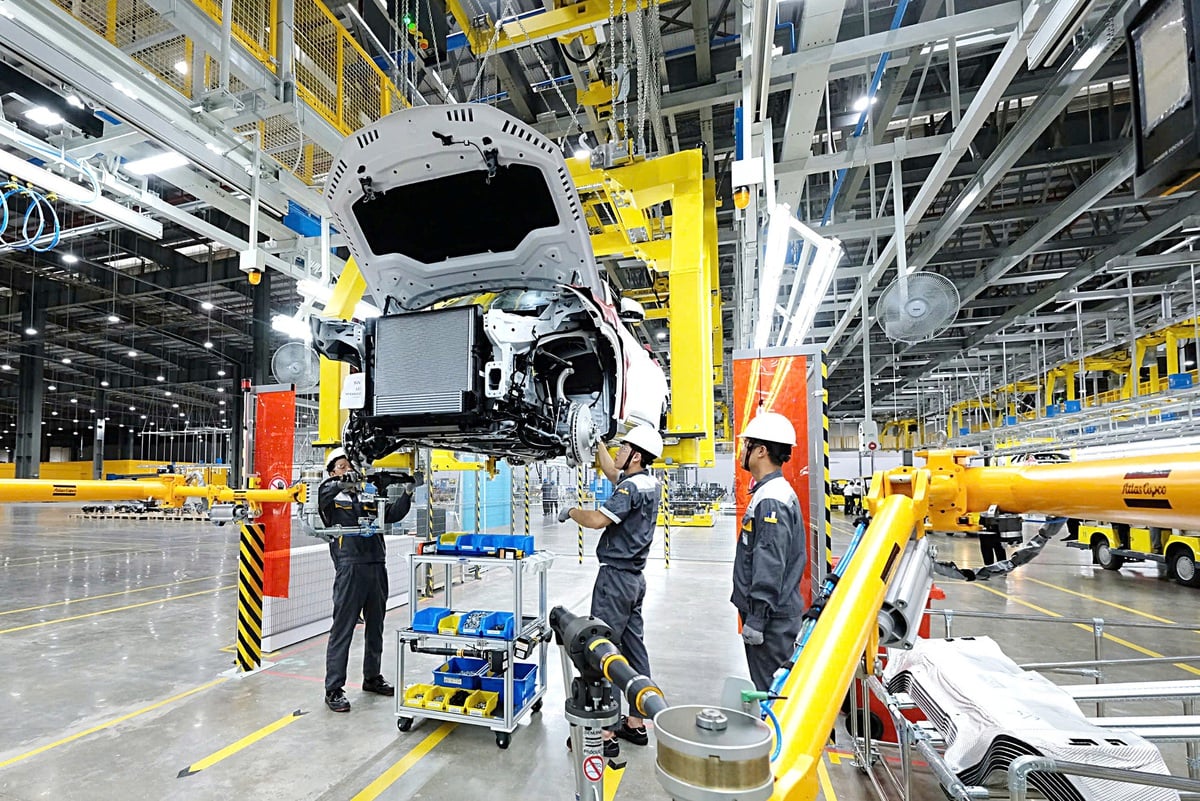
VinFast's automobile manufacturing plant in Hai Phong - Photo: NAM TRAN
There are specific policies and clear strategies to create equality and fairness for the private sector.
General Secretary To Lam 's important messages on the private economy at the meeting on March 7th have immense significance in the current context, and are expected to create a solid foundation and give wings to Vietnamese businesses.
In fact, after nearly 40 years of reform, Vietnamese private enterprises have made remarkable progress in all aspects. We now have more than 940,000 operating businesses and over 5 million individual business households.
Looking at other countries, the role of private enterprises is very important, undertaking many major functions.
Like in the US, SpaceX has launched rockets into space very successfully. This is a completely private enterprise, achieving groundbreaking success in the particularly complex field of space technology – an area seemingly unsuitable for private companies.
Similarly, inventions and technological innovations that have changed the world often originate from the private sector.
In Vietnam, according to statistics, the private sector contributes approximately 45% of GDP, 40% of total social investment, employs 83% of the total workforce, contributes 30% of total state budget revenue, accounts for 25% of export turnover and 35% of import turnover.
The country has also produced its first Vietnamese billionaires and many Vietnamese brands that have gained international recognition, such as VinGroup, FPT, Truong Hai, Hoa Phat, etc.
Nevertheless, there are still many concerns regarding the development of private enterprises. Resolution 10 of the 5th Central Committee Conference on June 3, 2017, on the private economy set a target of having at least 1 million enterprises by 2020, but this has not yet been achieved.
There are up to 5 million household businesses and individual entrepreneurs, but only about 2 million are registered. Millions of household businesses lack the motivation to transition into enterprises due to concerns about cumbersome procedures, legal risks, and outdated management skills.
Vietnam also has too few medium and large-scale domestic private enterprises, especially in the manufacturing and production industries. Vietnamese private enterprises are mostly small-scale and informal. This has hindered productivity growth and innovation.
Furthermore, the management level of Vietnamese businesses has not yet met the requirements, as most have started from a household scale, resulting in business organization and management practices that lack a systematic approach.
Cohesion remains very weak, stemming from fragmented business thinking. Intermediate organizations such as business associations have not truly played their connecting role, while the legal and policy environment does not adequately encourage collaboration.
Vietnamese private enterprises have also not been successful in connecting with FDI enterprises in Vietnam and global production chains. It is a reality that domestic private manufacturing enterprises have not developed strongly and lack effective support mechanisms.
Vietnam currently ranks 105th out of 137 countries in terms of the number of domestic suppliers and 116th out of 137 in terms of the quality of domestic suppliers, lagging behind other countries in the region such as Malaysia, Indonesia, Thailand, and the Philippines.
Compared to the FDI sector, domestic businesses have not yet achieved relatively complete mastery of independent production chains, which somewhat hinders the development of an independent and self-reliant economy.
Despite the increased attention given to private enterprises by various institutions and policies, since 2020, domestic private businesses have suffered extremely negative impacts, experiencing stagnant growth and a steadily increasing number of companies leaving the market.
Therefore, with new directions from the Party leader, the private business community expects that the next phase will require continued removal of barriers and strong institutional reforms to unlock private resources.
There are mechanisms for ordering, empowering, and encouraging private sector participation and investment in key areas, purchasing technology, or public services...
To develop a sustainable private economy, separate laws on business associations and business organizations are needed to encourage businesses to collaborate.
This is coupled with a capacity-building program aimed at protecting the rights of businesses and building a business culture based on mutual support, solidarity, integrity, commitment, and dedication to the country and the nation.
Source: https://tuoitre.vn/be-do-cho-doanh-nhan-viet-dan-than-20250309084135411.htm
![[Photo] General Secretary and President To Lam presides over a working session with the Central Policy and Strategy Committee on the development of the materials industry.](https://vphoto.vietnam.vn/thumb/1200x675/vietnam/resource/IMAGE/2026/05/21/1779359935432_a3-bnd-3129-1412-jpg.webp)
















































































Comment (0)