|
| Stock prices were the bright spot in the market on July 3rd, attracting capital flows amidst subdued trading in blue-chip stocks. |
VN-Index continues to fluctuate.
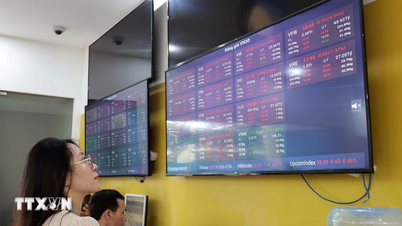
The Vietnamese stock market closed the trading session on July 3rd with a less than positive performance, as the VN-Index continued to face downward pressure amidst low liquidity. Investors remained cautious due to the tug-of-war among large-cap stocks, preventing the index from breaking through.
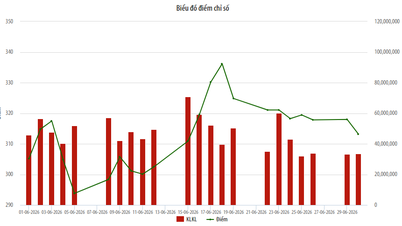
At the close of trading, the VN-Index fell 4.27 points, or 0.23%, to 1,862.08 points. On the HoSE exchange, there were 107 gainers and 202 losers. The total trading value reached VND 15,656.7 billion, down 9% from the previous session despite an 8% increase in trading volume, indicating that capital has not yet truly returned to the leading stock groups.
From the start of the trading session, the market experienced volatility as red dominated the electronic board. Most sectors fluctuated within a narrow range. The most negative performance came from PNJ shares, which fell to their lower limit of 58,700 VND/share with over 12.5 million units offered at the floor price. The selling pressure stemmed from news that Mr. Dang Ngoc Thao, former Director of PNJ Appraisal Company Limited, was under investigation in connection with diamond smuggling.
Towards the end of the session, selling pressure increased somewhat, but mainly at low prices, preventing the VN-Index from falling too sharply. However, the VN30 basket continued to be a major drag on the market, with only 6 out of 30 stocks rising in price.
The banking and steel sectors traded relatively quietly. VCB, BID, CTG, TCB, and MBB all saw slight declines, while HPG also lost 0.64%. Conversely, VPB was a rare bright spot among large-cap stocks, rising 0.36%.
Notably, the oil and gas sector faced the strongest selling pressure. GAS fell 2.59%, PLX lost 1.75%, while BSR reversed course and declined 0.8% after a slight increase in the morning session. In addition, LPB, GVR, SAB, VIB, VNM, and MWG all fell by over 1%, meaning that the efforts of a few stocks like VHM and VJC to maintain momentum were insufficient to help the market recover.



Liquidity in the VN30 basket continued to decline, accounting for only about 53.2% of the total trading value on the HoSE, the lowest level in 8 weeks. This reflects that capital is still on the sidelines observing or tending to seek opportunities in smaller-cap stock groups.
Is hot money flowing into the stock market?
Amidst the rather gloomy market outlook, securities stocks have emerged as a focal point attracting investment.
A series of mid- and small-cap stocks surged simultaneously. ORS and VDS hit their upper limit, with ORS seeing over 23 million shares traded. On the HNX and UPCoM exchanges, CSI rose nearly 14%, AAS 9.3%, PSI 5.9%, BVS 5.6%, EVS 5.5%, and VIG and WSS both increased by more than 4%.
Meanwhile, the "big players" in the securities industry showed rather cautious performance. SSI only increased by 0.92%, VCI by 1.01%, VIX by less than 1%, while HCM decreased by 1.6%. This indicates that capital is favoring small-cap stocks with large price fluctuations and the potential for higher short-term returns.
Liquidity also clearly reflects this trend. VIX and VND were the two stocks with the highest trading volume on the market, with approximately 33 million and over 30 million shares changing hands, respectively. On the HNX exchange alone, SHS also recorded liquidity of over 25 million shares, with a 2.7% increase.
Looking specifically at the afternoon session, trading value on the HoSE increased by approximately 30% compared to the morning, but the majority of the capital flow was concentrated in stocks outside the VN30 index. This signals that speculative capital is tending to shift towards small and medium-sized stocks instead of leading stocks.
According to experts, given the lack of improvement in overall market liquidity, the divergence trend will continue in the short term. Large-cap stocks lack upward momentum, making it difficult for the overall index to break through, while short-term capital tends to shift quickly between sectors in search of profit opportunities.



Although the surge in securities stocks is creating a positive psychological effect, analysts also note that this is mainly short-term speculative capital. To form a sustainable uptrend, the market still needs the return of large-scale capital flows, especially in the banking, real estate, and large-cap stock sectors.
In the short term, the VN-Index is likely to remain volatile around its current level as demand is not yet strong enough to absorb supply. Investors are advised to maintain a reasonable proportion of stocks in their portfolios, avoid chasing stocks that have risen sharply, and prioritize observing the flow of money before increasing their holdings during corrections.
Source: https://thoibaonganhang.vn/bluechip-tram-lang-co-phieu-chung-khoan-nho-but-pha-184418.html