I'm rereading To Hoai's work. His book "Old Stories of Hanoi " (2 parts) is nearly 700 pages long. It's undeniably interesting. The writer is talented; whatever he writes is good and captivating to the reader. This isn't just a fleeting moment, but a long-lasting one. I like his storytelling style, sometimes subtle, sometimes meticulous, his careful observation of characters and things, and To Hoai's masterful use of language—both familiar and unique.
Let me give you an example from many passages that are very relevant to what I just said about the creator of the extremely famous "The Adventures of the Cricket" because it will relate to what I want to discuss about the new rural development. At the beginning of the story "Market Cakes," To Hoai wrote:
Upon arriving at the market, children were dazzled by the array of treats. There were so many tempting things. The bright yellow starfruit, just looking at the string of them made their mouths water. And what about the countless cakes, fruits, and other treats? It was overwhelming to behold. The stalls in the suburban markets. The vendors carried baskets and bundles of goods, tied with banana fiber ropes, bundles of sticky rice straw, and baskets of leaves on trays. Dried lotus leaves, banana leaves for wrapping puffed rice, loose banana leaves, and Terminalia catappa leaves for wrapping sticky rice cakes; palm fronds and betel nut husks for wrapping rice balls. Back then, there was no newspaper, plastic wrap, or rubber bands for wrapping like there is now...

Illustration: LE NGOC DUY
Oh my goodness, how evocative those whispered words are, Mr. To Hoai! From the perspective of today's reader, the past and present are clearly separated. Or, looking further ahead, when we consider the future of humanity in the context of increasingly serious environmental pollution concerns.
What the writer in "Old Stories of Hanoi" describes as something that is practically nonexistent is precisely what many people long for today. The plastic film, now known as plastic bags, used to hold goods and gifts, is ubiquitous, found everywhere, from cities to rural areas.
Both newly developed and less developed rural areas are facing the problem of plastic waste everywhere, with plastic bags being the most visible example. Initially, when they first appeared, plastic bags were welcomed by people as a useful invention of modern life. They were incredibly lightweight and convenient.
Traditional markets, supermarkets, and shops all use plastic bags to hold goods for customers to take home. It's a common sight to see a woman returning from the market carrying many plastic bags: bags for fish, bags for meat, bags for fruit, bags for garlic, bags for chili peppers...
Each item comes with a plastic bag. Let's do the math: every day, after returning from the market, that woman uses about 4 to 5 plastic bags. Multiply that by how many bags she brings home each month. These convenient plastic bags eventually end up in trash bins, transported by specialized vehicles to landfills (in urban areas), or piled up by the roadside or buried in the ground (in rural areas).

I've been to many beautiful villages, with picturesque rivers and mountains, peaceful hamlets, and well-maintained houses, but there were always huge piles of garbage along the roadside. Many small and large plastic bags filled with trash were stacked haphazardly on top of each other, a very unsightly sight.
The New Rural Development program has transformed the face of the countryside. You can imagine it even with your eyes closed. Compared to a few decades ago, it's a world of difference. Electricity illuminates the village paths and every house. You can't find any thatched-roof, mud-walled houses like in the distant past. Asphalt and concrete roads have replaced the dusty, muddy dirt roads.
The well-maintained, standard-compliant school buildings peek out from behind the lush green trees. The health station is also decent and impressive; the dilapidated state is a thing of the past. Who wouldn't be happy to see such a rural landscape? The age-old dream of the people of the rice-farming civilization, "a single grain of fragrant rice, but countless hardships," has become a reality.
The reality, though not glamorous, is nonetheless endearingly precarious. So endearing that some people want to seek it out, to return and live there. It's a place worth living in—I've heard such exclamations of admiration.
However, it's not just a "however," but rather a regrettable fact that many new rural areas are still far behind in meeting environmental criteria. My district was the first in the province to achieve the status of a new rural area.
The peaceful town nestled beside a crescent-shaped river where I live with my family has been recognized as a "new rural area" for several years now, but I hear it's still failing to meet environmental criteria. The sight of free-roaming cows and pigs raised in densely populated residential areas, emitting a strong, pungent smell of manure, hasn't stopped. And, sadly, the residents haven't said no to plastic bags.
It's also worth knowing that, according to many sources, those familiar plastic bags are made from materials that are very difficult to decompose.
Surely, when they were first invented, people didn't fully foresee the harm they would cause. Plastic bags contribute to the greenhouse effect; when mixed into the soil, they prevent plants from growing, leading to erosion in hilly areas. Terrestrial and aquatic animals mistakenly ingest undigested plastic bags, causing death and polluting the ecosystem.
When plastic bags are burned, they produce two extremely toxic gases, dioxin and furan, which cause birth defects in children and weaken the human immune system... I was truly horrified when I read these figures: According to United Nations statistics, the world produces more than 400 million tons of plastic and consumes approximately 1 trillion to 5 trillion plastic bags every year. In Vietnam, according to statistics from the Ministry of Natural Resources and Environment, we use more than 30 billion plastic bags annually, with each family using an average of 5 to 7 plastic bags per day.
Perhaps, we should include in the criteria for building new rural areas the restriction and eventual elimination of plastic bag use. It's difficult, very difficult indeed, but if we are united and determined, I think our people can do it. We can do it by "returning to the old ways, doing things the way we used to."

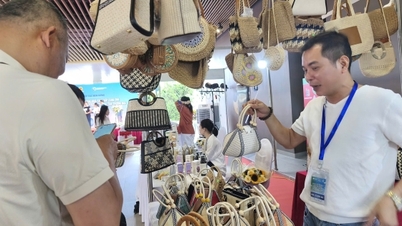
Every woman, every girl, every young lady going to the market or supermarket carries pretty, eye-catching baskets or bags made from environmentally friendly materials because of their easy biodegradability. Why not? These eco-friendly baskets and bags will protect the world .
At the macro level, I think the government should have the determination and take concrete actions towards the goal of banning the use of plastic bags. The sooner the better. As for each citizen, especially in rural areas, they should voluntarily limit and eventually stop using plastic bags. It would be great if women's associations took the lead in campaigning for people to say no to plastic bags.
Things will return to how they were in the old days, with baskets and woven bags accompanying women to the market. Paper and bags for packaging will only be made from biodegradable materials. The old story told by Uncle To Hoai becomes a new story today. The story of plastic bags disappearing from our lives.
Life without plastic bags is so much better. I sit here remembering my mother, when she came home from the market and called the oldest, the youngest, the little one, and the chubby child to sit beside her small basket. She would open it, and there were fried cakes wrapped in banana leaves, handfuls of puffed rice wrapped in lotus leaves, a custard apple with its eyes wide open, a ripe persimmon with its fragrant aroma filling the three rooms of our thatched house... How I miss those days. How could I possibly wish for "the days of the past" when plastic bags hadn't even been invented?
Nguyen Huu Quy
Source