- Pressure to collect budget revenue amidst numerous changes.
- Enhancing transparency and combating budget revenue losses.
- Revenue collection is positive but not yet sustainable.
This result reflects the decisive leadership of the province and the tax sector, as well as the efforts of the business community and household businesses to restore production and business activities .
According to the Ca Mau Provincial Tax Department, the province's total state budget revenue for the first six months of the year is estimated at 6,956 billion VND, equivalent to 61% of the projected target, an increase of 14% compared to the same period last year. This result not only affirms the locality's ability to overcome difficulties and adapt in the first year after the merger but also creates room for the final push in 2026.
Multiple growth drivers
Commenting on the results achieved, Mr. Chau Vinh Thuan, Deputy Head of the Ca Mau Provincial Tax Department, said: “The highlight of budget revenue collection in the first six months of the year is the consistent growth in many key revenue sources. In particular, lottery activities continue to play a leading role with an increased issuance limit from April 1, 2026; leading seafood businesses such as Minh Phu Group and Ca Mau Seafood Joint Stock Company have recovered production and business, generating high profits; and wind power projects, after stable commercial operation, have also begun to contribute positively to the local budget.”
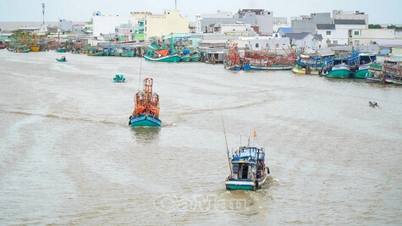
 The seafood processing and export industry has recovered its production and business activities, making a positive contribution to the growth of the province's budget revenue.
According to representatives from Minh Phu Seafood Group Joint Stock Company, the company's production and business activities achieved positive results in the first six months of the year, with processing volume increasing by 23% and export turnover by 14% compared to the same period last year. Stable raw material supply, increasingly favorable export markets, and the commissioning of the processing plant in Khanh An have created further impetus for production expansion. The company expects continued growth in the second half of the year, the peak season for the seafood industry, contributing positively to the local budget.
According to the provincial tax department, 12 out of 20 revenue sources are estimated to have reached over 50% of the projected target. Among these, several sources with a high proportion of total domestic revenue achieved high results, such as: revenue from central state-owned enterprises (69.8%); personal income tax (62.4%); registration fees (55.6%); land use fees (61%); lottery revenue (61.7%); and other budget revenues (60.2% of the projected target). In addition, 8 out of 20 revenue sources still fell below 50% of the projected target. Specifically, revenue from the non-state economic sector reached 48.3%; environmental protection tax reached 45.2%; and revenue from the use of sea areas reached 41.5% of the projected target. |
In terms of revenue structure, lottery activities are estimated to generate approximately 2,970 billion VND, reaching 62% of the annual forecast. This result is mainly due to the Ca Mau Lottery Company Limited and the Bac Lieu Lottery Company Limited paying approximately 1,100 billion VND in corporate income tax and after-tax profits for the 2025 period. In addition, increasing the lottery ticket issuance limit to 160 billion VND per period has created further growth potential for this revenue source.
 The stable production and business results of enterprises within the Ca Mau Gas-Electricity-Fertilizer Complex continue to generate significant revenue for the local budget.
The state-owned enterprise sector also made a positive contribution with estimated revenue of 665 billion VND, equivalent to 65% of the annual budget. In particular, enterprises belonging to the Ca Mau Gas-Electricity-Fertilizer Complex continued to play a leading role, with favorable production and business results in 2025 bringing in approximately 316 billion VND in corporate income tax for the local budget.



In addition, personal income tax revenue is estimated at 642 billion VND, equivalent to 62% of the projected amount; other budget revenues reached approximately 193 billion VND, equivalent to 54% of the annual projected amount. These figures show that production and business activities in the area are gradually recovering, creating a stable foundation for budget revenue.
Mr. Tran Ngoc Thach, Deputy Executive Director of Co.opmart Ca Mau, said: “In the first six months of the year, the unit's revenue increased by about 10% compared to the same period last year, and the number of shoppers increased by about 4%. The supply of goods is abundant, prices are stable, and Co.opmart is also promoting various promotional programs to stimulate consumer demand. From now until the end of the year, we will continue to implement many major programs to help maintain market purchasing power.”
 Vibrant trade and service activities contribute to maintaining revenue from the non-state economic sector and value-added tax.
Pressure in the final stretch
Despite the positive results achieved, the remainder of 2026 still poses significant pressure on local revenue collection efforts.
According to Mr. Chau Vinh Thuan, the biggest challenge currently is the implementation of the Law amending and supplementing a number of articles of the Value Added Tax Law No. 149/2025/QH15, which will take effect from January 1, 2026. Under the new regulations, raw shrimp will be exempt from value added tax instead of the previous 5% tax rate. This policy is projected to reduce domestic revenue by approximately 870 billion VND compared to the initial estimate developed with the Ministry of Finance .
 The new value-added tax policy on raw shrimp is projected to significantly impact budget revenue in 2026.
Revenue from environmental protection taxes is also affected by the implementation of the tax exemption policy for gasoline, diesel, and lubricants according to Decision No. 482/QD-TTg of the Prime Minister and Resolution No. 19/2026/QH16 of the National Assembly. Accordingly, this revenue is estimated to reach only 236 billion VND, equivalent to 45% of the annual budget.
Besides being affected by policy, budget revenue collection in the last six months of the year also faces many uncertainties from the global economy. Developments in the Middle East could affect energy prices, logistics costs, and the seafood export market – a key economic sector of the province. In addition, the continued implementation of policies to exempt, reduce, and extend tax and land rent payments will also impact the progress of budget revenue collection in the remaining months of the year.
 The policy of exempting gasoline and diesel from environmental protection tax will impact budget revenue in the first few months of 2026.
Faced with these challenges, the Tax Department has decided to implement a comprehensive set of solutions to fulfill its budget revenue collection target for 2026.
Mr. Chau Vinh Thuan, Deputy Head of the Ca Mau Provincial Tax Department, stated: “The tax sector will continue to closely monitor and forecast the developments of each revenue source, each locality, and each tax category; focusing on managing major revenue sources such as the Gas-Electricity-Fertilizer Complex, lottery activities, the non-state economic sector, and land use fees. At the same time, we will resolutely recover the amounts recommended for increased revenue by the State Audit Office, minimizing budget revenue losses.”



In addition, the Tax Department will effectively implement the Law on Tax Administration No. 108/2025/QH15 and its guiding documents; strengthen communication to ensure taxpayers fully understand the new regulations; accelerate tax debt recovery, control outstanding debts, and standardize management data; focus inspections on areas with a high risk of revenue loss, etc.
As we can see, half of the revenue collection period has passed with many positive results, but in the context of many new tax policies continuing to be implemented and the global economy still harboring many potential fluctuations, the journey to the finish line will not be easy.
“With the foundation already built and synchronized management solutions, the Ca Mau Tax Department will be determined to maintain its growth momentum, effectively exploit revenue sources, and create financial resources to serve the socio-economic development of the province in its first year of establishment,” Mr. Chau Vinh Thuan expressed his expectations.
Hong Nhung
Source: https://baocamau.vn/but-pha-nua-chang-duong-thu-ngan-sach-a130287.html





![[Image] Overview of the construction site for the underground station of metro line 5 at the Hanoi Ring Road 1 intersection.](https://vphoto.vietnam.vn/thumb/1200x675/vietnam/resource/IMAGE/2026/07/03/1783065595682_ndo_br_z7974930852369-100ca093c306e72675f1d3700966a86b-jpg.webp)