


Since the beginning of the year, the number of meningococcal meningitis cases in the country has increased.
According to the Ministry of Health's recent surveillance report from week 1 to week 14 of 2026, the country recorded 24 cases of meningococcal disease, including 4 deaths. The majority of cases were recorded among children under 15 years old, accounting for 46% of the total.
Cases have been recorded sporadically in the community, without forming any concentrated outbreaks. However, the number of cases has tended to increase recently and is higher than the same period in 2025 (14 cases).
The Ministry of Health assesses that there is a high risk of the disease continuing to appear, affecting the health of the population, especially children.
Meningococcal disease is an acute infectious disease caused by the bacterium Neisseria meningitidis. It is primarily transmitted through direct contact with nasal, pharyngeal, and throat secretions from infected individuals or asymptomatic carriers.
This is a dangerous infectious disease that can progress rapidly, causing severe forms such as purulent meningitis and sepsis. In particular, the disease can leave serious consequences such as deafness, paralysis, mental retardation, and even death if not detected and treated promptly.
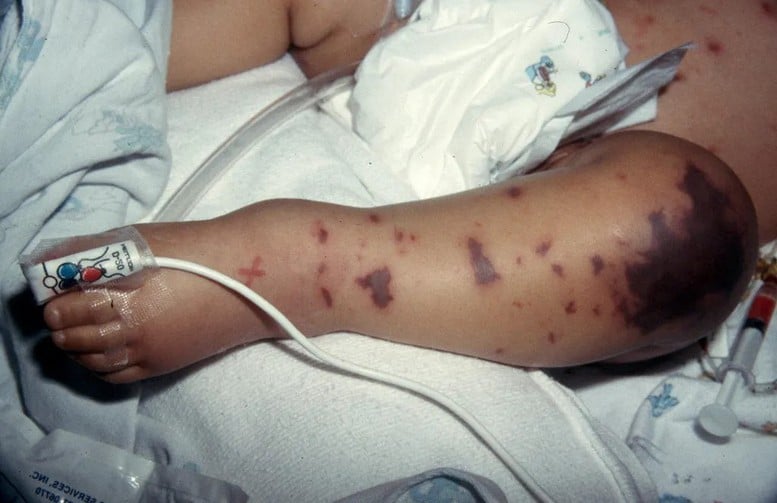
Typical skin rash signs in children with meningococcal meningitis.
Meningococcal disease progresses very rapidly and is easily mistaken for other illnesses.
According to According to Dr. Bach Thi Chinh, Medical Director of the VNVC Vaccination System, meningococcal disease progresses extremely rapidly and can be fatal within 24 hours of the first symptoms appearing. Meanwhile, the initial signs are often atypical and easily confused with common respiratory infections such as sore throat, fever, headache, and fatigue, leading to delayed diagnosis, missed "golden time" for treatment, and increased risk of death.
Alarmingly, anyone without immunity can be infected with meningococcal bacteria, with high-risk groups including young children, schoolchildren, teenagers, the elderly, and people with weakened immune systems. Not only is it dangerous because of its rapid progression, but meningococcal bacteria are also particularly complex due to the simultaneous circulation of multiple serotypes that cause the disease.
Globally , six major serotypes (A, B, C, W, Y, X) account for the majority of cases. In Vietnam, serotypes A, B, C, and W have been recorded. This means that even if a person has immunity to one serotype, they can still contract the disease if they are not fully protected against the others.
According to Doctor Bach Thi Chinh, meningococcal bacteria reside in the pharynx of both healthy and sick individuals. The bacteria are transmitted through the respiratory tract when sick or healthy carriers cough, sneeze, or talk at close range.
Bacteria can also spread through contact with hands, objects, and contaminated surfaces, entering the eyes, nose, and mouth, and then invading the bloodstream to cause illness. This characteristic makes meningococcal disease a potentially insidious but rapidly spreading illness, especially in crowded environments such as schools, dormitories, playgrounds, and festivals, where close contact control is limited.
Therefore, when someone is suspected of or infected with meningococcal bacteria, it is necessary to maintain distance, wear a mask, and wash hands with soap after contact with crowded places. These measures help protect everyone from meningococcal bacteria and many other infectious pathogens.
However, given the prevalence of asymptomatic carriers in the community, contact prevention measures are only supportive. For proactive and sustainable protection, these measures should be combined with full vaccination coverage across multiple serotypes to reduce the risk of infection at its source.
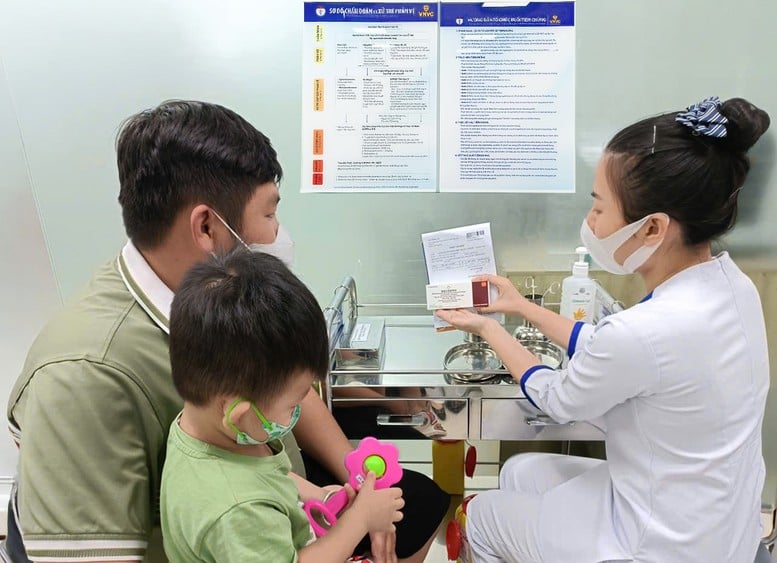
Children receiving meningococcal vaccine - Photo: VGP
Good habits to prevent meningococcal disease.
Meningococcal bacteria can exist in the body without causing disease, but they will proliferate and attack aggressively when the immune system is weakened, quickly entering the bloodstream and causing dangerous complications. Therefore, maintaining good health not only helps keep the body healthy but also plays a crucial role in controlling and limiting the risk of severe progression of the disease when infected.
Experts recommend that everyone adopt a healthy lifestyle: getting enough sleep, drinking enough water, eating a balanced diet, and limiting alcohol and tobacco – these are fundamental factors in strengthening the immune system.
Besides protein-rich foods like meat, fish, eggs, and dairy, it's important to supplement vitamins, minerals, and fiber from green vegetables, fruits, and grains to boost immunity. Simultaneously, maintaining a regular exercise routine also helps improve physical condition and enhance the body's ability to fight off pathogens.
In newborns, symptoms such as bulging fontanelle, lethargy, and refusal to feed may appear – dangerous signs that require urgent medical intervention.
Furthermore, doctors strongly advise against self-medicating with antibiotics without a doctor's prescription. Incorrect use can mask symptoms, making diagnosis difficult and missing the opportunity for early treatment, a crucial factor in meningococcal meningitis cases. In the long term, antibiotic abuse contributes to increased antibiotic resistance, leading to serious public health consequences.
The WHO and the Ministry of Health also recommend that vaccination is the most effective solution to control and prevent cases and outbreaks of meningococcal disease.
However, while vaccines offer high protection, Dr. Bach Thi Chinh believes it is still necessary to combine them with personal preventive measures such as rinsing the mouth and throat with saline solution; wearing masks, maintaining distance, washing hands frequently, and keeping the house clean and well-ventilated.
It's important to note that the gargling process should last about two minutes, allowing the solution to reach the deepest part of the throat three times, each time for about 15 seconds. Gargle 2-3 times a day, without rinsing with water afterwards. However, avoid gargling with antiseptic mouthwash too many times a day as this can dry out the throat, causing dryness and irritation, creating abrasions that allow microorganisms to enter the body.
Wash your hands with soap frequently after contact with crowded places and before each meal. Wash your hands with antibacterial soap for about 30 seconds; do not wash them too quickly.
For young children and shared living spaces such as boarding houses and dormitories, regular environmental cleaning is necessary, including mopping floors and soaking children's toys in a Cloramin B disinfectant solution for about 30 minutes.
In addition, children exposed to cigarette smoke are at a higher risk of developing meningococcal meningitis. Therefore, adults should avoid smoking near children.
Hien Minh
Source: https://baochinhphu.vn/ca-benh-do-nao-mo-cau-gia-tang-102260413111838364.htm
![[Photo] National Assembly Chairman Tran Thanh Man concludes official visit to Italy, departs for IPU-152](https://vphoto.vietnam.vn/thumb/1200x675/vietnam/resource/IMAGE/2026/04/15/1776253436109_vna-potal-chu-tich-quoc-hoi-ket-thuc-tham-chinh-thuc-italy-len-duong-du-ipu-152-tai-tho-nhi-ky-8702876-7969-jpg.webp)
![[Image] Overview of the Tam Trinh-Giai Phong connecting road section after land clearance is completed.](https://vphoto.vietnam.vn/thumb/1200x675/vietnam/resource/IMAGE/2026/04/15/1776245679644_ndo_br_dji-0195-jpg.webp)
![[Photo] General Secretary and President To Lam and his wife, along with General Secretary and President Xi Jinping and his wife, attending a tea party.](https://vphoto.vietnam.vn/thumb/1200x675/vietnam/resource/IMAGE/2026/04/15/1776245678527_vna-potal-tong-bi-thu-chu-tich-nuoc-to-lam-va-phu-nhan-cung-tong-bi-thu-chu-tich-nuoc-tap-can-binh-va-phu-nhan-du-tiec-tra-8702812-9829-jpg.webp)
![[Photo] General Secretary and President To Lam and General Secretary and President Xi Jinping meet with youth from both countries.](https://vphoto.vietnam.vn/thumb/1200x675/vietnam/resource/IMAGE/2026/04/15/1776245687540_vna-potal-tong-bi-thu-chu-tich-nuoc-to-lam-va-tong-bi-thu-chu-tich-nuoc-tap-can-binh-gap-go-thanh-nien-hai-nuoc-8702371-jpg.webp)
![[Photo] Capturing each moment at the "People We Meet" photography exhibition.](https://vphoto.vietnam.vn/thumb/1200x675/vietnam/resource/IMAGE/2026/04/15/1776245695648_1-8944-jpg.webp)
![[Image] Current status of the land area of over 5.5 hectares that Ho Chi Minh City is considering reclaiming.](https://vphoto.vietnam.vn/thumb/1200x675/vietnam/resource/IMAGE/2026/04/15/1776245690095_1-3102-8409-jpg.webp)









































































Comment (0)