

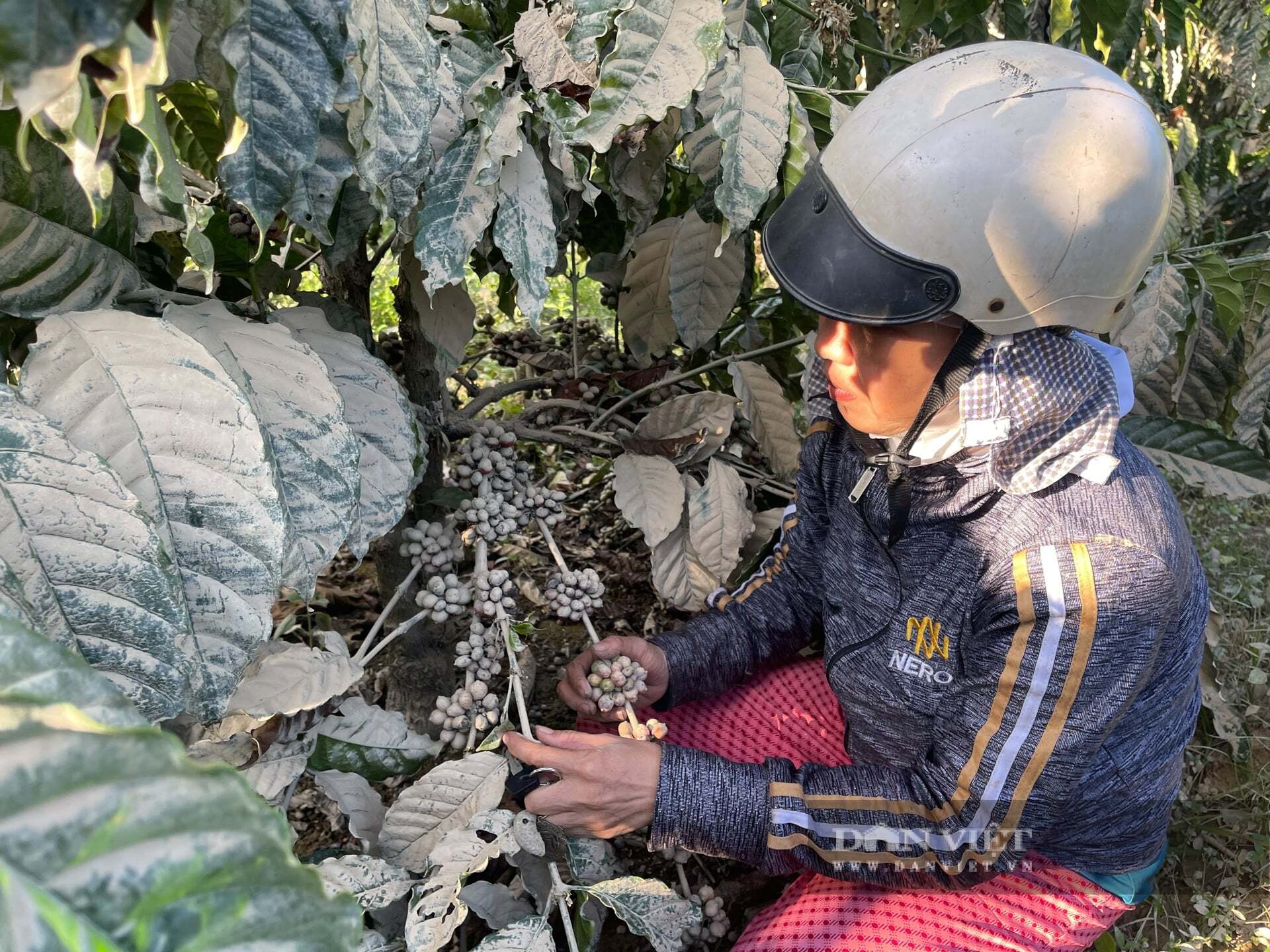
The Central Highlands provinces are in the peak of the coffee harvest season. Although the price of fresh coffee beans is fluctuating between 20,000 and 27,000 VND/kg, a very high price in recent years, farmers in Quang Phu commune are worried about the difficulty of selling their coffee.
After the floods at the end of November, about 80 hectares of coffee plantations in the commune were submerged, covered in mud, and the fruit fell off. Many households hired laborers at high prices to harvest, but there were no pickers available. Despite their efforts to harvest to cover costs, when they took the coffee to sell, dealers unanimously refused to buy it, fearing the mud would damage their drying ovens.
Even though the rain had only stopped a few days ago, Mr. Phan Duc Nhan, from Phu Thuan village, Quang Phu commune, still had to turn on the watering cans for his coffee plants. According to Mr. Nhan, his family's 6.5 sao (approximately 0.65 hectares) of coffee plants were deeply flooded. After the water receded, the coffee cherries ripened, but the thick layer of mud made harvesting extremely difficult. "Coffee prices are very high this year, but we're in a 'laughing and crying' situation after the flood. Now, even harvesting is very difficult. Normally, we hire laborers to harvest on a contract basis for 1,700 VND/kg, but now it's only 2,500 VND/kg, and no one is willing to pick them," Mr. Nhan said.
Mr. Nhan now has to pump water to wash away the mud for at least three hours before he can hire workers. Even so, it's still very difficult to find people willing to work in the garden because the ground is still slippery and the work is much more strenuous. "Watering like this causes a lot of coffee beans to fall off. Water costs, fuel costs, and labor costs all increase, but the yield decreases. However, coffee prices are high, so we try to harvest as much as we can," Mr. Nhan shared.
Not only is it time-consuming and costly, but what worries the villagers most is that after harvesting, they try to sell the coffee but no one buys it. Ms. Nguyen Thi Binh, also from Phu Thuan village, said that her family has 5 sao (approximately 0.5 hectares) of coffee planted in 2007, and in the past, they harvested more than 2 tons each year. Because of the mud, they try to harvest amidst the thick dust, and the coffee beans are covered in mud, so no dealers will buy them.
According to Mr. Pham Ngoc Vu, Chairman of the People's Committee of Quang Phu commune, the heavy rains and floods at the end of November submerged many areas of crops and perennial plants that were in the harvesting stage. After the water receded, people in the area quickly went to check their fields, assess the extent of the damage, and plan for restoring production.
According to statistics, the total flooded and damaged area is over 146 hectares, including: short-term crops (rice, corn, pumpkin, sweet potato, chili) over 61 hectares; perennial crops 85 hectares, including 80 hectares of coffee and over 3 hectares of other crops in Phu Thuan and Phu Loi villages, with approximately 75% damage. Regarding aquaculture, 1 hectare of fish pond in Xuyen Tan village was completely destroyed, estimated at about 30 tons of various types of fish.
“The local authorities are continuing to inspect and assess the extent of damage caused by the floods; at the same time, they are implementing comprehensive measures to help people overcome the consequences of the floods and restore production. Recently, the province also allocated 4 billion VND to the commune to support people affected by the floods,” Mr. Vu said. According to the leader of the Quang Phu Commune People's Committee, regarding the fact that coffee prices are high but many areas are flooded and damaged, the commune has also scheduled meetings with hydropower plants to compile statistics on damaged areas and consider providing additional support to farmers.
Source: https://baolamdong.vn/ca-phe-kho-ban-vi-phu-bun-sau-lu-409486.html
![[Photo] Prime Minister Pham Minh Chinh holds a phone call with Algerian Prime Minister Sifi Ghrieb](https://vphoto.vietnam.vn/thumb/1200x675/vietnam/resource/IMAGE/2026/03/18/1773849689752_ndo_br_dsc-9609-jpg.webp)


![[Photo] General Secretary To Lam presides over a thematic session on strategic technology.](https://vphoto.vietnam.vn/thumb/1200x675/vietnam/resource/IMAGE/2026/03/18/1773838586650_anh-1-bnd-1822-7089-jpg.webp)












































































Comment (0)