 |
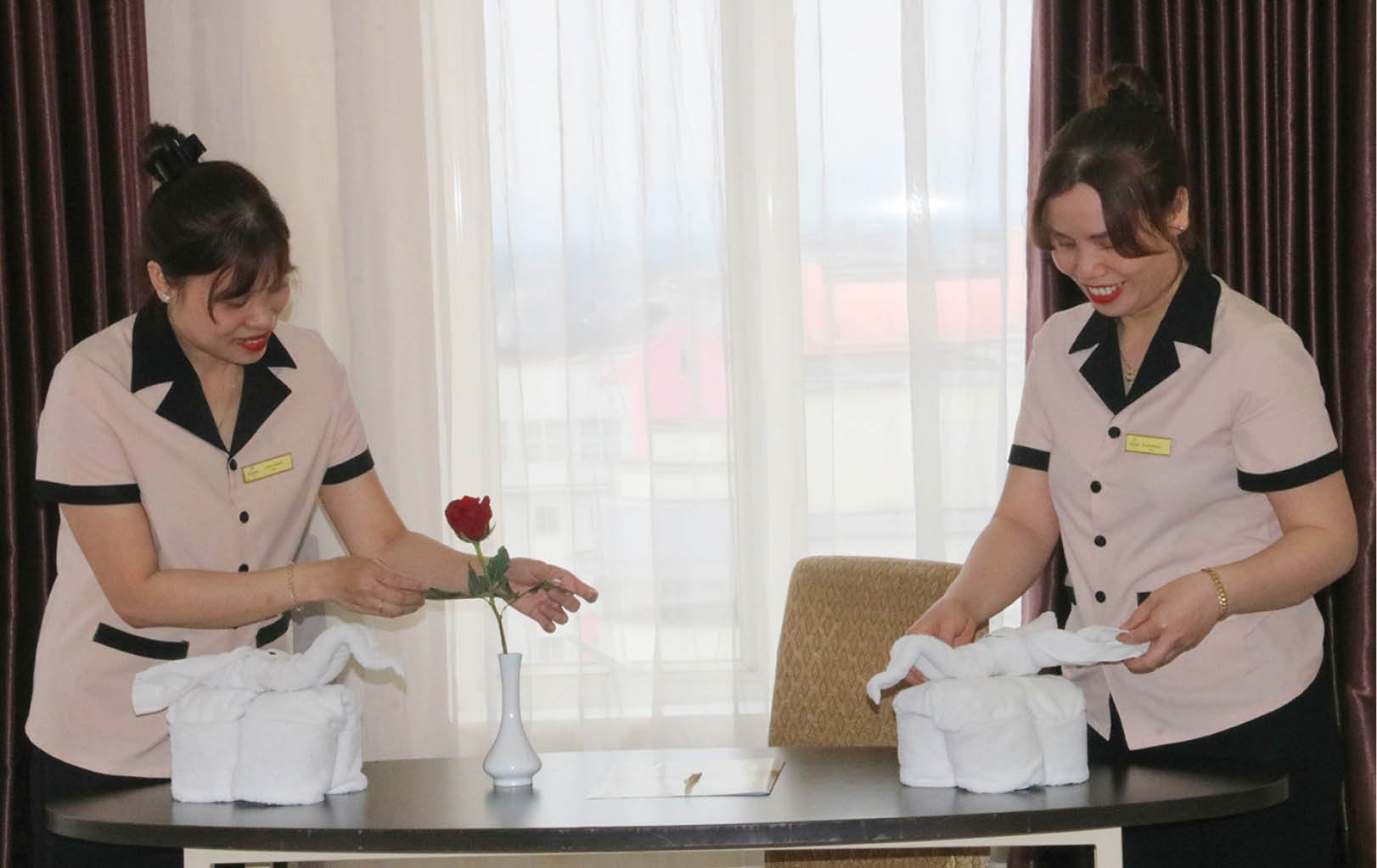
| Staff at Parkview Hue Hotel prepare guest rooms. |
Instability
Following the COVID-19 pandemic, the number of tourists visiting Hue recovered quite quickly, but hotel occupancy rates remained unstable and lacked significant breakthroughs. Although hotels have different strengths in the market, generally speaking, ensuring an average annual occupancy rate of 60-70% remains challenging.
Mr. Nguyen Huu Binh, Director of Century Riverside Hotel Hue, said that in Hue, the tourism market is divided into two distinct seasons: From October to the first half of April of the following year is the international tourist season, mainly for European tourists; the period from April to September is the domestic tourist season and for Asian tourists. Through many years of management, Mr. Binh said that the "fully booked" situation usually only occurs for a short period during holidays or weekends, while on weekdays, especially during off-peak periods, the room occupancy rate sometimes only reaches about 25-40%.
Over the past decade or so, hotel occupancy rates in Hue have fluctuated, but the overall rate has not been as high as expected. According to tourism statistics, the average hotel occupancy rate in Hue from 2016 to 2019 was relatively high, around 60%. During this period, the occupancy rate generally showed signs of increasing, reaching 55% in 2014 and then rising to 62% five years later (in 2019). Besides product-related issues, the amenities and services at accommodation establishments have not been adequately invested in and remain limited in number. Entertainment, beauty, spa services, and even essential services like food and beverage are still lacking, hindering this rate from increasing significantly.
According to Mr. Ho Dang Xuan Lan, Chairman of the Hue City Hotel Association and General Director of Parkview Hue Hotel, hotels have high expectations for 2025, when Hue hosts the National Tourism Year. Although the first seven months of the year have been relatively positive, the market has faced difficulties since August, partly due to floods affecting tourism activities. Furthermore, Hue has not yet attracted a significant number of high-end tourists who stay for extended periods; the average length of stay remains quite low. Many hotels aim for an average annual occupancy rate of 70%, but this is not easy to achieve. “At many times, Korean tourists only visit and leave immediately, rarely staying. Sometimes, the average length of stay is only about 1 or 2 days,” Mr. Lan said.


A current reality in Hue is that even high-end hotels (4-5 stars) are facing difficulties in achieving high occupancy rates. Mr. Phan Trong Minh, General Director of Azerai La Residence Hue, stated that it is concerning that 5-star hotels in Hue struggle to reach an average occupancy rate of 50% or higher throughout the year. Even Azerai La Residence Hue only averages 40%, despite offering promotional programs and incentives to attract guests during the summer.
Addressing challenges related to products and services.
According to data from the Department of Tourism, as of October 2025, the city had 899 accommodation establishments, with 14,326 rooms and 22,965 beds, including 205 hotels with 8,701 rooms and 14,310 beds.
Mr. Dinh Manh Thang, Vice President of the Vietnam Tourism Association and President of the Hue City Tourism Association, believes that the lack of new and attractive products is a major reason for the low length of stay, leading to low occupancy rates. Hue's tourism products still heavily rely on heritage tourism, while lacking entertainment, recreation, and nighttime experiences. “The customer market segments are not diverse; there aren't many tourists seeking experiences, enjoyment, and relaxation, so when staying in Hue for a short time, the occupancy rate will be low. The majority of tourists to Hue are traditional visitors with relatively low spending power, while Hue hasn't yet attracted young tourists – a group capable of year-round travel. For investors, business efficiency is always a key consideration. Investors will invest where the market is developing,” Mr. Thang analyzed.
Another reason is that people's travel trends have changed significantly after COVID-19. The trend now favors short trips, independent travel, small group travel, and the use of private accommodations such as homestays, villas, bungalows (single-story, detached houses), and camping. The demand for centrally located hotels has decreased, especially for traditional models.
To solve the problem of hotel occupancy rates, it's not just about the role and programs of hotels, but also requires synergy from many sides, with tourism products and markets being particularly important. According to Mr. Ho Dang Xuan Lan, the decisive factor in retaining tourists lies in the products and services at the destination: unique experiences, entertainment, nighttime services, etc. If there is a sufficiently attractive product range, hotels can enhance and improve service quality, connect with travel agencies and destinations, creating more sustainable results.



From this perspective, Mr. Dinh Manh Thang believes that tourists visiting Hue, in addition to sightseeing heritage sites, also need entertainment, shopping, and dining spaces. When nighttime offerings are diverse, experiential services are varied, and the market segment is expanded, tourists will be willing to stay longer. This is also a factor that directly influences businesses' investment decisions when assessing the potential of the Hue market.
Source: https://huengaynay.vn/du-lich/cac-co-so-luu-tru-chat-vat-lap-day-cong-suat-160242.html