

The study period was extended due to insufficient English proficiency upon entry.
The 100% English-language training program requires students to meet the English language entry requirements to study their major; otherwise, they must take intensive English courses. This prolongs the students' study period.
Bui Tri Dung (a 4th-year student in the Biomedical Engineering department, International University - Vietnam National University Ho Chi Minh City) was admitted based on his aptitude test score. The school states that it is divided into two levels: Intensive English (IE, which consists of three levels: IE0, IE1, and IE2) and Academic English (AE).
"Students need an IELTS certificate of 5.5 or higher to enter their major. If they take an intensive English course, students must study up to IE2 to study general subjects concurrently, and only after completing AE can they start their major. 'Because my English wasn't good, I was placed in IE0 and had to spend a year in intensive English. Therefore, I entered my major a year later,' Dung said."
Enrolled in the high-quality English-language program, Bui Mai Thao (a fourth-year student majoring in Chemical Engineering at Ho Chi Minh City University of Technology) diligently studied intensive English. "Without an IELTS score, I had to take a placement test and study intensive English until I reached the required level or achieved the IELTS score to be admitted to the main program. Therefore, I started my major a year later," according to Mai Thao.

Students are looking into English courses at English language centers.
Studying but not understanding
Lectures and materials in English pose a problem, preventing students from fully understanding them and interacting effectively in class.
Initially, Bui Tri Dung struggled to understand and interact with the lecturers. "Studying in an English-speaking environment when my English wasn't strong limited my ability to absorb information and prevented me from developing my strengths. Currently, my academic performance is stable, but I'm still quite struggling with English," Dung said.
Similarly, Bui Mai Thao also found it difficult to understand the lessons when listening to lectures in English, because the lessons contained many specialized vocabulary words, which she couldn't fully grasp due to her limited specialized vocabulary, which she needs to improve.
Le Thi Huyen Trang (a first-year student majoring in Control and Automation Engineering at the International University - Vietnam National University Ho Chi Minh City) shared: "All class activities are in English, so I have to use translation tools to help. Sometimes, the lecturer asks us not to use translation tools, which makes it difficult for me to understand the lesson."
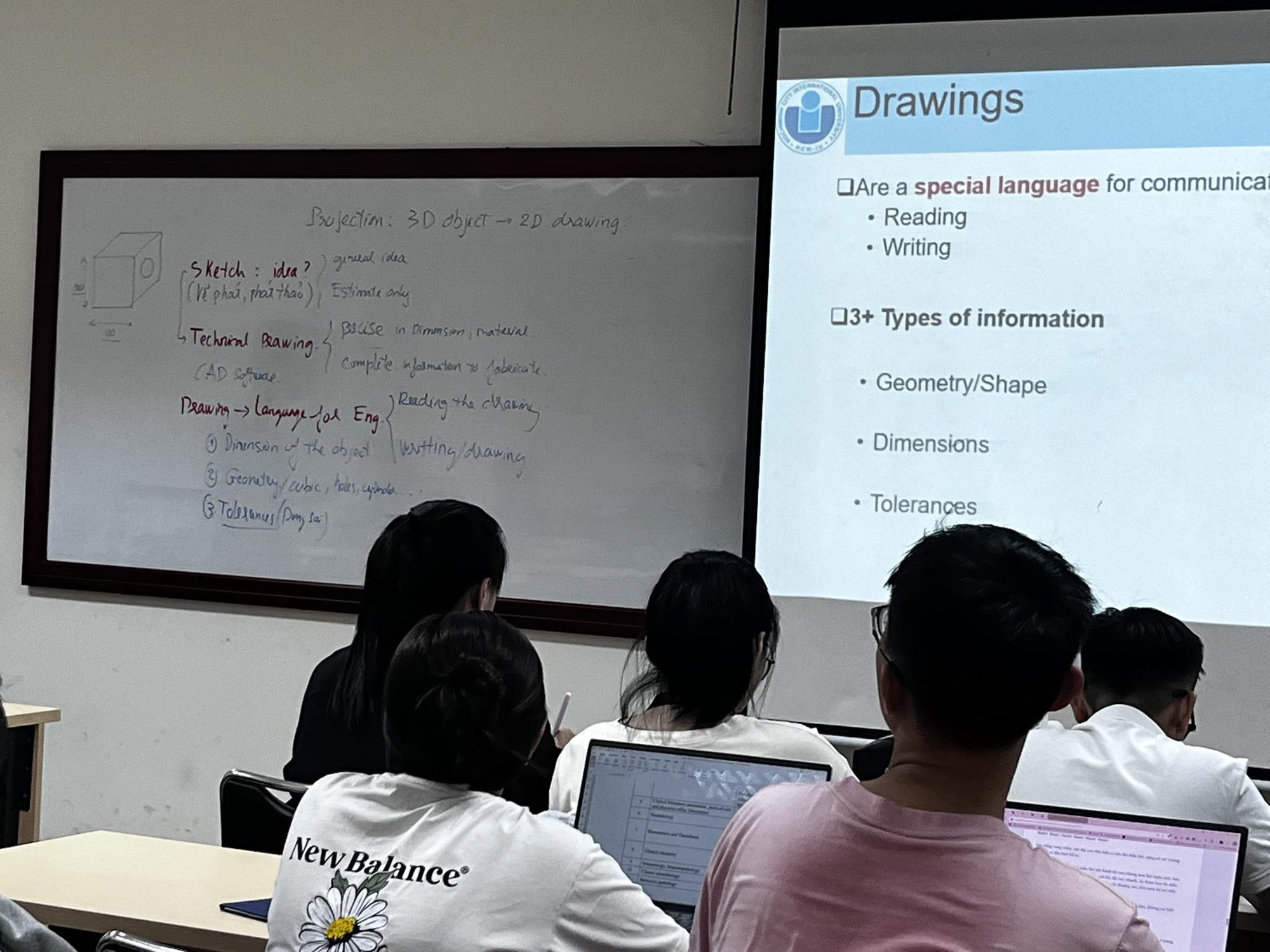
Lectures and materials in English make it difficult for students to keep up with the program.
On the other hand, NVQP (a second-year student majoring in Information Technology at Ho Chi Minh City University of Technology) struggles quite a bit with reading English-language materials. "I still study general subjects in Vietnamese. But the specialized materials are only in English, forcing me to understand them. Because of my limited English, I don't fully grasp the knowledge from the materials and often only refer to the code snippets," QP said.
"Studying without understanding" can easily lead to discouragement and giving up; however, many students still strive to improve their academic results.
Having considered changing majors after failing the intensive English course twice, Nguyen Nhan Van (a fourth-year student in the Biomedical Engineering department at the International University - Vietnam National University Ho Chi Minh City) successfully improved his English skills thanks to his persistent efforts. Sharing his effective learning methods, Van said: "Students should proactively seek out and read many English materials, taking notes on new vocabulary while reading. They can practice listening skills using English songs, videos , and audio on the internet, and should practice presentations to improve speaking skills. Additionally, reviewing the lesson before class will help them grasp the material more easily."
Consider carefully and be persistent when choosing an English program.
Speaking with a reporter from Thanh Nien Newspaper, Ms. Nguyen Thi Viet Tu, Deputy Head of the Training Department at the International University (Vietnam National University Ho Chi Minh City), commented that in a 100% English program, students with weak English skills will find it quite difficult to study their major. "When deciding to choose this program, students need to consider factors such as: financial resources (because they will need to improve their English proficiency), determination and effort, and passion for their chosen field," Ms. Tu noted.

Students must prepare their lessons before coming to class.
To achieve good results in English-language programs, Master Nguyen Dinh Minh Thang, lecturer in the Faculty of Linguistics, International University (Vietnam National University Ho Chi Minh City), affirms that students must proactively seek help from teachers, friends, or online learning resources. "Studying with peers helps students absorb knowledge more easily, so it's advisable to form study groups with academically strong students to exchange ideas and review classroom material. Simultaneously, students should participate in review courses from online learning resources. There, they can listen to and reflect on parts they didn't understand in class, and there are also exercises to do," Mr. Thang said.
To improve their English skills, Master Minh Thang suggests that students should focus on seeking support from their English course instructors to help with writing assignments and provide feedback on presentations or projects.
Furthermore, to improve comprehension of English lectures, Ms. Nguyen Hoang Yen Oanh, an English teacher at IIG Vietnam Education Organization, advises: "Students should start practicing listening comprehension by watching videos and listening to podcasts on topics they enjoy, then move on to simpler topics related to their field of study and progress to academic topics in lectures. Always preparing before class will help students understand 50% of the content and selectively absorb knowledge."
Learn more with a teaching assistant to grasp the material.
Lectures are given in English, and each class is quite short, making it challenging for students with weak English skills to fully grasp the material. Therefore, in addition to group study, students can seek assistance from teaching assistants.
Source link

![[Photo] Prime Minister Pham Minh Chinh receives the Chinese Ambassador to Vietnam](https://vphoto.vietnam.vn/thumb/1200x675/vietnam/resource/IMAGE/2026/04/05/1775397481797_ndo_br_dsc-5512-jpg.webp)








































































































Comment (0)