

Vietnam has a hot and humid climate with abundant rainfall, which is favorable for the growth of various types of wild mushrooms, including many poisonous species. Some poisonous mushrooms only grow in spring or spring-summer, others mainly grow in summer or summer-autumn, and some grow year-round. The rapid changes in size, shape, and color can easily lead to confusion when distinguishing edible mushrooms from poisonous ones.
According to Dr. Bui Thi Tra Vi - Department of Nutrition & Dietetics - Hanoi Medical University Hospital, poisonous mushrooms in nature often have bright, eye-catching colors, complete caps, gills, and stems that are membranous and swollen like bulbs, or mushrooms with pale pink spores, red caps with white scales, and hyphae that emit light. Some mushroom species may have varying levels of toxins depending on the season, the growth process (young or mature mushrooms), and different soil conditions. Therefore, it is possible to experience poisoning from eating the same type of mushroom at different times. In addition, poisonous mushrooms often have a pungent smell and may ooze a milky substance...
However, there are many exceptions; some poisonous mushrooms have the same color and shape as common mushrooms. Therefore, it is very difficult to distinguish between safe and poisonous mushrooms without sufficient experience and knowledge. That's why, according to Dr. Tra Vi, it's best to consider all mushrooms in the forest as poisonous and avoid eating them.
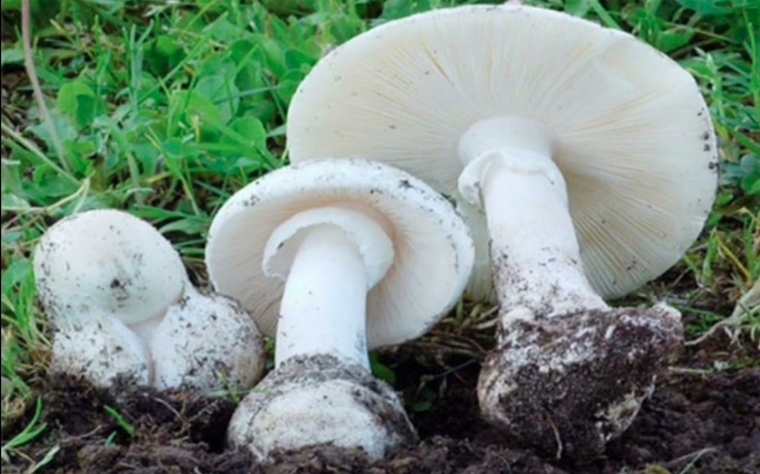
White-gilled poisonous mushrooms. Some common types of poisonous mushrooms.
Poisonous white-gilled mushrooms: These mushrooms grow in clusters or singly on the ground in forests and other places. In Vietnam, white-gilled mushrooms are commonly found in the northern mountainous provinces such as Ha Giang, Tuyen Quang, Thai Nguyen, Yen Bai, Bac Can, and Phu Tho . They usually grow in areas bordering bamboo, reed, and palm forests, as well as some sparsely planted forests with many tree species.
The main toxin in the white-gilled mushroom is amanitine (amatoxin), which is highly toxic. The mushroom toxin affects liver cells, causing liver necrosis, and is excreted in urine and breast milk, causing poisoning in infants. The first symptoms after consuming the mushroom appear late (6-24 hours), on average about 10-12 hours, with symptoms including nausea, abdominal pain, vomiting, and frequent watery diarrhea. This is followed by liver failure, kidney failure (jaundice, frequent or decreased urination, coma), and death.
Morphological characteristics : The mushroom cap is white, sometimes with a dirty yellow center. The surface of the cap is smooth and shiny when dry, and sticky and slimy when humid. When young, the cap is round, with the edges tightly attached to the stem. As it grows, the cap becomes conical, and finally, when mature, the cap flattens out with a diameter of about 5-10 cm. The gills are white, the stem is white with a white ring, the base of the stem is bulbous, with a cup-shaped volva. The flesh is soft, white, and has a mild aroma.
Grey-brown notched cap mushroom : This type of mushroom contains muscarin and usually grows on the ground in forests or in places with a lot of decaying leaves. Grey-brown notched cap mushrooms have conical to bell-shaped caps with pointed apex and yellow to brown mycelial threads radiating from the apex down to the edge of the cap.
When mature, the edges of the mushroom cap split into separate rays. The diameter of the cap is 2-8 cm. The gills are slightly white when young, firmly attached to the stem; when mature, they are gray or brown and separate from the stem. The stem is slightly white to yellowish-brown, 3-9 cm long, with a non-bulging base and no ring. The flesh of the mushroom is white.
This type of mushroom contains muscarin, a toxin that affects the parasympathetic nervous system, causing symptoms such as sweating, shortness of breath, wheezing, slow pulse, coma, and seizures. Symptoms appear quickly, within 15 minutes to a few hours.
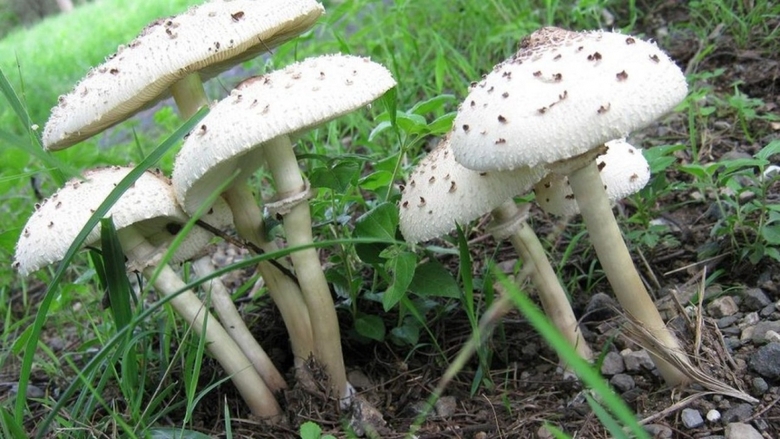
White-gilled umbrella mushroom with green gills : This mushroom belongs to the group of gastrointestinal toxins. The toxins act quickly, causing nausea, vomiting, abdominal pain, cramps, and diarrhea. The mushroom usually grows in clusters or singly near buffalo and cow sheds, on grasslands, cornfields, and some areas with loose, humus-rich soil in nature. When young, the cap is elongated hemispherical, pale yellow, with small light brown or light gray scales. When mature, the cap is umbrella-shaped or flattened, white, with a diameter of 5-15 cm. The surface of the cap has thin, dirty brown scales, which thicken towards the apex. The gills (underside of the cap) are white when young, and have a pale green or grayish-green tint when old; the green color becomes more pronounced with age. The stem is white to brown or gray, with a ring near the top, close to the cap. The base of the stem is not bulbous and lacks a volva; it is 10-30 cm long. The flesh of the mushroom is white. This type of mushroom contains toxins that cause digestive disorders (abdominal pain, vomiting, severe diarrhea), and can be fatal due to dehydration, electrolyte imbalance, and associated with other chronic diseases.
How to prevent mushroom poisoning
Dr. Bui Thi Tra Vi advises against ever picking or using unfamiliar mushrooms, mushrooms of unknown origin, or mushrooms suspected of being unsafe for food preparation, even just once. Only use mushrooms sold at reputable establishments.
In mountainous areas, when eating mushrooms, it's advisable to ask experienced people for advice on identifying poisonous mushrooms. Avoid picking mushrooms that are too young, before the cap has fully opened, as this prevents a clear assessment of their structure and whether they are poisonous or not.
If symptoms of mushroom poisoning appear, go immediately to the nearest medical facility for first aid, emergency care, and timely treatment.
Source


![[Photo] General Secretary and President To Lam meets with National Assembly delegates from ethnic minorities.](https://vphoto.vietnam.vn/thumb/1200x675/vietnam/resource/IMAGE/2026/04/20/1776696701056_a1-bnd-8331-3342-jpg.webp)
![[Image] National Assembly discusses the implementation of the socio-economic development plan.](https://vphoto.vietnam.vn/thumb/1200x675/vietnam/resource/IMAGE/2026/04/20/1776696707422_ndo_br_img-20260420-185419-jpg.webp)










































































Comment (0)