
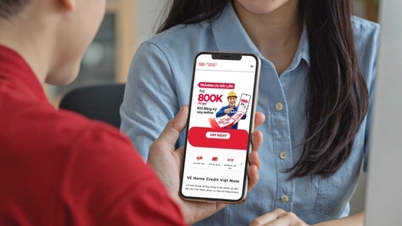
Providing guidance on recognizing the signs of fake websites on smartphones is crucial. (Graphic: Thai Binh)
Double-check the website address.
The first and most important step when accessing any link is to carefully observe the website's address in the browser's address bar. Scammers often create domain names with structures similar to reputable websites to deceive viewers. A moment of inattention or poor eyesight can easily lead users to mistakenly click on them. A common trick is to change or add a few small characters in the official domain name. For example, instead of the correct address "nganhang.com.vn," scammers might create "nganhhang.com.vn" (with an extra 'h') or "nganhang.net" (different suffix). In more sophisticated cases, they use characters with similar shapes, such as replacing the letter "o" with the number "0," or the regular "l" with the number "1," making it very difficult to detect the difference at first glance.
In addition, the domain extension of a website is also a factor to pay special attention to. Official websites of government agencies and reputable organizations in Vietnam usually end with ".vn" or ".com.vn". Meanwhile, fraudulent websites often use unusual, less common, or very cheap domain extensions such as ".xyz", ".top", ".club", ".info", or ".vip". If you receive a link related to a bank, police department, or public administrative services with these unfamiliar domain extensions, it is highly likely to be a fake website.
Another technical detail to watch out for is the padlock icon in front of the website address. Previously, the presence of a padlock (HTTPS protocol) was considered a sign of security, but this is no longer entirely accurate. Malicious actors are becoming increasingly sophisticated, registering free security certificates to create this padlock icon to gain the trust of victims. However, if a website requests important information such as passwords, ID numbers, or account numbers and completely lacks a padlock icon, or if the browser displays a red "Not secure" warning, absolutely do not proceed to access the site or enter any information.
Many smartphone users have a habit of clicking on links sent via text messages or social media without checking. This is very dangerous because shortened links often hide the real address. Therefore, the unwavering principle is to clearly see the full domain name and check its spelling before taking any further action. Being cautious right from the address entry stage will help eliminate most of the risk of being lured into traps.
Observe the interface and the content displayed.
Legitimate websites of government agencies, banks, or large businesses are always professionally designed with clear visuals, well-organized layouts, harmonious colors, and sharp logos. Conversely, fraudulent websites are often hastily and carelessly constructed with the goal of a quick profit. The most easily recognizable signs are images that are often blurry, faded, distorted, or have garish colors that don't match the familiar brand identity. The website layout is usually chaotic, menu items don't work or lead to the same landing page, and fonts are inconsistent, sometimes large, sometimes small.
In particular, spelling and grammatical errors are a major weakness of fake websites. Because many scammers use automatic translation tools from foreign languages to Vietnamese, or due to their limited literacy, the content on these sites often contains awkward sentences, grammatically incorrect Vietnamese, or uses language inappropriate for administrative or journalistic writing styles.
Beyond the outward appearance, the content that plays on psychology is also a sophisticated trap, such as displaying urgent notifications like "Your account will be locked in the next 24 hours," "Suspicious transaction detected, verification required immediately," or incredibly attractive prize information like "You've won a motorbike," "Receive a valuable thank-you gift." Information about prize winnings or threats related to legal issues often causes panic or excessive excitement. Scammers exploit this psychological vulnerability to request users to enter personal information, bank passwords, or OTP codes into pre-designed fields on the website.

It's important to note the difference between the address bar of a legitimate website and a phishing website with incorrect characters. (Graphic: Thai Binh)
A reputable website will never ask users for login passwords, OTP codes, or personal financial information through a suspicious link or a sudden pop-up window. Furthermore, fake websites usually focus on a single page requesting data entry; other links like "About Us," "Contact Us," or "Privacy Policy" are often dead links (clicking them has no effect) or are simply for show. No authorities conduct investigations via text messages or require citizens to disclose confidential information on suspicious websites.
Use authentication tools.
Currently, the Ministry of Information and Communications and other relevant agencies have implemented many solutions to support people in searching for and verifying information on the internet, such as the "tinnhiemmang.vn" portal. This system publishes a list of reputable domain names (White List) and a list of infringing or fraudulent domain names (Black List) that have been verified by the authorities. When encountering a suspicious website, users can access this system to check if that website is on the blacklist.
Additionally, checking the contact information at the bottom of the website (footer) is also essential. A legally operating website in Vietnam, especially e-commerce sites, news sites, and social networks, is required to publicly display information such as: the name of the managing agency, the actual office address, contact phone number, the operating license number issued by the competent authority, and the person responsible for the content. Try copying that address or phone number and searching on Google. If the information does not exist, or leads to scam warnings from others, then it is certainly a fake website.
For websites selling goods or providing services, users should check if the website has the "Notified to the Ministry of Industry and Trade " logo (blue) or "Registered with the Ministry of Industry and Trade" logo (red) at the bottom of the page. However, it should be noted that fraudsters may also paste this logo onto fake websites to deceive users. To be sure, click directly on the logo. If it's real, it will link to the Ministry of Industry and Trade's e-commerce management system page and display full business information. If clicking on it yields no response or only shows a magnified image, it's a fake logo.
Equipping yourself with the skills to identify phishing websites is not only a way to protect your personal assets, but also contributes to maintaining security and order in the area. When detecting websites with suspicious signs, people should absolutely not access them, not share them with others, and quickly notify the nearest police station or send a report to the National Cybersecurity Monitoring Center.
bienphong.com
Source: https://baolaocai.vn/cach-nhan-biet-trang-web-lua-dao-don-gian-nhat-post892752.html




























































































Comment (0)