

According to CIEM's assessment, Vietnam still lacks a unified, synchronized, and sufficiently strong legal framework to serve as a basis for promoting internal structural transformation within the industrial sector. Development policies for priority and key industries are fragmented and lack focus, leading to inefficient resource utilization...
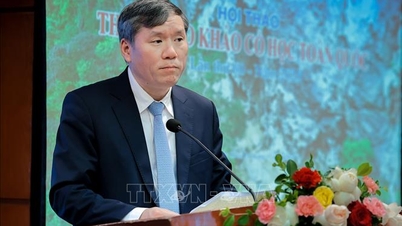
At the seminar "National Industrial Policy: Some New Trends and Visions for Vietnam" held on December 20th in Hanoi, Dr. Tran Thi Hong Minh, Director of the Central Institute for Economic Management Research (CIEM), stated that the Fourth Industrial Revolution is fundamentally changing the economic development model, production methods, and global value chains. Countries around the world, especially major economies, have been adjusting their industrial strategies to adapt to this trend, leveraging new technologies to enhance competitiveness and sustainable development.
Furthermore, global challenges such as climate change, depletion of natural resources, and the urgent need for sustainable development are creating immense pressure on countries, especially developing economies like Vietnam. In this context, adapting to and mitigating the impacts on economies depends not only on national environmental policies but also on the capacity to develop new industries to drive this adaptation and mitigation process.
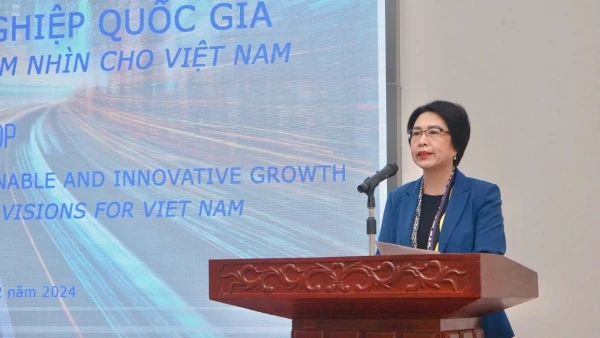
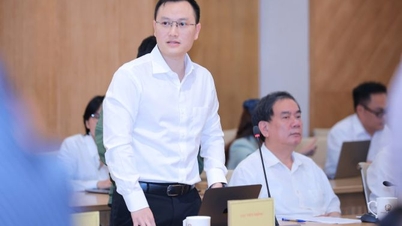
Dr. Tran Thi Hong Minh - Director of the Central Institute for Economic Management Research (CIEM).
"In the context of deep international economic integration and increasingly fierce competition, building and implementing an effective national industrial policy is not only an urgent requirement but also a long-term strategic one. Today's industrial policy should not only guide and create momentum for the development of individual economic sectors, but also create new impetus to enhance national competitiveness, promote sustainable economic growth, and strengthen the level and effectiveness of participation in global value chains," the Director of CIEM emphasized.
Ms. Minh argued that the new development model requires identifying industries and sectors with both static and dynamic competitive advantages, linked to improving both the innovation capacity and the independence and self-reliance of the economy.
"International economic integration remains a major trend and still limits the use of traditional trade policy tools to protect imports, but it is also a positive 'pressure' for countries' industrial policies to adjust both in content and implementation methods," Ms. Minh said.
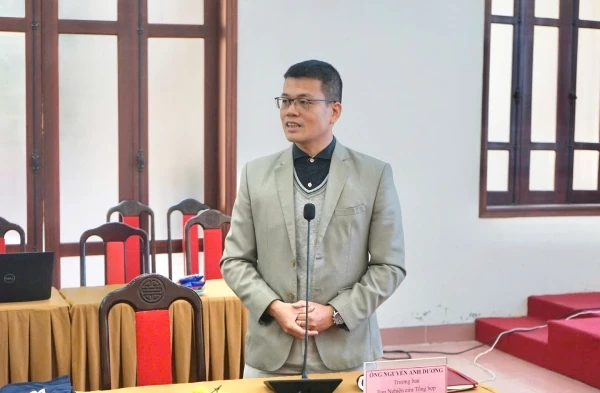
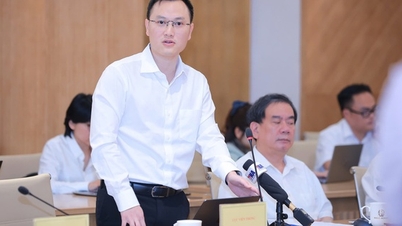
Mr. Nguyen Anh Duong - Head of the General Research Department, CIEM.
Presenting the report "National Industrial Policy: Some New Trends and Vision for Vietnam," Mr. Nguyen Anh Duong, Head of the General Research Department at CIEM, stated that the legal framework for industrial policy in Vietnam has been gradually improved. According to the 2024 Global Innovation Index report, Vietnam ranked 44th out of 133 countries and economies, an increase of two places compared to 2023. Vietnam ranked first in the world in three indicators: high-tech imports, high-tech exports, and exports of innovative goods as a percentage of total trade transactions.
However, in evaluating industrial policy in relation to new trends, Mr. Duong argued that Vietnam still lacks a unified, synchronized, and sufficiently strong legal framework to serve as a basis for promoting internal structural transformation within the industrial sector. Development policies for priority and key industries are fragmented and lack focus, leading to inefficient resource utilization.
Lack of coordination among localities has led to unhealthy competition. Industrial development management through specialized legal systems, particularly regulations on taxation, investment, and land, has revealed many shortcomings. The capacity of industrial enterprises has not been enhanced in the context of implementing commitments under FTAs, such as rules of origin, trade defense, and technical barriers.
Based on this situation, CIEM recommends focusing on promoting the export of high value-added products, attracting quality foreign investment, and creating favorable conditions for domestic businesses to effectively connect to regional and global supply chains. Solutions such as improving production capacity, training human resources, and improving access to finance will help businesses, especially small and medium-sized enterprises (SMEs), overcome current barriers and gradually contribute to the self-reliance of the economy, including in new sectors associated with digital transformation and green transformation.
CIEM also recommends strengthening substantive linkages between domestic and foreign enterprises, thereby forming a sustainable industrial ecosystem that adapts to global development trends, aiming to build a modern and sustainable industrial base.
Nguyet Minh
Source: https://doanhnghiepvn.vn/kinh-te/chinh-sach/can-chinh-sach-cong-nghiep-dot-pha/20241221125715182


![[Photo] Conference announcing the Politburo's Decision on organizational and personnel matters](https://vphoto.vietnam.vn/thumb/1200x675/vietnam/resource/IMAGE/2026/04/01/1775017881825_bnd-2410-1472-jpg.webp)


![[Photo] Conference on the transfer and reception of Party organizations and Party members between the Party Committee of the Government and the Party Committees of the Central Party Agencies](https://vphoto.vietnam.vn/thumb/1200x675/vietnam/resource/IMAGE/2026/04/01/1775036784472_ndo_br_bnd-2620-jpg.webp)














































































Comment (0)