PRIVATE SUPPORT SHOULD NOT BE PROVIDED THROUGH A REQUEST-AND-GIVE MECHANISM.
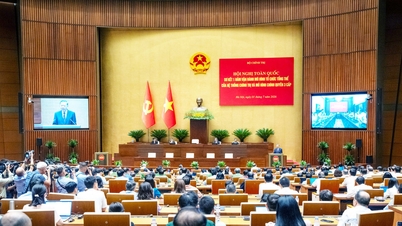
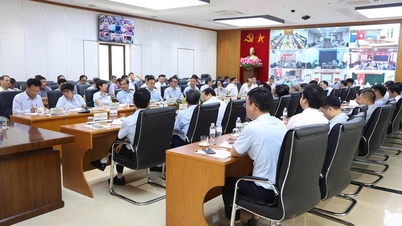
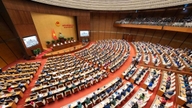
On the afternoon of April 20th, continuing its first session, the National Assembly discussed socio-economic development in the plenary hall.
In his remarks, delegate Pham Trong Nhan (Ho Chi Minh City) cited the Government's report, stating that GDP growth in 2025 will reach 8.02%. This result stems not only from the state-owned economy and the FDI sector but also from the resilience of the private sector. The private sector currently contributes approximately 51% of GDP annually, over 30% of the state budget, creates jobs for over 82% of the workforce, and accounts for nearly 60% of total social investment.
However, behind those growth figures, the number of businesses leaving the market remains high. And despite contributing more than half of GDP, the private sector accounts for only about 30% of exports, with the remainder belonging to FDI.

The National Assembly discussed socio-economic development on April 20th.
PHOTO: VNA
According to a delegate from Ho Chi Minh City, this disparity reflects the reality that the private sector still primarily operates in the domestic market, focusing on processing or low-value segments, while strategic sectors, high technology, and infrastructure lack the leading role of the private sector. Recalling recent resolutions on private sector development by the Politburo and the National Assembly, Mr. Nhan noted that despite efforts to improve policies, the approach still leans towards "support," but this mindset will struggle to remove the "request-and-grant" barriers, while what businesses need is a stable and equitable legal framework.
Believing that "there can be no further delay," Mr. Nhan believes the National Assembly needs to include a fundamental framework law in its legislative program – the Law on Guaranteeing the Right to Develop the Private Economy. Mr. Nhan cited the example of South Korea, which enacted the Law on Monopoly Regulation and Fair Trade in 1980, creating an institutional foundation for the private economy to develop alongside large corporations, laying the groundwork for the "Miracle on the Han River." Successful countries are not successful because they offer more incentives to businesses, but because they have created a sufficiently solid institutional foundation for the private sector to confidently develop and have the capacity to participate in sectors that determine the nation's future.
"The National Assembly needs to begin a new chapter in its development with a foundational law for the private economy, to move from promises to institutions, from policies to legal guarantees," MP Pham Trong Nhan recommended.
MANY ADMINISTRATIVE PROCEDURES STILL CAUSE INCONVENIENCE
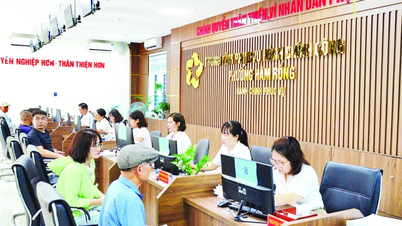
Commenting on administrative procedure reform, National Assembly Deputy Hoang Minh Hieu (Nghe An delegation) assessed that, despite significant improvements, practical experience shows that there are still shortcomings and limitations. Many administrative procedures remain cumbersome and create difficulties for citizens and businesses; in particular, inter-agency procedures related to land, investment, planning, and finance still have many structural obstacles, leading to prolonged appraisal times. According to feedback from some investors, some projects take many years just to complete the initial procedures, and some projects are even stalled and cannot be implemented, causing a huge waste of resources.
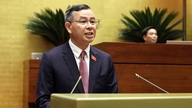

Mr. Hieu observed that lengthy procedures and high compliance costs are among the reasons affecting the overall labor productivity of the economy, and one of the two targets not met in the past term. "It is necessary to recognize that simplifying administrative procedures is not just an administrative task, but a key solution to unlock resources, enhance competitiveness, and strengthen market confidence," the delegate stated.
Mr. Hieu suggested that the Government continue to be more decisive in reforming administrative procedures, shifting strongly from simplification to substantial reduction; reviewing to clearly distinguish which procedures are still necessary to simplify, and which are outdated to abolish; and which procedures can be replaced by post-inspection to avoid reducing paperwork while maintaining the "request-and-grant" mentality.
In particular, it is necessary to develop specific indicators to evaluate administrative procedures based on actual results as a measure, avoiding formality. Instead of just reporting the number of procedures that have been reduced, evaluation should be based on the actual time taken to complete the procedure, the number of trips people have to make, the actual compliance costs, etc. Digital transformation of administration is not about putting paper documents online, but about redesigning processes to suit the digital environment, to create genuine convenience for people, for example, administrative procedures that are not geographically defined, proactive administrative procedures, etc.
DO NOT INCREASE REVENUE AT ALL COSTS
During a discussion on saving in budget revenue and expenditure management, National Assembly Deputy Tran Van Lam (from Bac Ninh province) argued that budget revenue should be considered within the overall goal of sustainable development. "If increasing revenue stifles production and business incentives, shrinks economic sectors, or creates social problems, affecting long-term growth potential, then the effectiveness of such revenue increase needs to be thoroughly re-evaluated," Mr. Lam stated. Therefore, he emphasized the need to consider how revenue should be increased, in which sectors and areas, to both ensure budget resources and nurture revenue sources, thereby promoting long-term development.
Emphasizing the necessity of saving on recurrent expenditures, the delegate from Bac Ninh suggested clarifying what constitutes saving. He argued that if operations remain operational and management goals are met after cuts, the accuracy of expenditure norms and the quality of budget preparation need to be re-examined. "The fundamental solution must be to review and refine expenditure norms; improve the quality of budget preparation to better reflect reality, rather than simply cutting 5 or 10% of the budget," Mr. Lam stated.
Regarding investment spending, the delegate argued that the requirement for savings is not about reducing the scale of capital, but about improving the efficiency of capital utilization. The ICOR coefficient is currently high, indicating limited investment efficiency, and even signs of waste. "The paradox is that in many cases, the more investment increases, the greater the risk of waste. If we save on recurrent expenditures but concentrate resources on inefficient projects, those that are slow to implement, or those that fail to fulfill their intended purpose after investment, then that is an even greater waste," delegate Lam stated.
Therefore, according to the delegate, it is necessary to focus on solutions to improve investment efficiency: from the selection of project portfolios to investment preparation, project planning, budgeting; implementation and disbursement; control of losses and waste; and management, operation, and exploitation after investment. The principle is that "investment with borrowed capital must yield higher returns than the borrowing costs; investment must be quickly put into use and yield practical results."
"Spending less isn't saving. Saving is saving. At the same time, we shouldn't increase revenue at all costs, but rather nurture sustainable revenue sources for the economy. Every dollar of budget revenue and expenditure must be used appropriately, at the right time, and create real value for the rapid and sustainable development of the country – that's the greatest saving," emphasized Representative Tran Van Lam.
This morning, April 21st, the National Assembly continued its discussion in the plenary session on socio-economic issues. Leaders of ministries, sectors, and the Government will participate in explaining the issues raised by the deputies.
The tax threshold for household businesses should be at least 2 billion VND.
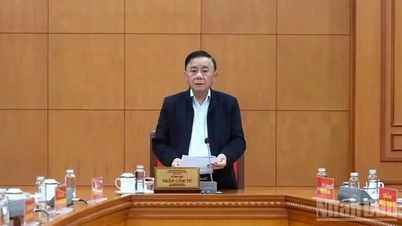
Earlier that day, the Standing Committee of the National Assembly met to discuss the draft law amending and supplementing several articles of the Law on Personal Income Tax, the Law on Value Added Tax, the Law on Corporate Income Tax, and the Law on Special Consumption Tax.


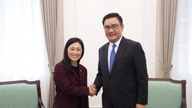
According to Minister of Finance Ngo Van Tuan, in light of the adverse impact of the global economy, to support individuals and business households, it is necessary to continue researching and adjusting the revenue threshold for individual business owners to be exempt from personal income tax and the revenue threshold for business households and individuals to be exempt from value-added tax.
Presenting the verification report, the Chairman of the Economic and Financial Committee, Phan Van Mai, agreed with the Government's proposal but suggested further careful consideration of the specific revenue threshold. Previously, the revenue threshold was 100 million VND, the drafting agency proposed raising it to 300 million VND, and then adjusted it to 500 million VND. "However, many opinions suggest that this level is still low. The Association of Small and Medium Enterprises proposed up to 3 billion VND, while the verification agency believes that a minimum of around 2 billion VND should be considered to ensure humaneness and practicality," Mr. Mai stated.
It is proposed that November 24th be designated as Vietnam Culture Day.
On the morning of April 20th, presenting the draft Resolution of the National Assembly on the development of Vietnamese culture, Minister of Culture, Sports and Tourism Lam Thi Phuong Thanh stated that the resolution consists of 13 articles with 10 policies. Notably, the draft institutionalizes the Politburo's policy of choosing November 24th each year as "Vietnamese Culture Day," and workers are entitled to a day off with full pay.
Regarding the implementation roadmap, Minister of Culture, Sports and Tourism Lam Thi Phuong Thanh clarified the reason for including this content in the resolution instead of waiting for amendments to the Labor Code. Accordingly, waiting until the October session to finalize the Labor Code would not be timely enough for this year's activities. Including it in the resolution provides a legal basis for immediate implementation. The cultural sector is actively advising on the development of a framework for celebratory activities to ensure readiness when the resolution takes effect.
Source: https://thanhnien.vn/can-dao-luat-rieng-cho-kinh-te-tu-nhan-185260420231336453.htm