

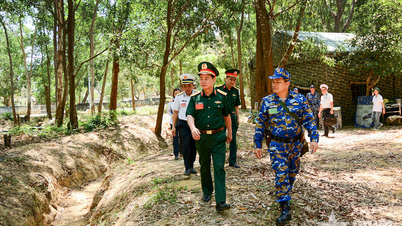
On the way back to his office, knowing I was about to march to Station V74, Hai enthusiastically recited a line from Nguyen Du's *The Tale of Kieu* to me: "In spring, swallows fly back and forth / The bright sunlight of ninety days has already passed sixty." Then he said that spring days pass quickly, and we must take advantage of the time to inspect and encourage the troops, especially at the remote stations.
 |
Officers, staff, and soldiers of Brigade 132 laying fiber optic cables. Photo: TRAN HOANG |
I understand that behind those gentle words lie considerable concerns: worries about ensuring uninterrupted communication during holidays and festivals; worries about maintaining the Brigade's achievements, for which it was awarded the Corps' emulation flag in 2025. This is the result of the collective's persistent efforts throughout the past year, a source of pride but also a great responsibility, creating momentum for continued progress in the years to come.
In 2025, Brigade 132 ensured continuous, confidential, secure, and uninterrupted communication for agencies, units, and localities in the area. The "Determined to Win" emulation movement was organized effectively, widely, and in depth. The work of building a comprehensively strong unit that is "exemplary and outstanding" achieved many clear results. Training, competitions, and specialized contests related to communication were highly appreciated by superiors through inspections and reviews. In particular, the two outpost stations V74 and V75 of Company 4, Battalion 2, were outstanding examples.
 |
| Officers, staff, and soldiers of Brigade 132 worked to resolve the problem in the dark of night and rain. Photo: TRAN HOANG |
Station V74, situated atop a mountain over 500 meters above sea level, serves as a key command and control information hub in the region. Its mission is to ensure microwave and fiber optic communication, organize patrols to protect the cable lines, conduct training, and maintain readiness for deployment to ensure communication during exercises and other tasks as ordered by superiors. The road to Station V74 is quite treacherous. I've been there many times and have never seen anyone successfully navigate a scooter to the summit. Even those with steady hands on motorcycles are drenched in sweat upon arrival. The steep slopes and sharp turns mean that a slight loosening of the throttle can cause the vehicle to roll backward. During the rainy season, water cascades down from the mountain peak in long trenches across the slope, causing the wheels to spin wildly due to loss of traction. In the dry season, hot winds from the valley carry red dust, covering clothes, hats, and shoes, seeping deep into the skin. But for the soldiers at Station V74, all those hardships were like "mosquito bites on stainless steel."
When the station was first established, it was almost entirely forest, rocky mountains, and wind. Infrastructure was virtually nonexistent, and water was severely scarce. Officers and soldiers had to carry cans of fresh water up the slopes for daily use, carefully conserving every liter of used water to irrigate vegetables and increase production – a stark contrast to life on a remote island. The stable living conditions we have today are the result of the care and investment from higher authorities, and the hard work and sweat of generations of officers and soldiers at Station V74.
 |
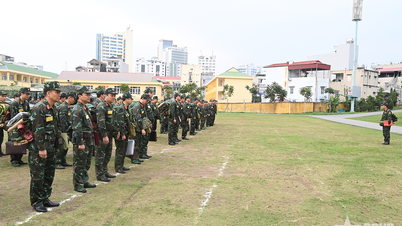
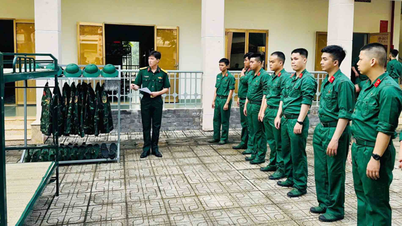
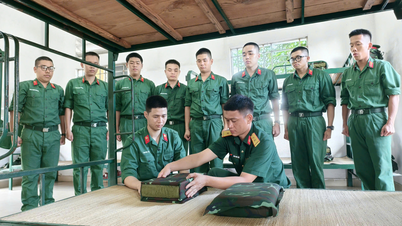
| One of the training exercises on ensuring communication at Brigade 132. Photo: TRAN HOANG |
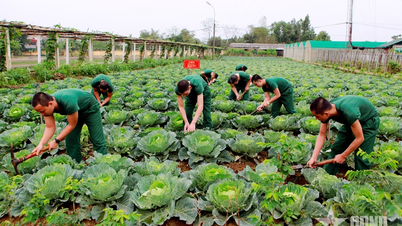
To cultivate vegetables, they had to carry sacks of fertile soil up hundreds of meters of steep mountain slopes. This seemingly simple task was repeated for months and years. And today, within the station's grounds, there are lush green vegetable beds, shady trellises of pumpkins and gourds, a small fish pond, and neat, clean livestock pens. This approximately 400m² farming area not only contributes to improving the soldiers' lives but also serves as vivid evidence of the self-reliance, resilience, perseverance, and responsibility of the signal corps soldiers.
The commander of Station V74 is Major Nguyen Giang Nam, a non-commissioned officer from Phuc Tho commune ( Hanoi ). He has worked in many units, from Ho Chi Minh City, Nha Trang, and Quy Nhon (formerly), and has been working here for nearly 20 years. His wife is a high school teacher. Their home is less than ten kilometers from the station, but he only visits once every two weeks.
For the officers, staff, and soldiers of Station V74, in addition to their duties of manning the equipment, they also have to patrol and protect the nearly 100km long fiber optic cable line. This work is not simple, especially during the rainy season. When landslides or trees fall onto the cable line, causing communication disruptions, the officers and soldiers must immediately march through the night to deal with the problem. Some nights they return after dawn, their clothes covered in mud, their limbs exhausted, but in the eyes of each person there is still a glimmer of joy when the communication signal is restored and the mission is accomplished. Station Chief Nguyen Giang Nam shared that the biggest worry for the team is the rodents around the station. They can gnaw through the fiber optic cable at any time. Some nights, they just finished repairing one section only to receive news that another section has been cut, dozens of kilometers away.
A special memory associated with Station V74 is the sapodilla tree planted by Deputy Prime Minister Nguyen Hoa Binh during his visit to the former battlefield of his father. The tree was planted right next to the entrance to the living quarters. Every morning, in their familiar routine, the officers and soldiers care for and water the tree. For them, that sapodilla tree is a symbol of faith, connection, and responsibility, silently watching over the unit's growth and development.
 |
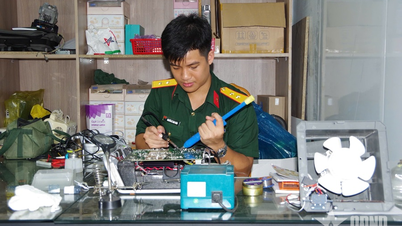
| Officers and staff of Station V74, Company 4, Battalion 2, Brigade 132, Signal Corps, performing their duties to ensure communication. Photo: TRAN HOANG |
One of the effective methods used by Station V74 in protecting the cable line is its close relationship with the local people. For the station, the local people are reliable "eyes and ears." When they detect signs of landslides, construction machinery, or trees at risk of falling onto the cable line, they promptly notify the soldiers so they can handle the situation. Thanks to the coordination, assistance, and support of the people, the government, and local organizations, the cable line managed by Station V74 has remained safe and stable for many years, especially during the rainy and stormy season. This is the result of trust, affection, and the close bond between the military and the people, like fish and water.
With love for their profession and their unit, the officers and soldiers of Station V74 united as one, overcoming all difficulties to build the station into a "four-good" model, becoming a leading example in the Brigade's Emulation Movement for Victory. What truly impressed me was bringing fresh water to the mountaintop, transforming a once water-scarce area into a model of agricultural production with the image of "growing vegetables on rocks, raising fish on hills."
That afternoon, as we said goodbye to Station V74 and returned to the Brigade, standing on the mountaintop, I saw the sunset gradually fade, a thin layer of mist descending, enveloping the space in a gentle blue hue. The red flag with a yellow star fluttered in the mountain breeze. The antenna tower stood tall, a solid focal point against the vast sky. I understood that spring had arrived. And our radio waves had also gained new life, fresher, stronger, and continuously flowing smoothly through the enduring stream of time.
Source: https://www.qdnd.vn/quoc-phong-an-ninh/xay-dung-quan-doi/canh-song-ngay-xuan-1025888






























































Comment (0)