Chinese telecommunications and fiber optic companies have achieved a significant milestone in next-generation communications. They have successfully conducted the world's first field test of a hollow-core fiber optic transmission system capable of delivering speeds of 1.2 Tb/second per wavelength.
This project brings together China Telecom, Yangtze Cable & Fiber Co., Ltd., and Dekoli within the framework of a national research initiative focused on advanced fiber optic technologies.
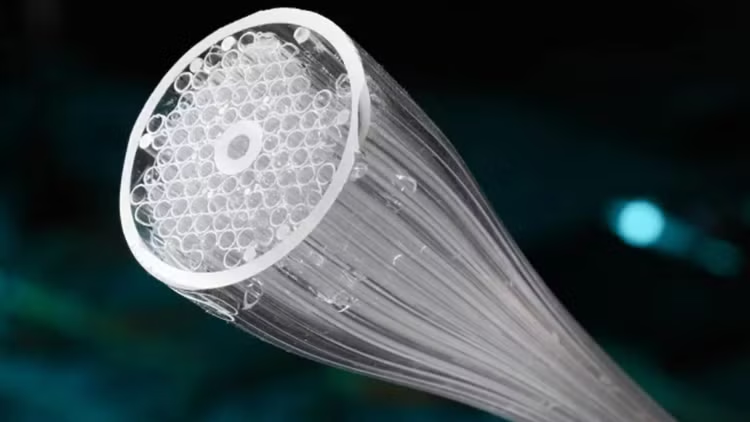
The test was conducted on the world's longest commercial cross-border hollow-core fiber optic cable. Using an optimized transmission system, the research team achieved a total capacity of 51.3 Tb/second over a distance of approximately 200km without the need for signal amplifiers, setting a new benchmark for long-distance high-capacity data transmission.
Reduce latency and increase network capacity.
Unlike traditional fiber optic cables that transmit light through a solid glass layer, hollow-core fiber optic cables conduct light through the air. This fundamentally different design reduces signal latency and increases transmission capacity, overcoming the main limitations of conventional fiber optic cables.
Thanks to these advantages, hollow-core fiber optic cables are increasingly seen as a promising technology for next-generation optical networks, especially for backbone infrastructure and large-scale data centers.
Now, the project team has solved the previously unattainable challenge of transmitting high-power signals in a real-world hollow-core fiber optic network.



By validating stable high-speed performance outside of laboratory conditions, the test further strengthened the argument for hollow-core fiber optics as a new communication technology.
High-power and stable amplifier architecture
The research team improved overall transmission performance by introducing a wavelength-dependent adaptive speed control mechanism, combined with flexible channel power allocation across the system.
Instead of relying on fixed parameters, this method dynamically adjusts how each wavelength transmits data, allowing the system to operate under more optimal and flexible conditions.

This design allows for hybrid transmission across multiple data rates, channel spacing, and power levels individually tuned for each wavelength. As a result, the system can better balance performance across the entire channel spectrum rather than handling them uniformly.
The research team has introduced a novel high-power amplifier design based on a cascaded dual-amplifier architecture combined with a multi-component doping method.
This configuration was developed to improve both performance and stability in optical signal amplification under high-power conditions. As a result, researchers were able to fabricate an optical amplifier with high gain flatness, ensuring more stable signal performance across the entire operating range.
This system also achieves a maximum output power of up to 33.5 dBm, supporting more robust transmission performance across the entire fiber optic cabling setup. Furthermore, the system is equipped with additional safety measures to minimize risks associated with optical connection failures.



These measures include optical path power anomaly detection for continuous monitoring of signal stability, an interlocking auto-shutdown function to halt operation upon detection of unsafe conditions, and an alarm-linked feedback mechanism that triggers system-wide alerts.
As a result, these protective measures allow for the rapid identification of abnormal operating conditions and provide multiple layers of protection.
By responding quickly to faults or unstable power levels, the system helps prevent equipment damage and improves overall safety and reliability in high-power optical transmission environments.
Source: https://khoahocdoisong.vn/cap-quang-rong-day-toc-do-internet-len-12tbs-post2149105673.html



![[Image] National conference summarizing one year of operation of the overall organizational model of the political system, the three-tiered government model.](https://vphoto.vietnam.vn/thumb/1200x675/vietnam/resource/IMAGE/2026/07/01/1782882811691_ndo_br_1-jpg.webp)




































![[GALLERY] First AI law firm wins lawsuit, recovers over 220 million VND.](https://vphoto.vietnam.vn/thumb/402x226/vietnam/resource/IMAGE/2026/07/01/1782887322251_ga-3-png.webp)